
Until color photography arrived in the middle of the twentieth century, a painter who wanted to keep the northern lights had to work afterward, from a pencil note, a memory or another man's account. The results range from a red sky over Kyoto, drawn so exactly that physicists later used it to measure a solar storm, to a sky smaller than a postcard, painted by a man who had long since stopped exhibiting.
Cool Stories About Art is a newsletter to learn art the fun way.
Join 200,000+ readers and get:
10 new art stories / month
The entire archive of content (140+ articles)
Comment, ask questions, and chat with other readers
Painting a Light That Will Not Hold Still
An aurora is light high in the sky, made when particles from the sun strike the gases of the upper atmosphere. It usually stays close to the poles, but a strong storm on the sun can push it far to the south: in 1859 it was seen as far as Cuba.
That light is what made it so hard to paint. It appears only at night and changes shape within seconds, so painters nearly always worked afterward, indoors, from a quick sketch made in the cold or from what they remembered.
Between 1770 and 1917, each work chosen answers that difficulty in its own way. Several came back from voyages to the far north, some of them with scientific expeditions, and one shows an Arctic sky that its painter never saw there himself.
12. Étienne Léopold Trouvelot, Aurora Borealis (1872)
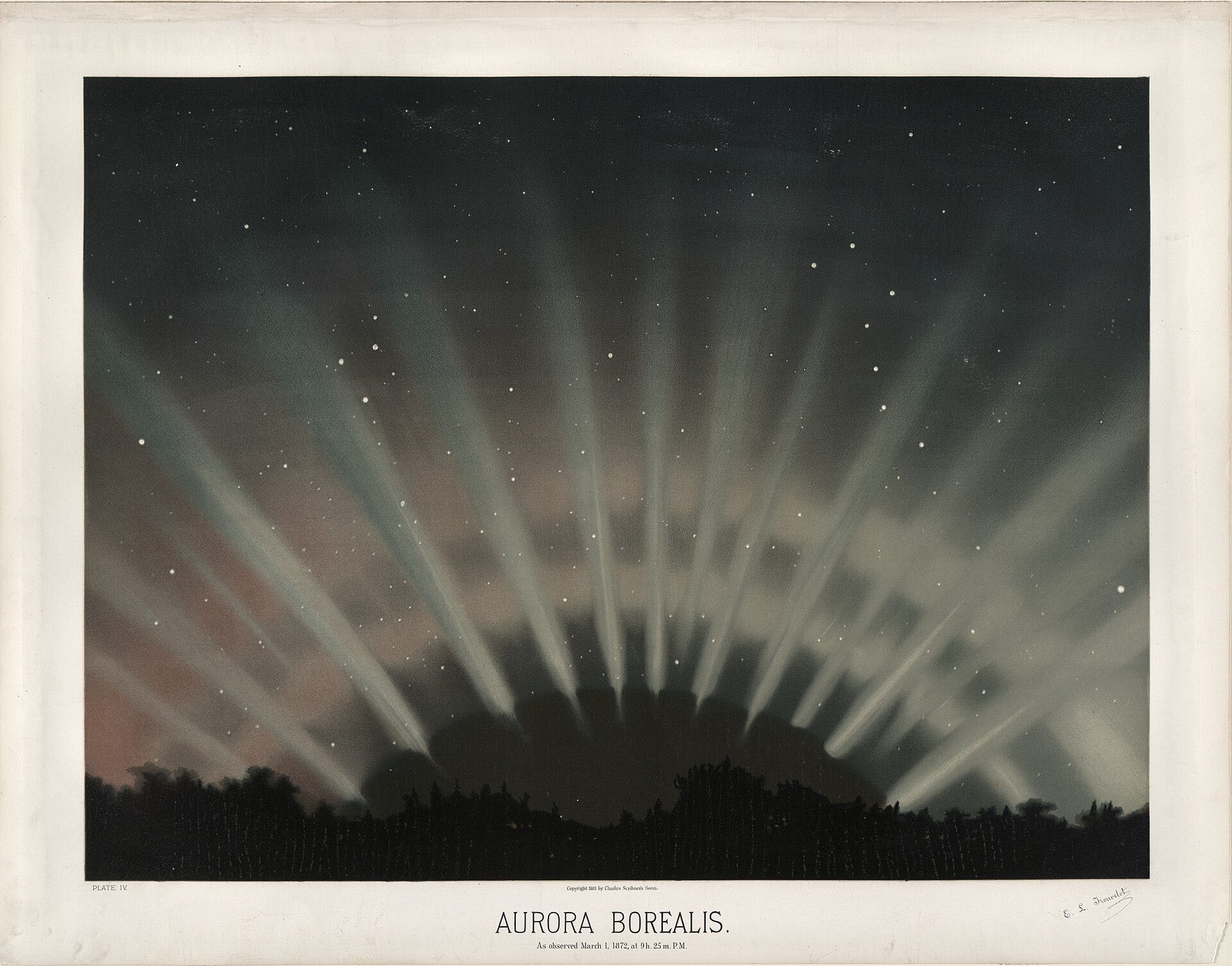
Tall rays of red and pale green rise from a glowing arc above a flat, snowy horizon, and the drawing is dated to the minute: observed March 1, 1872, at 9:25 in the evening. Étienne Léopold Trouvelot made this Aurora Borealis in pastel, and the publisher Charles Scribner's Sons printed it in color in 1881, in a set of astronomical plates.
Such precision is surprising from a man better remembered in New England for an insect. Trouvelot, a French artist living in Medford, Massachusetts, was interested in silk. He hoped to cross the silkworm with other species and breed a hardier one, and in the late 1860s he brought over from Europe the eggs of the gypsy moth, whose caterpillars eat the leaves of trees. He raised them at his home on Myrtle Street.
Some of the caterpillars escaped from the breeding cages. The story usually told is that an egg mass went missing in a storm in 1869, and that Trouvelot himself warned the entomologists. For years, nothing happened. Then, in 1889, the caterpillars stripped the trees of the same neighborhood bare. Medford raised money, the state voted its first funds the next year, and the moth has never been wiped out.
By then Trouvelot had long since turned to the sky. Several auroras he watched in 1870 drew him to astronomy, and two years later Harvard hired him to draw what its telescopes showed. He made about seven thousand astronomical drawings, and in a manual published in 1882 he explained why a pencil still mattered: "A well-trained eye alone is capable of seizing the delicate details of structure."
The same manual describes how a great aurora arrives. First comes "a peculiar grayish appearance of the northern sky just above the horizon," then a soft, pearly light that spreads upward. Most displays stay whitish or pale green, he wrote, but in the brightest ones red and green take over. The night of March 1, 1872, was one of those.
At a Glance
Artist: Étienne Léopold Trouvelot (1827 to 1895)
Made: Observed March 1, 1872, published 1881
Medium: Pastel drawing, published as a chromolithograph
Size: 72.4 × 97 cm (28.5 × 38.2 in), sheet of the printed plate
Where to see it: New York Public Library
11. François-Auguste Biard, Magdalena Bay (about 1841)
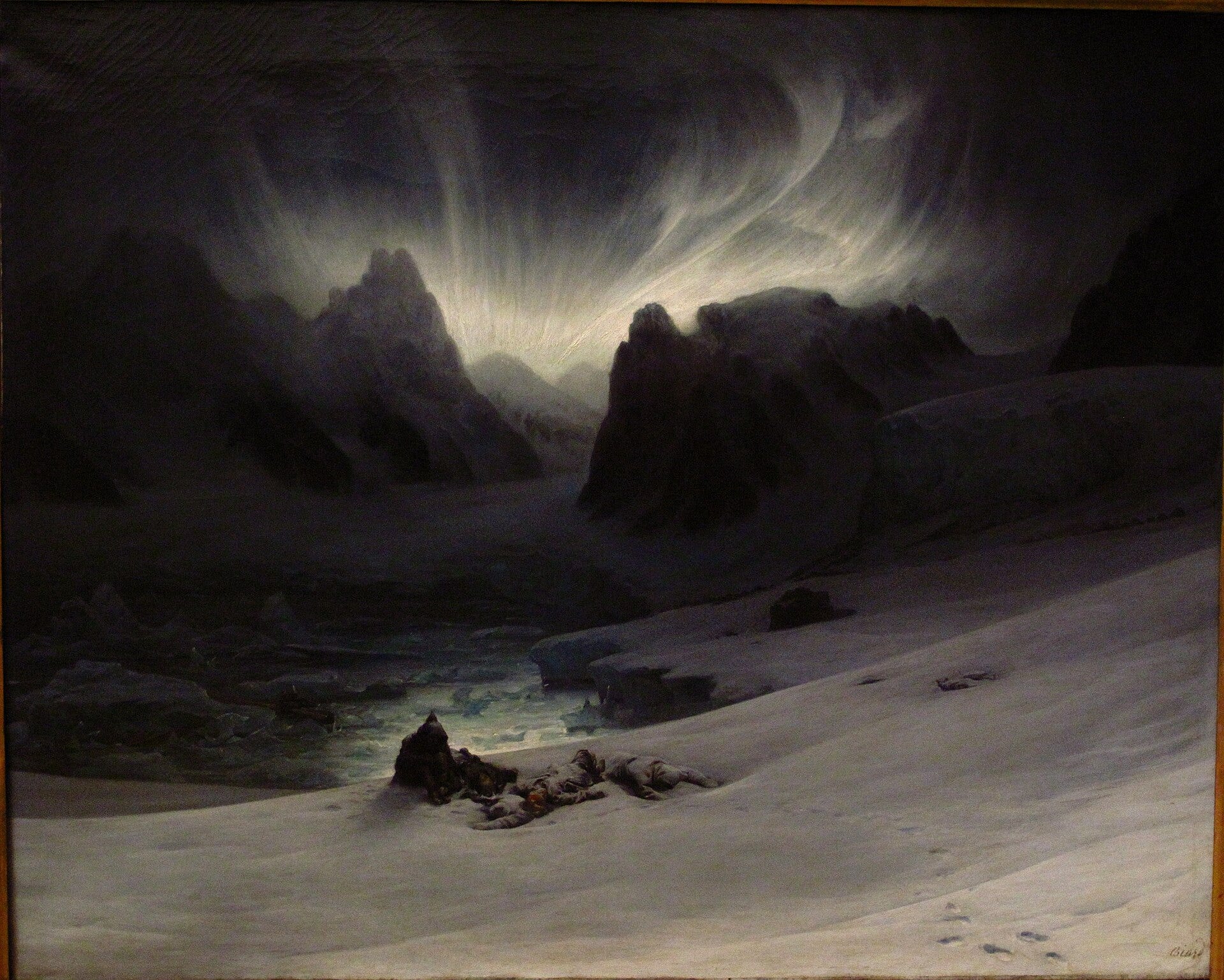
Five men lie in the snow of an Arctic shore under a green and gold aurora. The setting came from a voyage of 1839, on which a Frenchwoman of about nineteen, Léonie d'Aunet, sailed north from Le Havre aboard the corvette La Recherche with a scientific expedition. François-Auguste Biard joined the ship at Hammerfest, in Norway, at his own expense. She would marry him the next year, and the marriage would cost her far more than the voyage.