A painted object is rarely just itself. A key names who runs a household, pearls claim chastity, an empty pair of scales in Vermeer weighs a life against a Last Judgement, and a candle beside a skull counts down time. Twelve everyday objects, one shared code.
Why painters reached for objects instead of words
Painters had a problem. They needed to tell you who a sitter was, what they owned, what they feared, and what they were hiding, and they had to do it without a caption.
So they used things. A ring, a hat, a mirror, a letter left open on a table. Objects that every viewer handled daily, loaded with meanings that every viewer of the time could read at a glance.
Those meanings have mostly gone quiet. We see a glove and think of cold weather. A seventeenth century viewer saw a diplomatic code, a legal status, sometimes a challenge to a duel.
This page is the map. Twelve ordinary objects, twelve deep dives, one shared grammar of status, mortality, secrecy, and rank. Each section below gives you the short version and links to the full decoding.
The oldest example on this page is a self portrait painted in 1433.
Keys and Locks
In the Dutch seventeenth century, handing over the household keys was a real legal moment in a marriage. A bundle of keys at a woman's belt, the sleutelbos, told everyone she ran the house.
Keys also open the other direction, toward heaven. Two keys, one gold and one silver, identify Saint Peter through Matthew 16:19, and on vanitas tables a key sits beside a skull, a watch, or a snuffed candle as one more way of talking about possession and death.
Perugino painted the founding image of the code, The Delivery of the Keys, in 1481 to 1482, on the wall of the Sistine Chapel.
Gloves
The code was precise. Holding one glove while wearing the other signaled readiness to negotiate. Throwing a glove down meant a duel. A bishop's embroidered glove, worn during Mass, marked hands too consecrated to touch ordinary things directly.
Holbein compressed a whole career into this language in The Ambassadors, 1533. Jean de Dinteville holds a pair of gloves in one hand and a dagger in the other, diplomat and soldier in a single pose.
Twelve of these hand signals are decoded in Gloves in Portraits: 12 Paintings Decoded.
Van Dyck's formula, one glove held and one worn, became the standard template for aristocratic portraiture for two centuries of English painting.
Jewellery
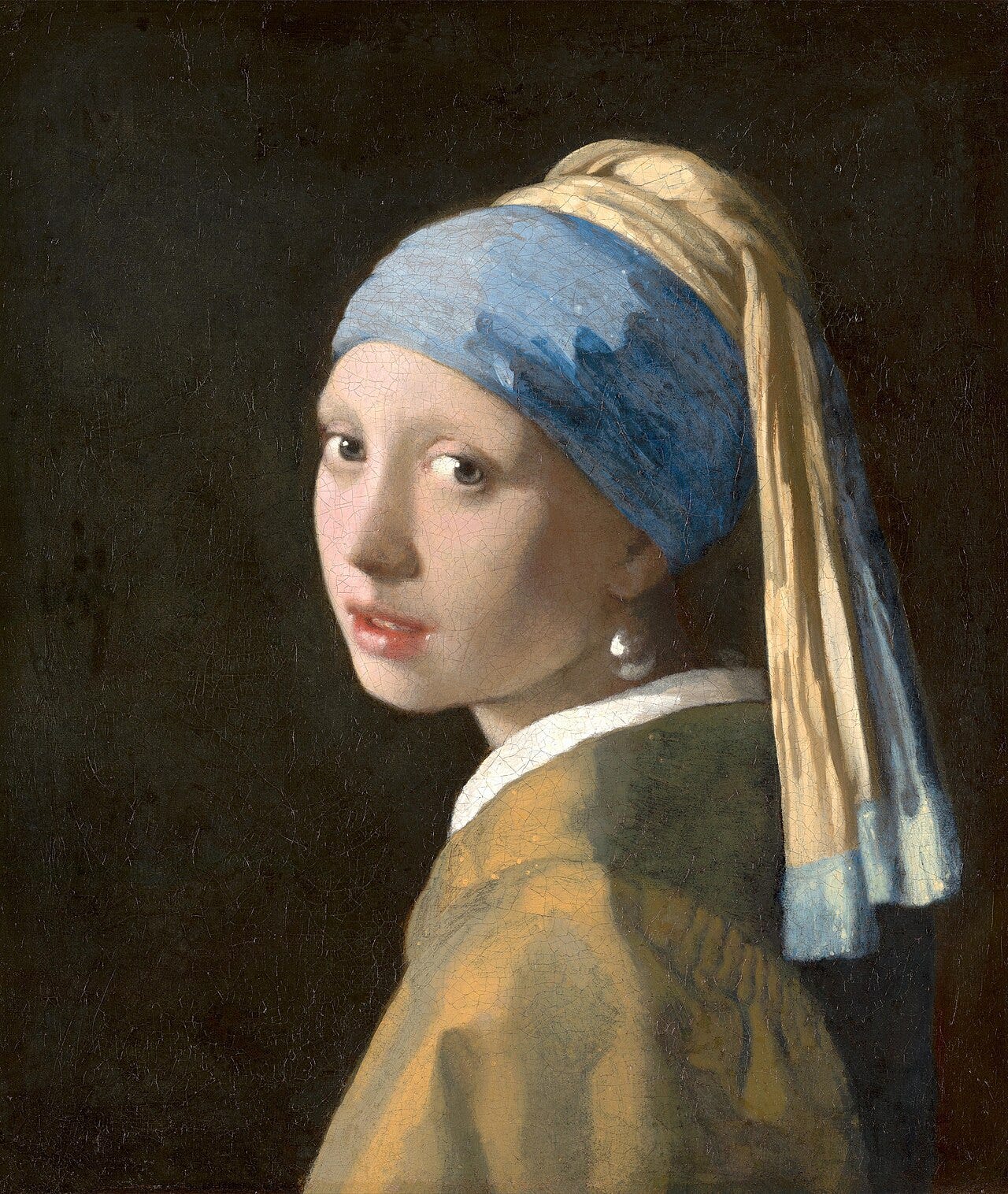
Is the most famous pearl in art even a pearl? Vermeer's Girl with a Pearl Earring, about 1665, wears what is likely painted glass or polished tin, rendered in two brushstrokes of white lead with no visible hook or fastening.
Real jewels carried real politics. In the Armada Portrait of about 1588, pearls signaled chastity for the self styled Virgin Queen. And Marie Antoinette never bought the 647 stone diamond necklace at the center of the 1785 scandal that bears her name; a con artist used a forged signature, and she was blamed anyway.
Every one of these cases, including Rembrandt's bracelets built up in thick ridges of paint in The Jewish Bride, is in Jewellery in Portraits: 12 Paintings Decoded.
Klimt painted a diamond choker inside the gold leaf of Portrait of Adele Bloch Bauer I in 1907. The Nazis later seized both the painting and the real choker.
Hats
Start with a date: 1433. Van Eyck's Portrait of a Man in a Red Turban is likely the earliest known Western self portrait on panel, its frame inscribed with his motto, "as I can." The headgear is doing half the talking.
Hats fixed rank with almost legal force. Bellini's Doge Leonardo Loredan, about 1502, wears the corno ducale, a stiff horned cap whose exact shape Venetian custom reserved for the head of state. At the other end of the scale, the upturned funnel hat on Bosch's "surgeon" in The Extraction of the Stone of Madness, about 1494, was a Netherlandish sign of a quack or fool.
Magritte closed the loop in 1964 with The Son of Man, a bowler hatted man with a green apple hovering where his face should be. All twelve are in Hats in Art: 12 Famous Paintings.
Napoleon owned roughly 120 bicorne hats. One sold at auction in 2014 for about 1.9 million euros.
Shoes
A satin slipper flies through the air in Fragonard's The Swing, 1767, kicked off mid swing toward a statue while a hidden lover watches from below. Few painted objects are this openly indiscreet.
Shoes could also mark sacred ground. In the Arnolfini Portrait of 1434, wooden pattens lie discarded in the foreground and both figures stand barefoot, a detail read as an echo of Exodus. And in 1886 Van Gogh bought a pair of shoes secondhand in Paris and painted them at least four times; Heidegger and the art historian Meyer Schapiro later disagreed in public over whose shoes they were.
Venetian chopines reached up to fifty centimeters, high enough that servants had to help women walk, and sumptuary laws tried and failed to limit their height.
Mirrors
The mirror behind the barmaid in Manet's A Bar at the Folies Bergere, 1882, is deliberately wrong. The reflection is shoved too far right and shows a customer who is not there in the direct view.
Painters loved mirrors precisely because they smuggle in what the frame excludes. Van Eyck's convex mirror in the Arnolfini Portrait, 1434, reflects two extra figures standing where the viewer stands, ringed by ten tiny scenes from the Passion. Velazquez's mirror in Las Meninas, 1656, reflects King Philip IV and Queen Mariana, who stand outside the painted scene entirely.
Parmigianino went furthest, painting his Self Portrait in a Convex Mirror, about 1524, on a specially curved panel matched to the warp of an actual barber's mirror. The whole set is in Mirror Paintings: 12 Famous Works and Their Secrets.
Velazquez's Rokeby Venus was slashed seven times by the suffragette Mary Richardson at the National Gallery, London, in March 1914.
Books
X rays of Fragonard's A Young Girl Reading, about 1770, show he first painted her looking out at the viewer, then changed the pose so she looks down into the book. He decided the reading itself was the subject.
A single painted book could mark a sitter as learned, devout, or, for a woman reading a novel alone, quietly unconventional for her era. Antonello da Messina turned shelved books into a technical showpiece in Saint Jerome in His Study, about 1475, each tiny volume rendered in oil.
The twelve most readable cases are in Books in Art: 12 Famous Paintings and Their Stories.
Van Gogh's Still Life with Bible, 1885, shows his late father's Bible open to Isaiah 53, set beside Zola's novel The Joy of Life and an unlit candle.
Letters

A sealed letter is the one painted object the viewer can never open. Unlike a book, it withholds its information completely, which is exactly why painters reached for it.
Vermeer built entire scenes on that tension. In Girl Reading a Letter at an Open Window, about 1658, restorers discovered in 2021 that a large painting of Cupid had been hidden on the wall behind her, painted over for more than 200 years.
The letter paintings, Vermeer's above all, are gathered in Vermeer and other artists' letter paintings.
In The Love Letter, about 1669 to 1670, a maid interrupts her mistress to hand her a letter.
Windows
Where do painters put their secrets? Very often beside a window. Windows stage private moments, letters and waiting, and mark the line between a sheltered interior and the wider world. An open window can suggest possibility, a closed one confinement.
The pattern is easiest to see when window and letter share one canvas. Vermeer's Girl Reading a Letter at an Open Window, about 1658, is the test case, and the twelve best examples are in Windows in Painting: 12 Famous Works and Their Secrets.
That single Vermeer carried its hidden Cupid, painted over on the back wall, until restorers uncovered it in 2021.
Maps and Globes
A map on the wall of a portrait rarely means the sitter liked geography. In portraiture, maps and globes generally marked worldly ambition, trade wealth, or geographic reach, a way of claiming the world without leaving the room.
Paintings that hang a map behind a sitter tend to be paintings about power measured in distance: routes, colonies, cargo. The object stands in for everything the frame cannot show.
The specific cases are worked through in Maps and Globes in Painting, which decodes 12 famous examples one by one.
Money
Painted coins cut two ways. In Northern genre and vanitas painting, purses and moneybags generally identified a sitter's trade, banker, moneylender, merchant, or served as a moral warning about greed. Sometimes the same picture does both at once.
That double reading is the point. A painting that shows money counted on a table tends to be asking whether the counting has replaced everything else.
The individual pictures are decoded in Money in Art, a deep dive into 12 famous paintings.
Candlelight

Georges de La Tour, the greatest painter of candlelight, was forgotten for over two centuries. The scholar Hermann Voss reconstructed his body of work in 1915.
His Magdalen with the Smoking Flame, about 1635 to 1637, sets a single candle beside a skull, the core pairing of the vanitas tradition: light burning down, time running out. In Geertgen tot Sint Jans's Nativity at Night, about 1490, one of the earliest night scenes in European painting, the light source is the infant Christ himself, no candle needed.
Van Honthorst earned the Roman nickname "Gherardo delle Notti," Gerard of the Night, for scenes like these. Twelve of them are in Candlelight Paintings: 12 Glowing Scenes to Know.
Caravaggio painted himself as the lantern bearer in The Taking of Christ, 1602, a painting rediscovered in 1990 in a Jesuit house in Dublin.
Cross Reading the Objects
Once you know the codes, the twelve objects start talking to each other.
Mirrors and windows do the same job from opposite directions: both stage what sits outside the direct frame. The mirrors in Mirror Paintings pull absent kings and viewers into the picture, while the openings in Windows in Painting point out of it, toward the world the sitter cannot reach.
Keys and letters are both about access, one physical and one informational. The locks in Keys and Locks in Art control who enters a room; the sealed pages in Vermeer and other artists' letter paintings control who knows a secret, including you, the viewer, who never gets to read them.
Jewellery and gloves are both status worn on the body, one displayed and one withheld. The jewels in Jewellery in Portraits put wealth in plain sight, while the codes in Gloves in Portraits work by covering the hand, and paintings that use one tend to use the other in the same pose.
Frequently Asked Questions
What is a vanitas object in painting? A vanitas object reminds the viewer of mortality and passing time. Typical pairings put a skull beside a candle, a watch, a key, or a purse, as in La Tour's The Magdalen with the Smoking Flame, about 1635 to 1637.
Who is reflected in the Arnolfini Portrait mirror? Van Eyck's convex mirror of 1434 reflects two extra figures standing exactly where the viewer stands, and the mirror frame is ringed by ten tiny scenes from the Passion of Christ.
Why do sitters in old portraits hold one glove and wear the other? Holding one glove while wearing the other signaled readiness to negotiate. Van Dyck turned the pose into the standard template for English aristocratic portraiture for two centuries.
Why does Louis XIV wear red heels in his 1701 portrait? Red heels were a privilege. The king restricted the color to favored courtiers at Versailles, so in Rigaud's portrait the shoes are a statement of rank.
What was discovered behind Vermeer's Girl Reading a Letter at an Open Window? In 2021, restorers uncovered a large hidden painting of Cupid on the wall behind her. It had been painted over for more than 200 years.
The Object That Isn't There
Every object on this page works because painters trusted viewers to look closely. The strange part is how often close looking reveals that the object itself is a trick.
The clearest case is the most famous one. The pearl in Vermeer's Girl with a Pearl Earring, about 1665, is likely painted glass or polished tin rather than a real pearl.
Look closer still and it dissolves entirely: two brushstrokes of white lead, with no visible hook or fastening attaching it to her ear.