
Occult means hidden, and the art of the occult lives with a contradiction: knowledge meant for a few initiates, set down in pictures that anyone could look at. From the 1500s to the First World War, alchemists, astrologers and mediums used images to teach, to persuade and, they believed, to speak with the dead. Some of those images count among the earliest abstract works ever made.
Cool Stories About Art is a newsletter to learn art the fun way.
Join 200,000+ readers and get:
10 new art stories / month
The entire archive of content (140+ articles)
Comment, ask questions, and chat with other readers
What the Occult Asked of Artists
The word occult comes from the Latin for hidden. It covers knowledge kept for initiates: astrology, learned magic, and alchemy, which sought to change lead into gold and, for many of its followers, to purify the soul at the same time.
That knowledge was hard to put into words, so its keepers turned to pictures. An image could show a chemical process as a dragon, or the whole universe as a set of circles. In the 1800s two new movements went further. Spiritualism held that the dead speak through mediums, and theosophy, a movement founded in 1875, asked artists to paint the invisible itself.
Every work here comes from inside these beliefs, or tells a true story about the people who held them. Pictures that use magic only as a spectacle were left out. What links the twelve is the hope of reaching what the eye cannot see: gold inside lead, the order of the heavens, the spirit.
12. Henry Gillard Glindoni, John Dee Performing an Experiment before Queen Elizabeth I (late 19th century)
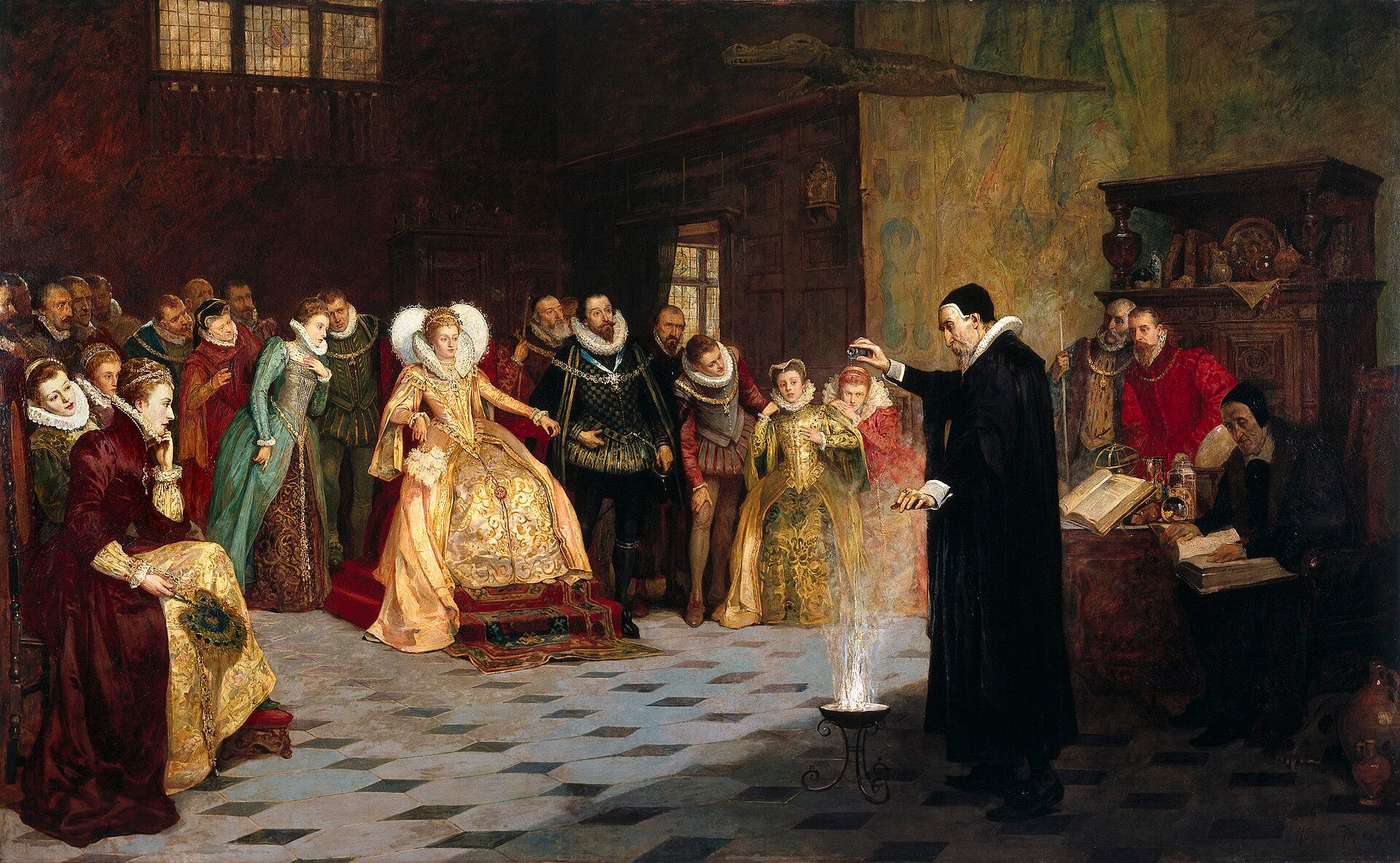
Queen Elizabeth I watches from her chair, in a gold dress, as a tall man in a black gown holds his hand over a small fire burning on the floor. The man is John Dee, mathematician, astrologer and adviser to the queen, and he is giving a demonstration in his own house at Mortlake, near London. Two of the leading figures of her court, Walter Raleigh and William Cecil, stand among the onlookers.
The scene is imagined. Henry Gillard Glindoni painted it late in the 19th century, some three hundred years after Dee's lifetime. Behind Dee he placed a man in a skullcap: Edward Kelley, the assistant who claimed to talk with angels on his master's behalf. The cap is said to hide ears cropped as punishment for a crime.
The canvas had its own hidden layer, and it came to light only in 2016. For an exhibition on Dee held in London that year, the painting was X-rayed. Under the surface, Dee stood inside a circle of human skulls. Glindoni had painted them, then covered them over, and the X-ray showed that Kelley, too, had been added later.
Whoever ordered the picture probably found the skulls too disturbing, and so a sorcerer became a dignified scholar. I find the buried version closer to the real man. In Dee's time, mathematics, astrology and conversations with angels still belonged to one search, and Glindoni changed his mind halfway through about which part of it to show.
At a Glance
Artist: Henry Gillard Glindoni (1852 to 1913)
Painted: Late 19th century
Medium: Oil on canvas
Size: 152 x 244.4 cm (59.8 x 96.2 in)
Where to see it: Wellcome Collection, London
11. Philippe-Jacques de Loutherbourg, A Philosopher in a Moonlit Churchyard (1790)
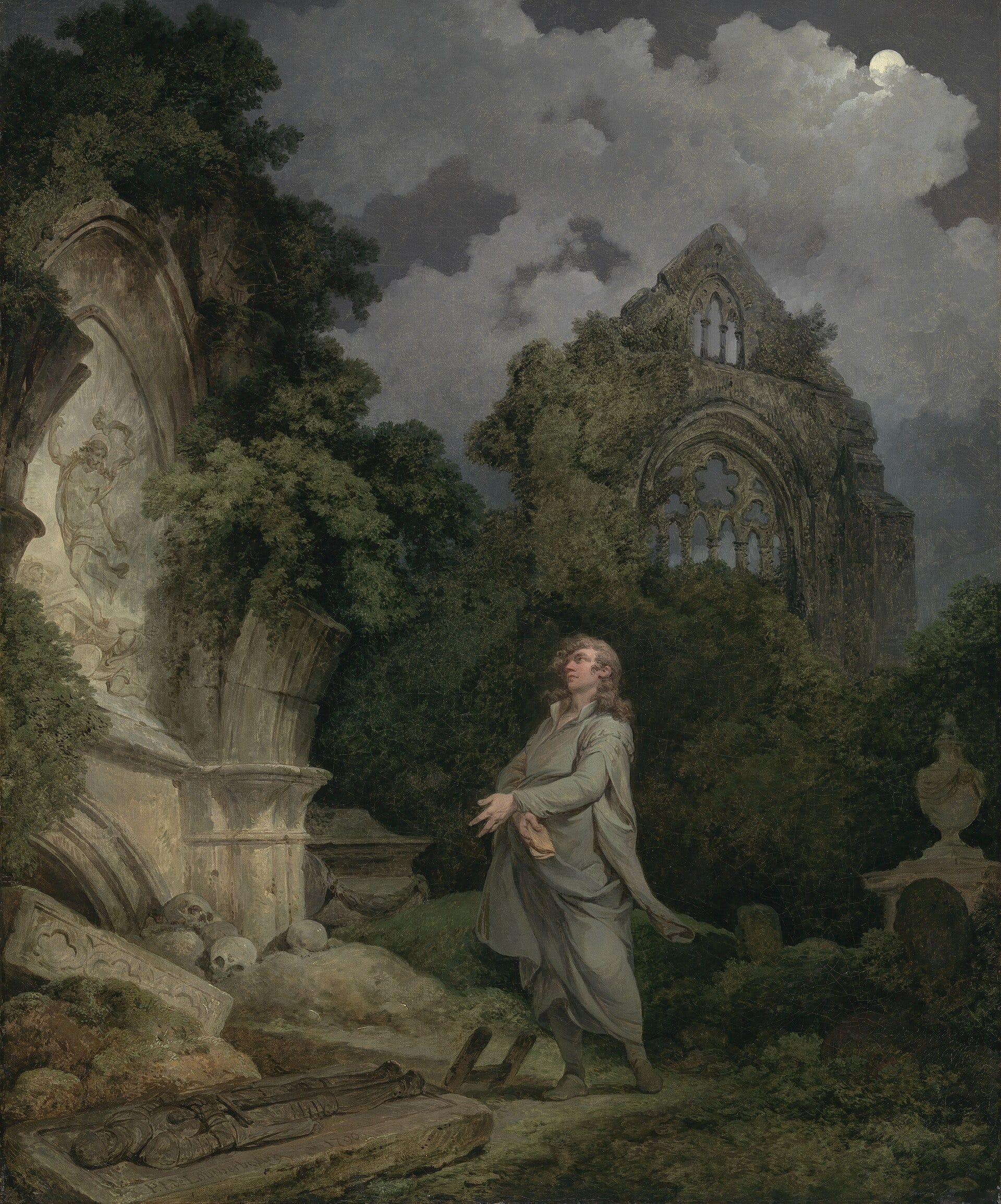
On the sundial in the foreground, the moon casts a shadow that points to one o'clock in the morning. Beside an open tomb in a ruined abbey, a young man in a long pale coat looks up. The painter, Philippe-Jacques de Loutherbourg, was a Royal Academician and the man behind the scenery of London's Drury Lane theater. Four years before this picture, he had left London for Switzerland in the company of an occultist.