Olympia by Manet: Why It Caused a Scandal in 1865

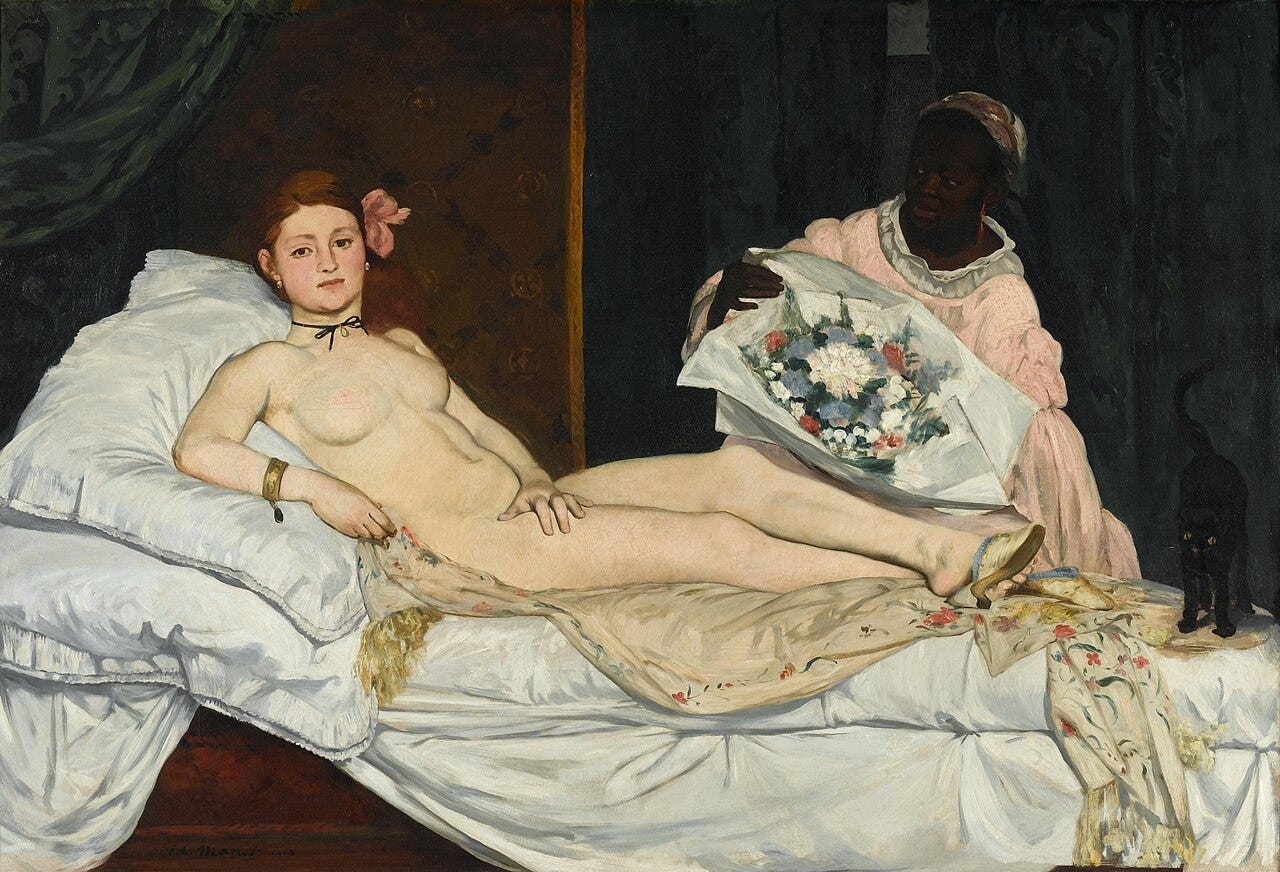
Olympia is an 1863 painting by Edouard Manet, in the Musee d'Orsay in Paris. It shows a nude woman on a bed, staring straight out at the viewer.

Paris understood at once that she was a prostitute, and the scandal at the 1865 Salon was so violent that guards had to protect the canvas.

Nude woman on a bed looking straight at the viewer, a servant behind
Edouard Manet, Olympia, 1863

The nudity was not the problem. Paris had walls full of nude goddesses. The problem was that Manet painted a real, modern working woman and let her look back. Here is why she caused a riot, who she is, and what every object in the picture is saying.


Learn art the fun way. Free stories every week, no boring lectures.


The look that started a riot

When Olympia went on show at the Paris Salon of 1865, the crowd was so hostile that the painting was moved high up a wall out of reach, and the museum posted two guards beside it to stop people jabbing at it with canes and umbrellas.

What enraged them was her gaze. A classical nude looked away, modest, dreaming, an object for the viewer to enjoy unobserved. Olympia looks straight at you, level and unbothered, and her look turns the viewer into exactly what he is: a client who has just walked in.

The critics called the painting obscene, and they meant the eyes.

A goddess turned into a working woman

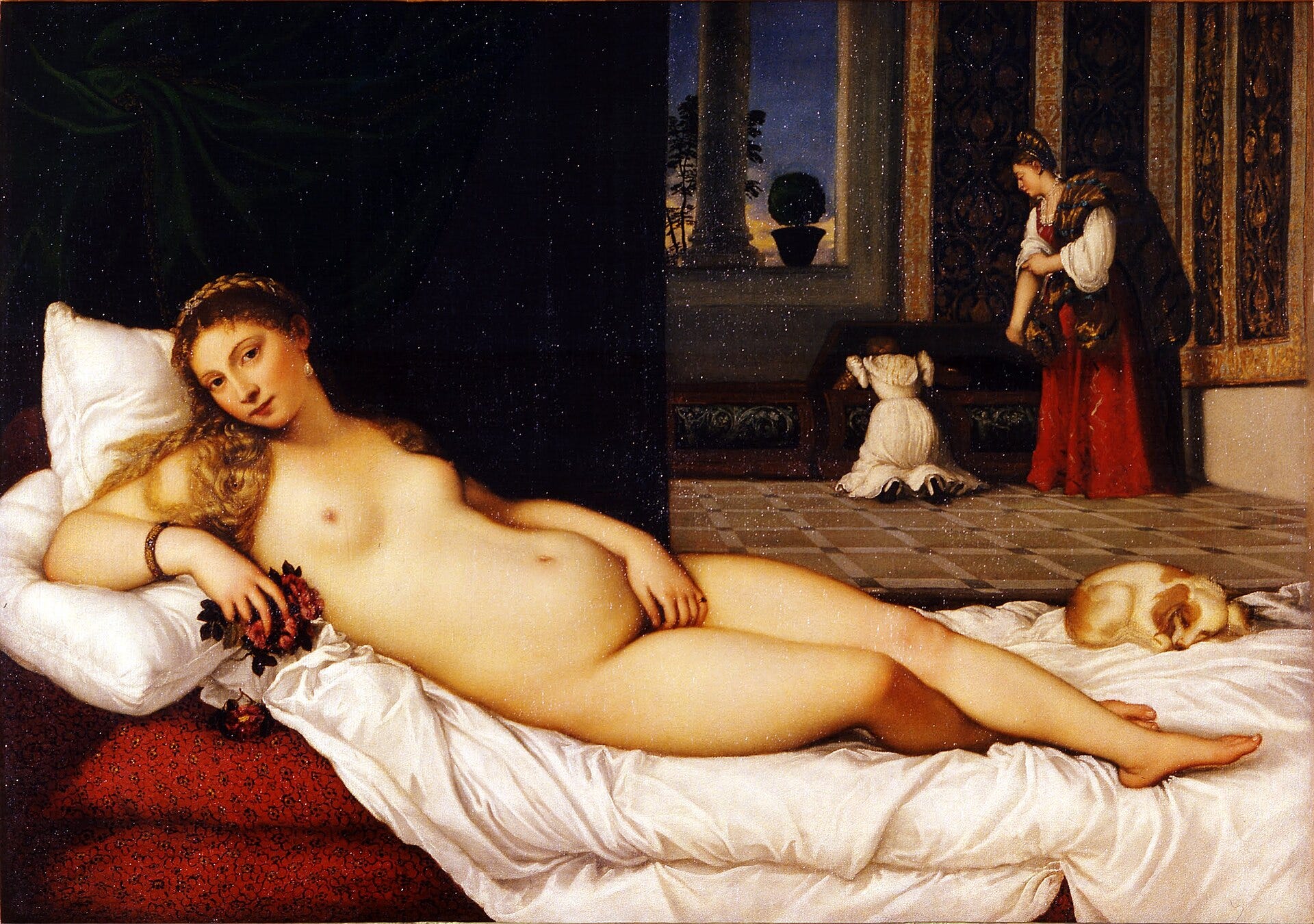
Manet did not invent the pose. He lifted it almost exactly from Titian's Venus of Urbino, a celebrated Renaissance nude from 1538, and any educated visitor recognized the quotation instantly.

That was the trap. He borrowed the frame of a revered old master and dropped a contemporary Parisian sex worker into it.

The differences are what I keep coming back to. Titian's Venus is soft and inviting; Manet's woman is painted in hard, flat light with blunt edges, more confrontation than seduction.

Where the old master hid a little dog, the sign of fidelity, at the foot of the bed, Manet put a black cat with its back arched, a creature of the night and, in the slang of the day, a coarse double meaning nobody in the room missed.

Reading the objects on the bed

Every detail is a message. Behind her a servant, painted from a model named Laure, holds out a large bouquet still in its paper, a gift just delivered by a client waiting off canvas.

The orchid in Olympia's hair, the pearl earrings, the gold bracelet, the silk slipper dangling from one foot are the props of a paid transaction.

Then there is her left hand, laid flat and firm over her lap. Titian's Venus rests her hand there gently, almost caressing. Olympia's hand is a shut door.

She decides what is on offer and what is not, and the black ribbon knotted tight at her throat separates the body for sale from the person who is renting it out.


Join 130,000 readers who get the secrets behind the paintings. Free.


Who is Olympia

The model was Victorine Meurent, Manet's favorite sitter, who posed for many of his most famous pictures. She was a painter herself and exhibited at the same Salon that had rejected Manet, a detail that undercuts the old story of her as a passive muse.

The name Olympia was itself a signal. It was a fashionable stage name for a courtesan in the Paris of the day, familiar from novels and plays.

Manet was not painting a specific woman named Olympia. He was painting the type, and naming her the way her clients would have.

Where Olympia hangs now

Olympia hangs in the Musee d'Orsay in Paris. Manet never sold it; after the uproar he kept it, and after his death his widow held onto it until a public subscription led by Claude Monet in 1890 raised the money to buy it for France, over official resistance.

It carries no market price. In 2013 it left France for the first time since it entered the national collection, travelling to Venice to hang beside the Titian it had quoted, a century and a half after the scandal.

The brushwork that offended as much as the subject

It was not only who she was, but how she was painted. Manet refused the smooth, sculpted shading the Salon expected and laid her down in flat, blunt patches of paint, the body pale and hard edged against the dark, with almost no soft transition.

To eyes trained on polished academic nudes it looked crude, unfinished, wrong.

Courbet reportedly sneered that she was as flat as the queen of hearts on a playing card, and a Salon critic jeered that she looked like a queen of spades fresh out of the bath.

That flatness was the future. Manet had started to treat the canvas as a surface of paint rather than a window onto rounded flesh, and younger painters saw it at once.

Laure, the second woman in the picture

For a century almost nobody looked at the servant. Manet painted her from a model named Laure, one of the few Black women named in the records of Paris modeling, and for generations she was written off as a prop behind the white nude.

Recent scholarship has put her back at the center of the picture. Major exhibitions in Paris and New York have traced who these overlooked Black sitters were, and Olympia, long read only as a scandal about a prostitute, now reads also as a painting of two women, one for sale and one all but erased, which to me makes it stranger and sharper than the old story allowed.


Olympia, quick answers

  • Why was Olympia controversial? Not the nudity but the honesty. Manet painted a modern prostitute who stares back at the viewer, in the pose of a Titian goddess. At the 1865 Salon guards had to protect it.

  • Who is the model in Olympia? Victorine Meurent, Manet's frequent model and a painter in her own right. The servant was posed by a woman named Laure.

  • Who painted Olympia and when? Edouard Manet, in 1863. It was shown at the Paris Salon in 1865.

  • What does the black cat mean? It replaces the faithful dog of Titian's Venus. A night creature with an arched back, it carried a crude sexual pun in the slang of the time.

  • Where is Olympia? The Musee d'Orsay in Paris.


If this painting pulled you in, you will love these too:


The painting that bought its own place in the Louvre

The critics of 1865 were sure Olympia was a joke that would be forgotten. Instead it became the hinge on which modern painting turned, the moment art stopped flattering and started confronting.

When Monet organized the subscription to give it to France in 1890, the state was reluctant to accept a picture that had once needed a police guard.

It hung in the Louvre for decades before moving to the Orsay, the scandal now the reason people cross Paris to see it.

You can see Olympia in person at the Musee d Orsay. For more by the artist, browse the Metropolitan Museum collection.

The questions Olympia still provokes

  • What is Olympia? A reclining nude painted by Edouard Manet in 1863 and shown at the Paris Salon of 1865, where it caused an uproar.

  • Why was it so scandalous? The model is clearly a modern courtesan, not a goddess, and she looks straight out at the viewer without shame. The black cat and the servant with a bouquet made the meaning plain.

  • Who was the model? Victorine Meurent, a favourite model of Manet who also posed for several of his other paintings.

  • What older painting is it based on? Titian Venus of Urbino from 1538. Manet borrowed the pose and turned the sleepy goddess into a frank modern woman.

  • Where is Olympia today? It hangs in the Musee d Orsay in Paris.


Two new stories a week, 130+ secrets unlocked. Start free.