
Ophelia drowns offstage. In Hamlet, nobody sees her die.
For more than two centuries, painters have had to invent what the play leaves out. In 2025, one forgotten canvas even drew a crowd of pop fans into a German museum.

Cool Stories About Art is a newsletter to learn art the fun way.
Join 200,000+ readers and get:
10 new art stories / month
The entire archive of content (140+ articles)
Comment, ask questions, and chat with other readers
A Death the Play Never Shows
Ophelia is a character in Hamlet, the tragedy Shakespeare wrote around 1600. She is the young woman courted and then pushed away by Hamlet, the prince of Denmark, and when he kills her father by mistake, she loses her mind.
The audience learns of her death from a speech. In Act IV, Scene 7, Queen Gertrude, Hamlet's mother, comes in to tell it. A willow branch broke, the girl fell into a brook and floated for a while, singing, until the water pulled her under.
A painter who takes on Ophelia has to choose one moment and fill in the rest. Some chose an evening long before the water, when Hamlet stages a play at court and she still has her reason. Others chose the day she wanders through the palace handing out flowers, or the garlands on the bank, or the branch, or her body in the stream.
The earliest canvas was made for a London publisher in 1792. Another, long forgotten, drew lines of music fans in 2025.
12. Friedrich Heyser, Ophelia (about 1900)
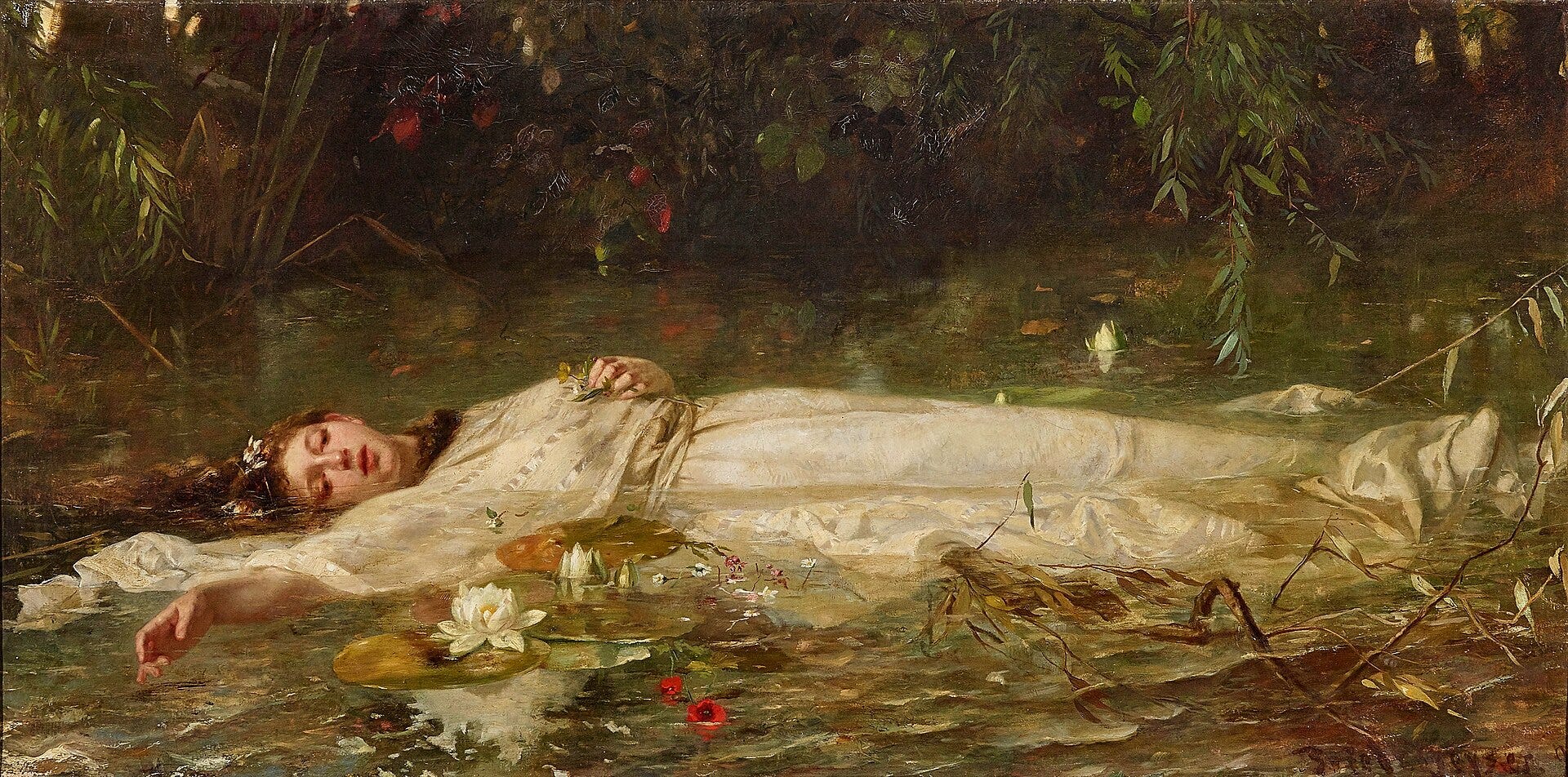
A woman in white lies stretched out on black, still water, ringed by white water lilies. Her long hair spreads across the surface. This is Ophelia as Friedrich Heyser painted her around 1900, and for more than a hundred years almost nobody knew his name.
Heyser was a German Symbolist, one of the painters around 1900 who turned away from everyday scenes to paint dreams, myths and moods. Born in 1857, he trained in Dresden, Karlsruhe and Paris, and he died in Dresden in 1921.
His canvas only reached the Museum Wiesbaden, in western Germany, in 2017. It came with a private collection of Symbolist works and of Art Nouveau, the decorative style of long, curving lines that spread across Europe around 1900.
That obscurity ended in October 2025, when the American singer Taylor Swift released the video for "The Fate of Ophelia," the first single from her album The Life of a Showgirl. In its opening scene she floats as Ophelia, motionless, like a living picture.
At the museum, the staff saw that her pose followed Heyser's canvas almost exactly, far more closely than the famous Ophelia by John Everett Millais. Swift herself has never said that the Wiesbaden painting inspired her.
The visitors followed straight away. The weekend after the video's release, hundreds more people than usual walked in to see the canvas. Many were American families from a nearby United States Army base, and one family had driven from Hamburg, at the other end of the country.
On November 2, the museum held a tour for fans, free to anyone dressed as Swift or as Ophelia, and all of its roughly two hundred places were taken. Its director, Andreas Henning, said he hoped to show Swift the original one day.
At a Glance
Artist: Friedrich Heyser (1857 to 1921)
Painted: About 1900 (the exact year is unknown)
Medium: Oil on canvas
Size: Not published
Where to see it: Museum Wiesbaden (Hessisches Landesmuseum für Kunst und Natur), Wiesbaden, Germany
11. Eugène Delacroix, The Death of Ophelia (1838)
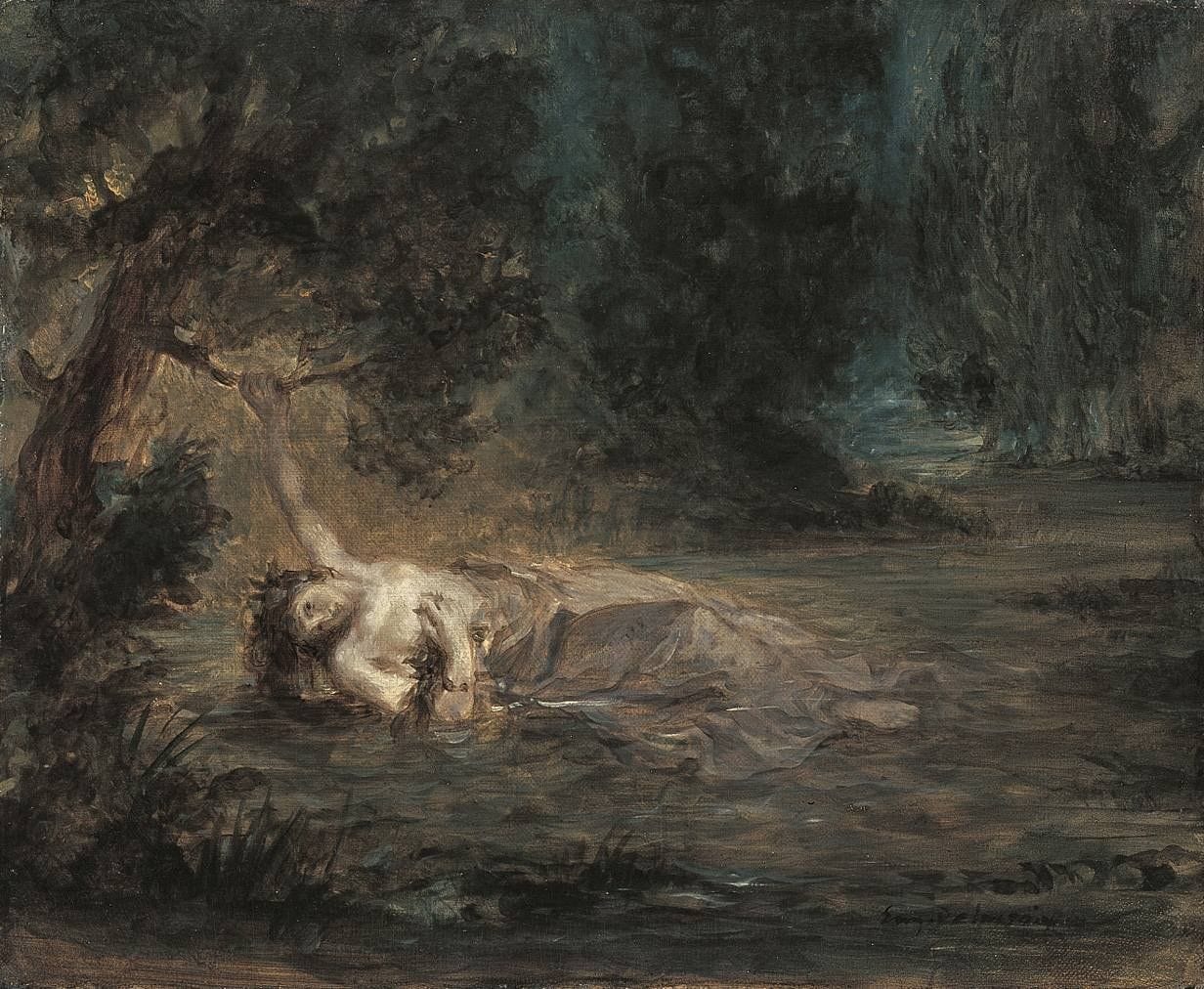
Long before Heyser, the French painter Eugène Delacroix had already shown the drowning itself. In his small canvas, Ophelia slides into a dark stream, and only one arm still reaches up to the willow branch she was holding.
Delacroix's picture has its roots in a Paris theater. In September 1827, an English company opened Hamlet at the Odéon, one of the great stages of Paris, in English, a language most of the audience barely spoke. The part of Ophelia went to an unknown Irish actress, Harriet Smithson.