Optical Illusion Paintings: 12 That Trick the Eye

For centuries painters have built tricks into their work. A skull that only appears from the side. A ceiling that opens to a sky that is not there. A face made of fruit. These twelve paintings fool the eye on purpose.

Some illusions hide a message. Holbein buried a skull to whisper about death. Some are pure showing off. Harnett painted a violin so real that guards had to stop people touching it. All of them ask the same question. Can you trust your own eyes?

  • Anamorphosis: Holbein and Gilbert hid a skull that only snaps into focus from the right angle.

  • Trompe l oeil: Barbari, Gijsbrechts and Harnett painted objects real enough to touch.

  • Ceiling tricks: Mantegna and Pozzo made flat plaster open onto painted sky.

  • Double images: Arcimboldo and Dali built one face out of many small things.

If these draw you in, you will also love the hidden detail in Holbein Ambassadors, 7 secrets hidden in famous paintings, and what a vanitas painting really means.


Learn art the fun way. Free stories every week, no boring lectures.


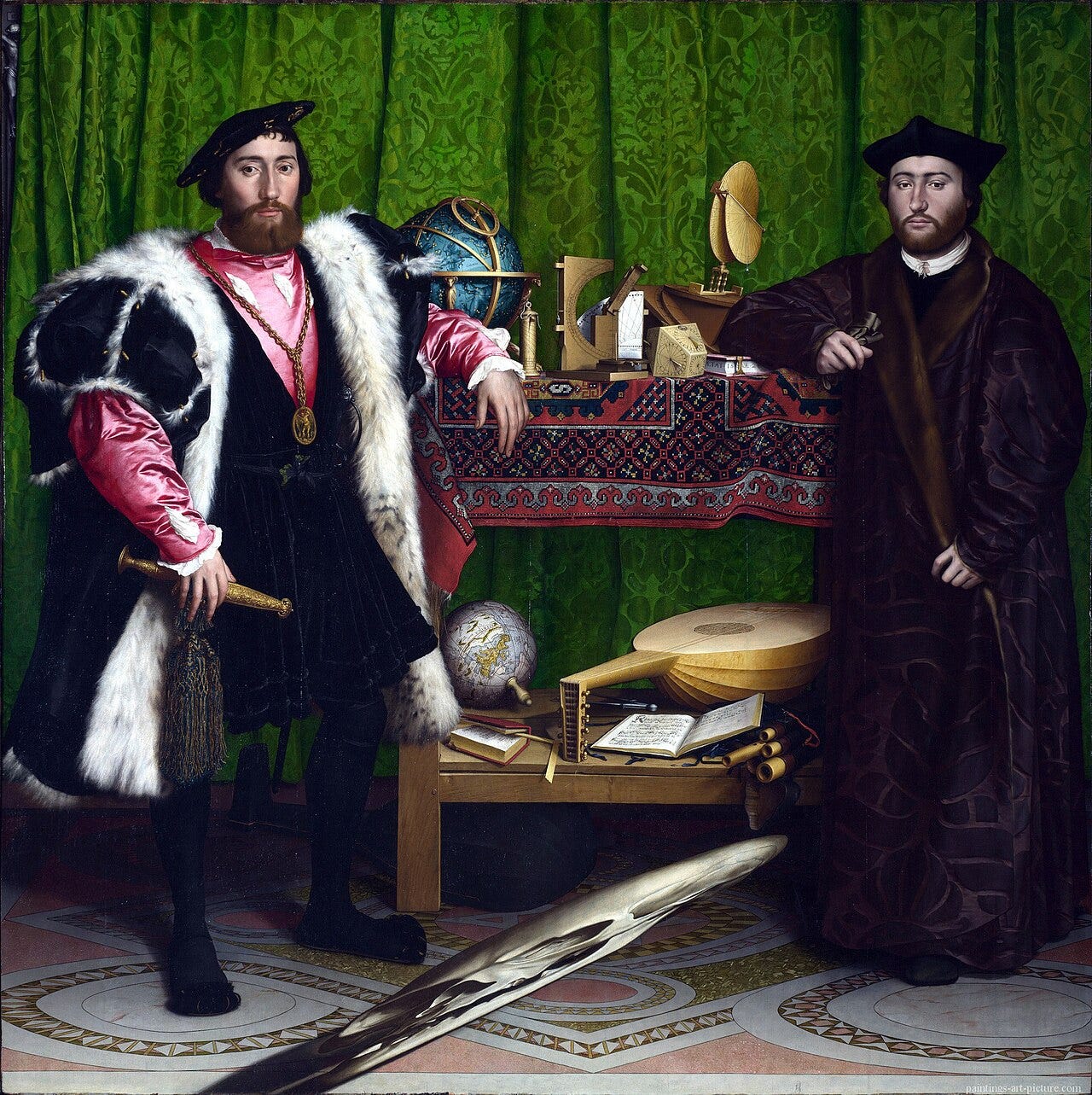
1. Hans Holbein the Younger, The Ambassadors

Two diplomats with a strange grey smear across the floor
Hans Holbein the Younger, The Ambassadors, 1533. National Gallery, London.

In 1533, Holbein painted two French diplomats surrounded by globes, books and instruments. Across the floor at their feet lies a long, grey smear. Stand in front and it makes no sense at all.

Move to the right and look along the surface, and the smear snaps into a human skull. This trick is called anamorphosis. The skull is a reminder of death hidden among all the symbols of learning and power.

The picture may have hung on a staircase, so a person climbing past would suddenly catch the skull from the side. The National Gallery has owned it since 1890.

2. Andrea Mantegna, Camera degli Sposi ceiling

A flat ceiling painted to open onto sky with figures peering down
Andrea Mantegna, Camera degli Sposi ceiling, 1465 to 1474. Ducal Palace, Mantua.

Between 1465 and 1474, Mantegna painted the ceiling of a room in the Ducal Palace in Mantua. He made the flat plaster appear to open into a round hole in the roof, showing blue sky and clouds above.

Around the fake opening, painted women and plump cherubs lean over a railing and peer down at you. One cherub seems about to knock a pot off the edge onto your head. It is the first ceiling painted to look straight up like this.

The trick is called di sotto in su, seen from below. Every grand illusion ceiling that followed, for the next 300 years, traces back to this small room in Mantua.

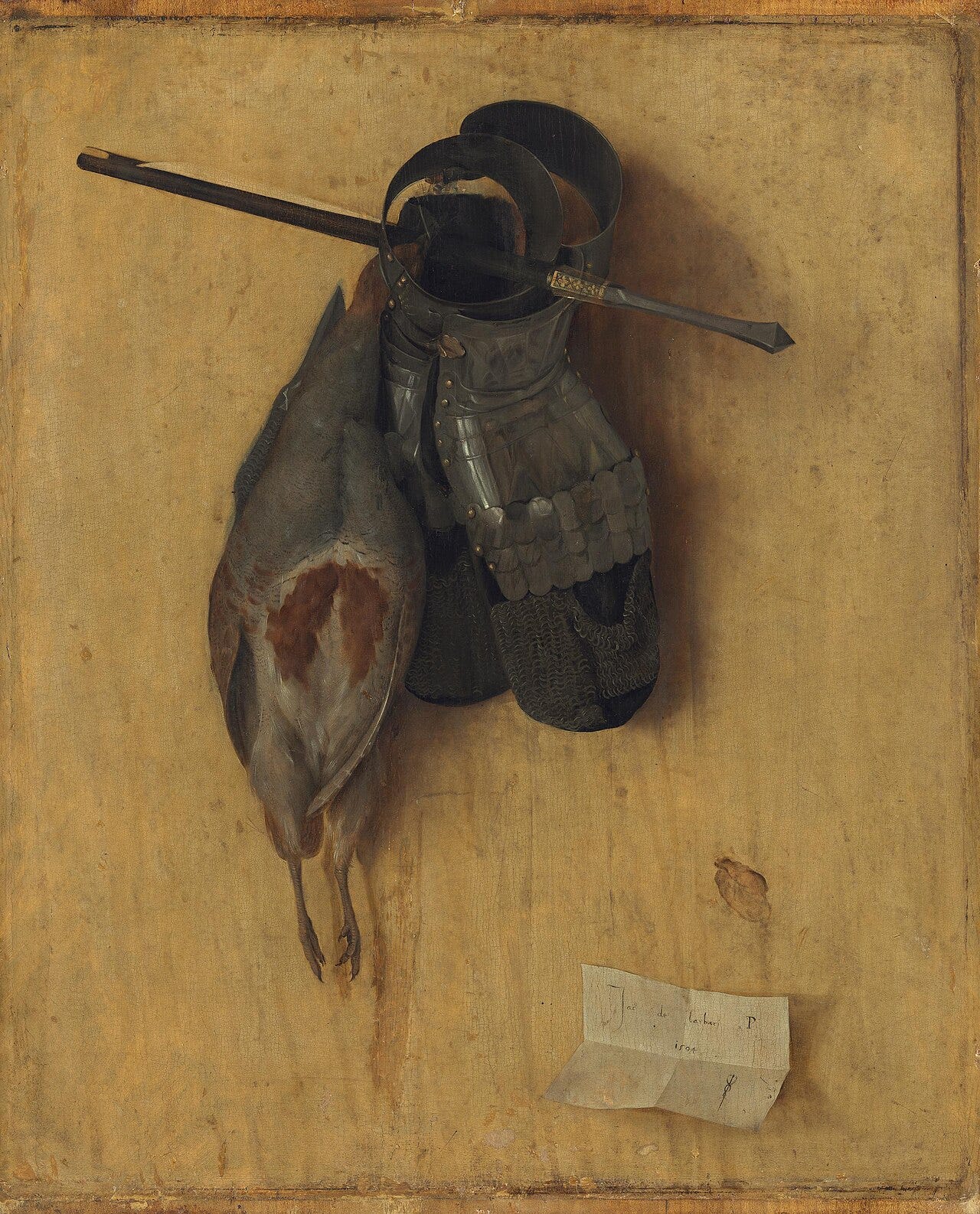
3. Jacopo de Barbari, Still Life with Partridge and Gauntlets

A dead partridge and iron gloves hung on a wooden wall
Jacopo de Barbari, Still Life with Partridge and Gauntlets, 1504. Alte Pinakothek, Munich.

In 1504, Jacopo de Barbari painted a dead partridge hanging on a wooden wall, with iron gloves and a crossbow bolt beside it. A small scrap of paper carries his signature and the date, as if pinned to the boards.

This modest panel holds a record. It is the earliest known trompe l oeil since ancient times, and the earliest standalone still life in European painting. The wall behind is painted to fake real wood grain.

It was probably a cover for a portrait or a decoration for a hunting room. From this one small panel grew a whole tradition of paintings designed to be mistaken for reality.

4. Giuseppe Arcimboldo, Vertumnus

An emperor portrait built entirely from fruit and vegetables
Giuseppe Arcimboldo, Vertumnus, about 1590 to 1591. Skokloster Castle, Sweden.

Around 1590, Arcimboldo painted the Holy Roman Emperor Rudolf II as a pile of fruit and vegetables. A pear becomes his nose, apples his cheeks, corn and gourds his brow. From a distance, it reads as a normal portrait.

It was a compliment, not a joke. The figure is Vertumnus, the Roman god of the seasons. By making the emperor out of every fruit of every season, Arcimboldo called him ruler of a new golden age.

Swedish troops looted the painting in the Thirty Years War. It resurfaced at Skokloster Castle in Sweden, where it still hangs, one of the most copied faces of the Renaissance.

5. Samuel van Hoogstraten, A Peepshow with Views of the Interior of a Dutch House

A painted wooden box that resolves into a perfect house through a peephole
Samuel van Hoogstraten, A Peepshow with Views of the Interior of a Dutch House, about 1655 to 1660. National Gallery, London.

Around 1655, Hoogstraten built a wooden box and painted the inside with a Dutch house. From the outside it looks like flat, distorted smears. Then you put your eye to a small hole cut in the side.

Through the peephole, the smears line up into a perfect little house, complete with tiled floors, a sleeping woman and a small dog. Only about six of these perspective boxes survive, and this is the finest.

The painting on top of the box, seen normally, is a stretched anamorphic scene of Venus and Cupid. Hoogstraten packed several illusions into one cabinet.

6. Cornelius Norbertus Gijsbrechts, The Reverse of a Framed Painting

A painting of the plain wooden back of a canvas
Cornelius Norbertus Gijsbrechts, The Reverse of a Framed Painting, 1670. Statens Museum for Kunst, Copenhagen.

In 1670, Gijsbrechts painted the back of a canvas. That is all. A wooden stretcher, the nails, and a small paper label with an inventory number, painted so carefully it looks like a real frame turned to the wall.

It is a joke with no front. Leaning against a wall in a gallery, it tempts visitors to walk over and flip it around to see the picture. There is no picture. The back is the picture.

Gijsbrechts made it while court painter to the Danish king. It still sits in Copenhagen, where it fools people who forget that the whole thing is paint.

7. Andrea Pozzo, The Apotheosis of Saint Ignatius

A flat church ceiling made to soar into columns and open sky
Andrea Pozzo, The Apotheosis of Saint Ignatius, 1685 to 1694. Church of Sant Ignazio, Rome.

Between 1685 and 1694, Pozzo painted the flat ceiling of the church of Sant Ignazio in Rome. He made it appear to soar upward into towering columns and arches, open at the top to a bright sky full of figures.

There is a marble disc set in the floor. Stand on it and the illusion is perfect. Step away and the painted architecture starts to lean and collapse, because it only lines up from that one spot.

The church needed a dome but could not build one. Pozzo painted a fake dome on flat canvas instead, seventeen meters wide. From below, most visitors never notice it is a painting.

8. William Michael Harnett, The Old Violin

A life size violin hung on a battered green door
William Michael Harnett, The Old Violin, 1886. National Gallery of Art, Washington.

In 1886, Harnett painted a violin hanging on a battered green door, life size, with a sheet of music and a torn envelope tucked behind the hinge. Every crack and worn edge is rendered exactly.

When it went on show, crowds tried to touch it to check if the violin was real. Galleries had to post guards to keep hands off the canvas. Harnett is called the father of American trompe l oeil.

A Cincinnati printer bought it and spread copies as color prints across the country. The original now hangs at the National Gallery of Art in Washington.


Join 130,000 readers who get the secrets behind the paintings. Free.


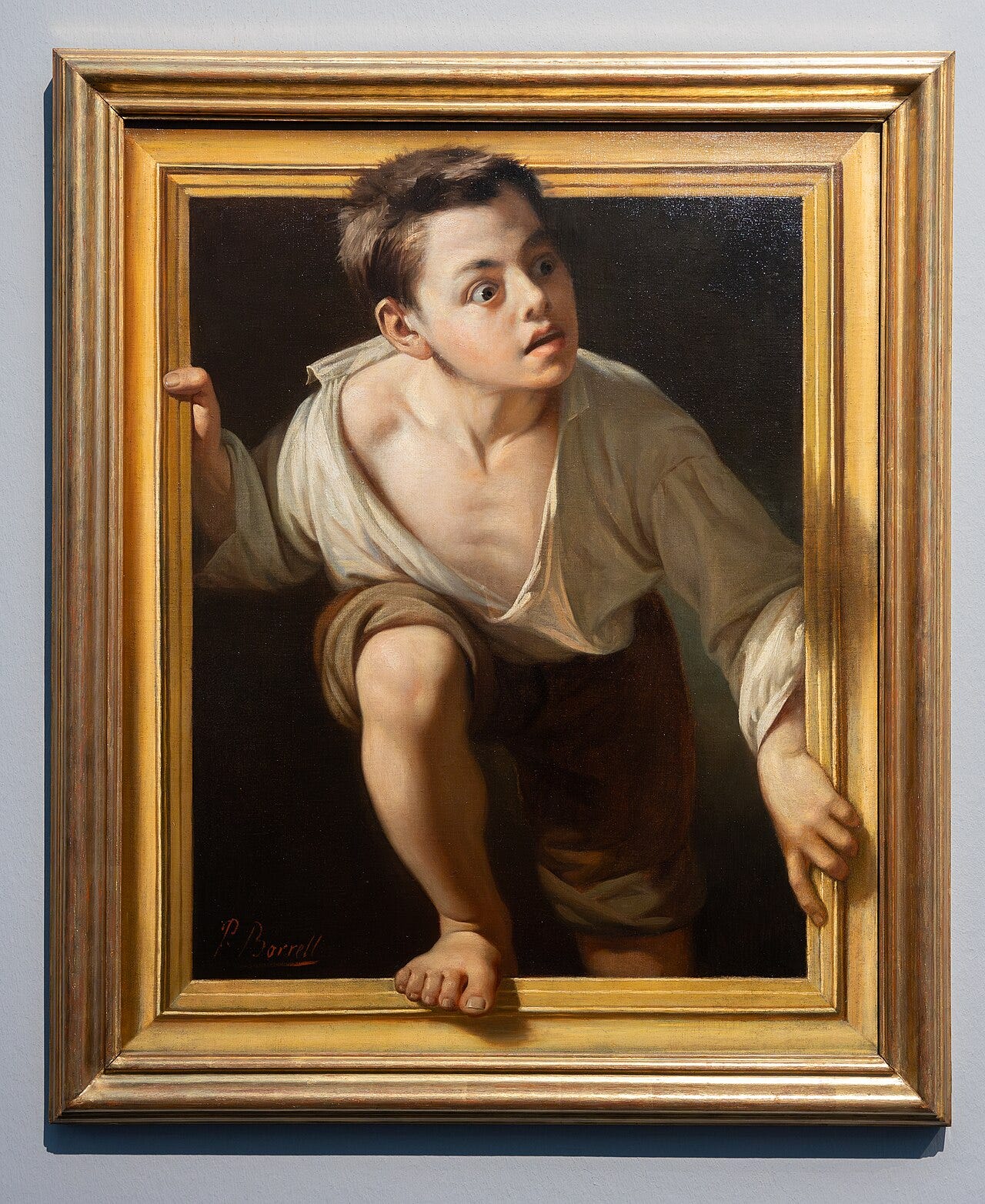
9. Pere Borrell del Caso, Escaping Criticism

A barefoot boy climbing out of a painted picture frame
Pere Borrell del Caso, Escaping Criticism, 1874. Banco de España, Madrid.

In 1874, the Catalan painter Pere Borrell del Caso showed a barefoot boy climbing out of a picture frame. His hands grip the gilded edge. His foot swings over the front. He seems to step out of the painting into the room.

The frame in the picture is painted, and so is the boy. The whole thing is one flat canvas pretending to have depth. The Spanish title, Fugint de la critica, means fleeing from criticism.

It became one of the most reproduced trompe l oeil images ever made. It now belongs to the Banco de España in Madrid and toured the world in illusion shows for years.

10. Charles Allan Gilbert, All Is Vanity

A woman at a dressing table that reads as a giant skull
Charles Allan Gilbert, All Is Vanity, 1892. Widely reproduced.

In 1892, an eighteen year old American named Charles Allan Gilbert drew a woman at her dressing table, gazing into a round mirror. Bottles and brushes sit on the surface. It looks like a quiet scene of vanity.

Step back, and the whole image becomes a giant human skull. The mirror is the eye socket, and the woman and her reflection form the teeth and jaw. The title comes from the line, all is vanity.

Gilbert sold it to Life magazine, which printed it as a poster. It spread everywhere and remains one of the most famous double images in the world.

11. Salvador Dali, Slave Market with the Disappearing Bust of Voltaire

A busy market where figures form a bust of Voltaire
Salvador Dali, Slave Market with the Disappearing Bust of Voltaire, 1940. Dali Museum, St Petersburg, Florida.

In 1940, Dali painted a busy slave market. In the center, a group of figures in old fashioned dress stand under an arch. Look at the whole shape and a stone bust of the writer Voltaire appears out of them.

It is a double image. The two women in white become the eyes and cheeks of Voltaire, and the dark gap behind becomes his face. Focus on the people and Voltaire vanishes. Focus on the bust and the people fade.

Dali said his aim was to make the normal look strange and the strange look normal. The painting hangs at the Dali Museum in St Petersburg, Florida.

12. M.C. Escher, Relativity

Three staircases crossing in a building with its own gravity each
M.C. Escher, Relativity, 1953. Lithograph, National Gallery of Art, Washington.

In 1953, the Dutch artist M.C. Escher printed Relativity. It shows three staircases crossing inside one building, each obeying its own gravity. Faceless figures walk up and down them in different directions at once.

What is a floor for one person is a wall for another. There is no single up or down. Escher built a space that cannot exist, then drew it so calmly that it looks almost ordinary.

He first cut it as a woodcut, then reworked it as a lithograph the same year. It became one of the most reproduced prints of the century, loved by mathematicians as much as artists.

Where to see them

  • National Gallery, London: Hans Holbein The Ambassadors and Samuel van Hoogstraten A Peepshow.

  • Church of Sant Ignazio, Rome: Andrea Pozzo The Apotheosis of Saint Ignatius.

  • Statens Museum for Kunst, Copenhagen: Cornelius Gijsbrechts The Reverse of a Framed Painting.

  • National Gallery of Art, Washington: William Harnett The Old Violin and M.C. Escher Relativity.

  • Dali Museum, St Petersburg, Florida: Salvador Dali Slave Market with the Disappearing Bust of Voltaire.

How the eye gets fooled

Several of these use anamorphosis, a stretched image that only reads correctly from one angle, like Holbein hidden skull.

Others are trompe l oeil, painted so real you reach out to touch them, and the ceilings use foreshortening to open flat plaster onto a painted sky.

Optical illusion paintings, questions people ask

  • What is the hidden shape in Holbein The Ambassadors? A human skull. It looks like a grey smear from the front, but from the right side it snaps into focus, a reminder of death called an anamorphosis.

  • What is trompe l oeil? French for deceive the eye. It is painting so realistic that a flat surface looks like a real, solid object you could pick up or touch.

  • How did painters fake domes and open skies? With perspective tricks. Mantegna and Pozzo painted flat ceilings so they seemed to open upward, an effect called di sotto in su, seen from below.

  • What is a double image in art? One picture that shows two things at once. Arcimboldo made a face out of fruit, and Dali made a bust of Voltaire out of a group of figures.

  • Where can I see famous optical illusion paintings? The National Gallery in London holds Holbein The Ambassadors and Hoogstraten peepshow. Pozzo ceiling is still in the church of Sant Ignazio in Rome.

The eye wants to be fooled

Every painting is already a trick, flat color pretending to be a world. These artists just made the trick visible. Holbein hid death in a smear. Pozzo built a sky out of plaster. Harnett painted a violin so convincing that a museum had to guard it from fingers. The oldest one, Mantegna ceiling, is more than five hundred years old, and people still tip their heads back and grin. Fooling the eye never goes out of style.


Two new stories a week, 130 secrets unlocked. Start free.