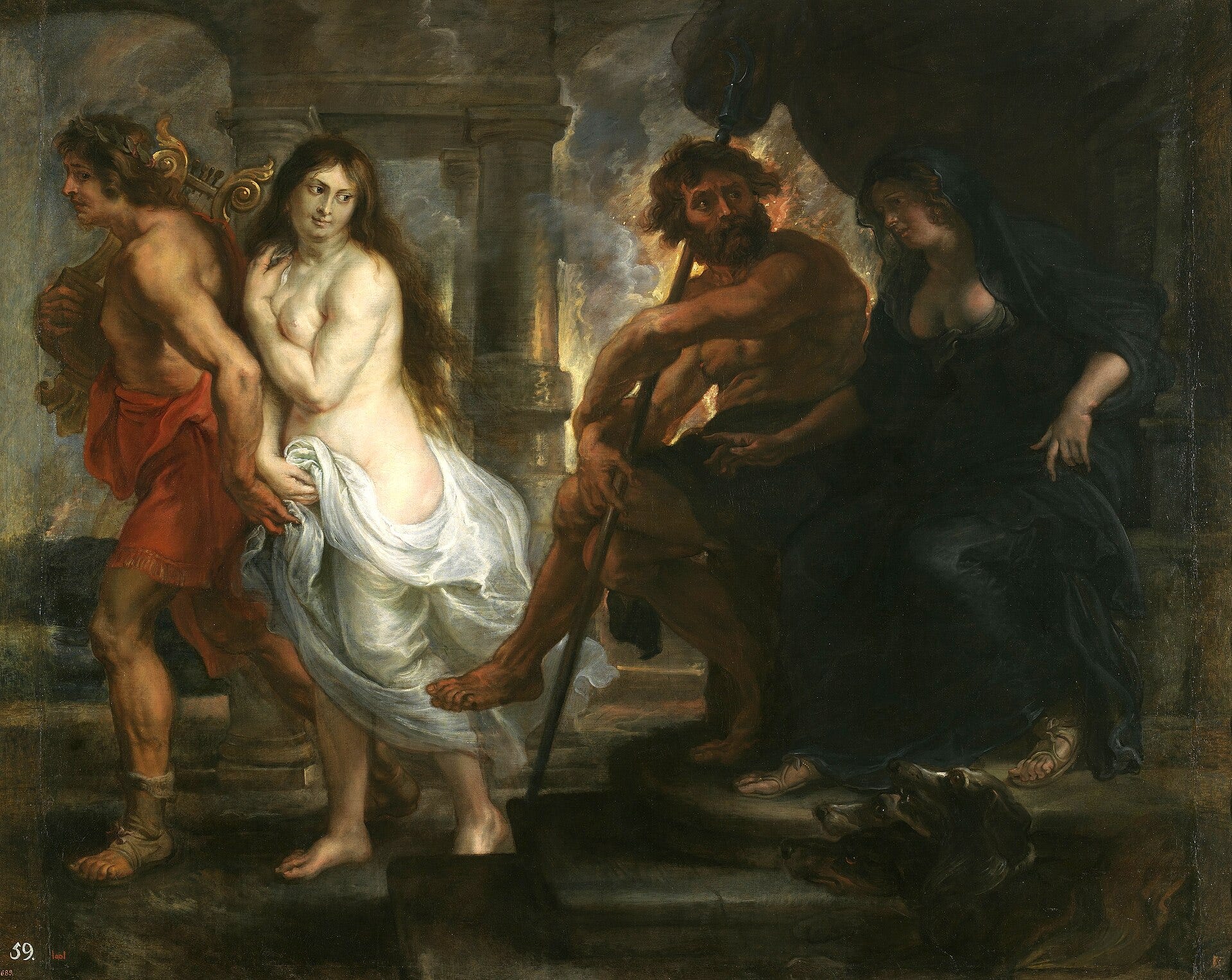
Hades gave Orpheus one rule. Walk ahead of her. Do not look back until you both reach the surface.

That single instruction is the whole tragedy. No monster, no battle, no rival. Just a man, a few steps from daylight, who turns his head.
In the myth, Hades and Persephone release Eurydice on one condition: Orpheus must not look back before reaching the surface. He does, and loses her forever. Corot's 1861 painting shows the hopeful ascent; Rodin's marble at the Met shows the fatal turn.
Artists have understood something useful about this story. It has exactly two moments worth painting, and you can tell which one you are looking at by checking a single detail: which way Orpheus is facing.
Corot: the moment before
Jean Baptiste Camille Corot painted Orpheus Leading Eurydice from the Underworld in 1861, in oil on canvas. Versions and related works are held in major collections, including the Museum of Fine Arts, Houston.
Corot picks the hopeful second. The couple moves toward the right edge of the canvas, toward the edge of a dark wood, toward the exit. Orpheus holds his lyre up in front of him as he leads the way. That lyre is how you know who he is.
He does not look back. Eurydice follows. In the image itself, nothing has gone wrong yet.
And still the painting reads as melancholy. Corot's lyricism carries the ending the picture refuses to show. Both figures are walking toward the light, and every viewer who knows the story knows they will never reach it.
Watts and Rodin: the moment after
George Frederic Watts, the British painter, chose the other second. His Orpheus and Eurydice shows the aftermath of the look: Orpheus clutching in vain at Eurydice's spirit as it dissolves back into the underworld. Where Corot gives you two walking figures, Watts gives you one man grasping at something that is no longer there.
Auguste Rodin carved the same instant in marble. His Orpheus and Eurydice group, now in the collection of The Metropolitan Museum of Art in New York, catches Eurydice at the threshold, her form still emerging from the stone as if half in darkness.
Rodin's Orpheus cannot feel her touch. He cannot hear her voice behind him. So he gives in and turns to look, and that is the gesture the marble freezes: the turn that makes her vanish.
Set the three works side by side and you get the whole story told twice. Corot shows you the walk. Watts and Rodin show you the price.
The myth in full
Orpheus was the son of the Muse Calliope and the greatest musician of Greek myth. His lyre charmed animals, trees, even stones.
His wife Eurydice died from a snake bite. Orpheus went down to the underworld and played for Hades and Persephone, and the music moved them enough to grant something no one else got: Eurydice could return to the living.
One condition. He must walk ahead of her and not look back until both of them reached the surface.
Just short of the exit, doubt or longing overcame him. He turned to check she was still following. Because he turned too soon, Eurydice was pulled back into the underworld, this time for good.
Orpheus was left to grieve. In most later tellings he was eventually killed by Maenads, or Thracian women, some say for spurning their advances after Eurydice's second death.
How to read any Orpheus artwork in two seconds
First, find the lyre. A lyre in a male figure's hands, or lying nearby, identifies Orpheus across virtually every depiction of the myth.
Then check the gaze. Figures moving forward together toward light, without looking back, mean the hopeful ascent. That is Corot.
A figure looking backward at a dissolving or vanishing companion means the moment of loss. That is Watts, and that is Rodin.
Orpheus is one of the few myths where the direction of a single glance tells you exactly which second of the story you are witnessing. The plot lives entirely in the neck.
FAQ
Why did Orpheus look back?
The myth does not settle it. Doubt or longing overcame him just short of the exit, and he turned to check Eurydice was still following. He turned too soon, and she was lost permanently.
What instrument did Orpheus play?
The lyre. It is his identifying attribute in art, the way keys identify Saint Peter. His playing charmed animals, trees, and stones, and persuaded Hades and Persephone themselves.
How did Eurydice die the first time?
A snake bite. Her death is what sends Orpheus down to the underworld to plead for her return.
Where can I see Rodin's Orpheus and Eurydice?
The marble group is in the collection of The Metropolitan Museum of Art in New York. It shows the instant Orpheus turns and loses her a second time.
In Corot's 1861 canvas, Orpheus holds the lyre raised in front of him as he walks, so the instrument that won Eurydice back from Hades is also the object leading her toward the exit she will never reach.