
Paolo Veronese was the Venetian painter of luminous banquets, the master of silver silks, marble halls and crowds of beautiful people feasting under blue skies.
His enormous canvases turn biblical scenes into glittering parties, and one of them got him hauled before the Inquisition.
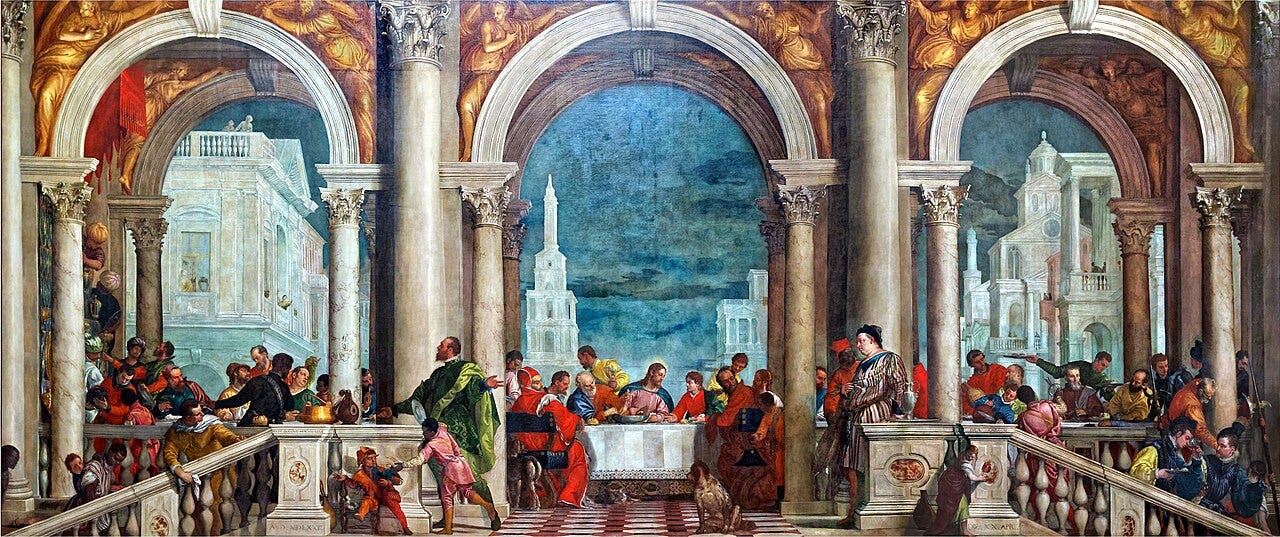
Where other painters preached, Veronese celebrated. His religion looks like the richest dinner in Venice, and that splendor is exactly the point and the problem.
Born: Verona, 1528, hence Veronese
Known for: vast feast scenes, luminous color and pageantry
Died: Venice, 1588
More incredible painter stories
If Paolo Veronese pulled you in, you will love these too:


Paolo Veronese at a glance
1528. Born Paolo Caliari in Verona, a stonecutter's son.
1553. Began working in the Doge's Palace in Venice, his adopted city.
1563. The Wedding Feast at Cana, nearly ten meters wide, for the refectory of San Giorgio Maggiore.
1573. Called before the Inquisition over a Last Supper. He renamed it Feast in the House of Levi rather than change it.
1588. Died after catching a chill in a procession. He is buried at San Sebastiano, among his own paintings.
The painter of feasts
Veronese specialized in the huge banquet scene. His Wedding at Cana, painted for a monastery and now one of the largest paintings in the Louvre, crams over a hundred richly dressed guests, musicians and servants around the moment Christ turns water into wine.
He painted contemporary Venetian luxury, satin, columns, dwarfs, dogs and exotic guests, and set sacred stories inside it. The effect is pure spectacle, lit by a clear, silvery light.
On trial before the Inquisition
In 1573 Veronese painted a vast Last Supper full of drunkards, dogs, dwarfs and German soldiers. The Inquisition summoned him to explain such irreverence in a holy scene.
His defense was that painters take the same liberties as poets. Rather than repaint it, he simply changed the title to Feast in the House of Levi, a less sacred meal where rowdy guests were acceptable. Problem solved, major work untouched.
Decorator of Venice
Veronese filled Venice and its villas with color. He painted ceilings for the Doge's Palace, where figures float and foreshorten high overhead, and covered the walls of the Villa Barbaro with playful illusions.
He so loved a particular cool green that the shade is still called Veronese green today. See how he built it in what is oil painting.
You can explore works by Paolo Veronese in the collection of the Metropolitan Museum of Art.
The stonecutter's son from Verona
He was born Paolo Caliari in Verona in 1528, the son of a stonecutter. The nickname Veronese, the man from Verona, stuck once he moved away and became the name history kept.
He trained locally under Antonio Badile, whose daughter he later married, and by his early twenties he was already winning commissions in the towns of the Veneto mainland.
He arrived in Venice around 1553 as an outsider from the provinces, and set about becoming the city's grandest decorator, competing for commissions with Titian and Tintoretto.
The gold chain from the Doge's Palace
One of his first Venetian jobs was ceiling painting in the Doge's Palace. For the Marciana Library nearby, a panel of his was judged the best by a jury that included Titian, and he was rewarded with a gold chain.
That prize, handed out by the old master of the city, was a public sign that the newcomer had arrived. From then on the great Venetian commissions came to him.
The Wedding Feast at Cana
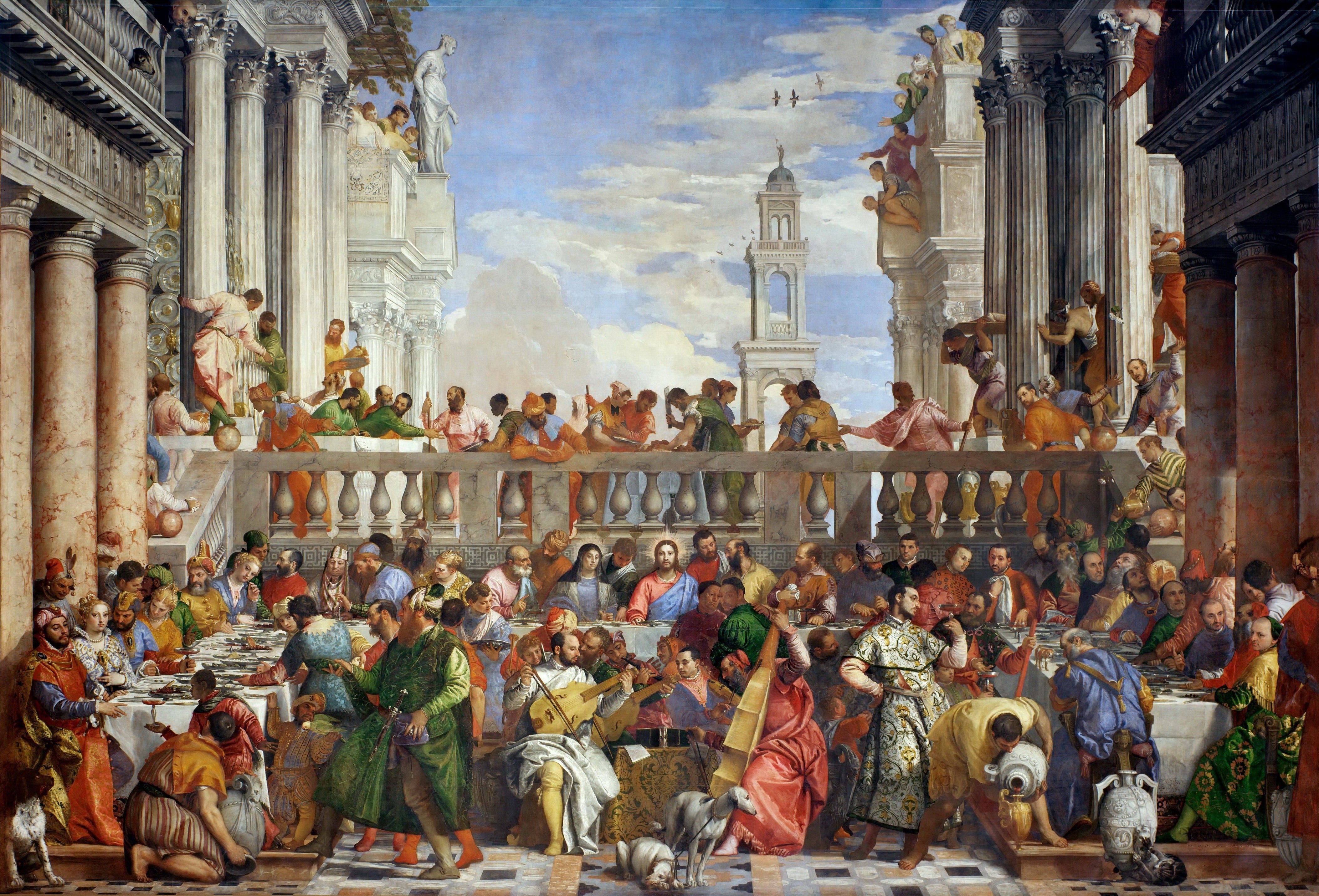
In 1562 the Benedictine monks of San Giorgio Maggiore asked Veronese for a picture to fill the end wall of their new refectory. He gave them The Wedding Feast at Cana, the Bible story of Christ turning water into wine, staged as a lavish Venetian banquet.
It is enormous, nearly seven by ten metres, crowded with over a hundred figures, musicians, servants and pet animals. Christ sits quietly at the centre of a party that pays him almost no attention.
The picture now hangs in the Louvre, where it is the largest painting in the collection.
How Napoleon carried the Cana to Paris
The Cana stayed in its Venice refectory for more than two centuries. Then in 1797 Napoleon's army took Venice, and his agents cut the canvas down and shipped it to Paris as war booty.
It was rolled, moved and later relined, and it never went home. After 1815 many looted works returned to Italy, but the Cana was judged too fragile to travel and was swapped for a smaller picture.
That is why the greatest Venetian banquet ever painted hangs today across the room from the Mona Lisa.
The painted rooms of Villa Barbaro
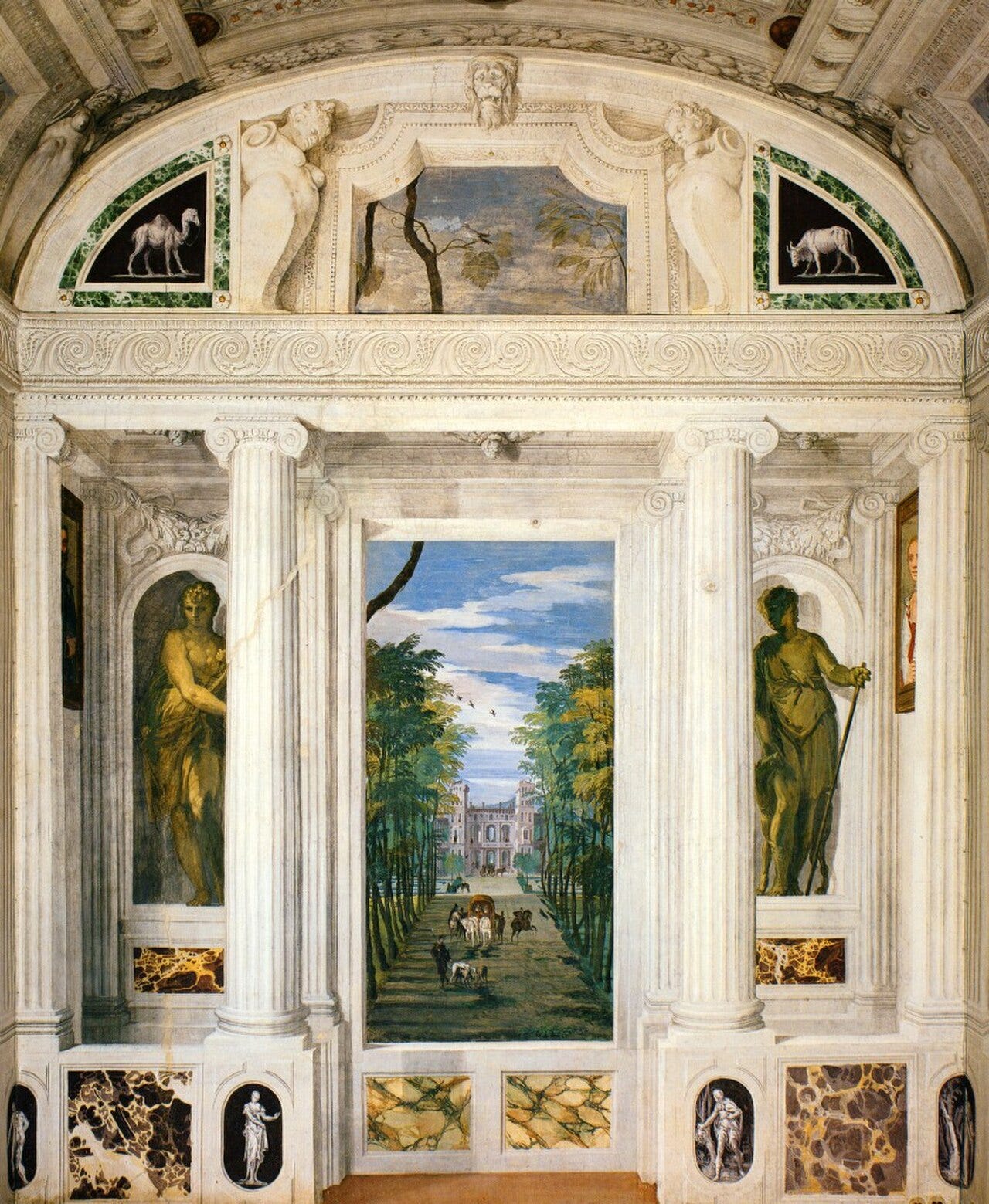
Around 1560 Veronese decorated the Villa Barbaro at Maser, a country house designed by the architect Andrea Palladio for two Venetian brothers. Inside, he covered the walls with fresco.
He filled the rooms with painted illusions: fake doors, a servant peeking in, a woman leaning over a painted balustrade, landscapes opening through columns that are also paint. Family members seem to walk into the rooms.
It is one of the finest surviving unions of Renaissance architecture and painting, and unlike his altarpieces it is still in the house it was made for.
Colorito, the Venetian way with colour
Veronese belonged to the Venetian tradition of colorito, building a picture through colour and light rather than the sharp drawn line the Florentines prized. His silvers, his blues and his shot silks are his signature.
He worked on a grand scale, arranging crowds within painted architecture, and he loved the textures of a rich world: brocade, marble, glass and fur. Even his holy scenes look like the feasts of a wealthy republic.
Later painters studied him closely for exactly this. His handling of light on cloth fed straight into the Baroque.
The Family of Darius before Alexander
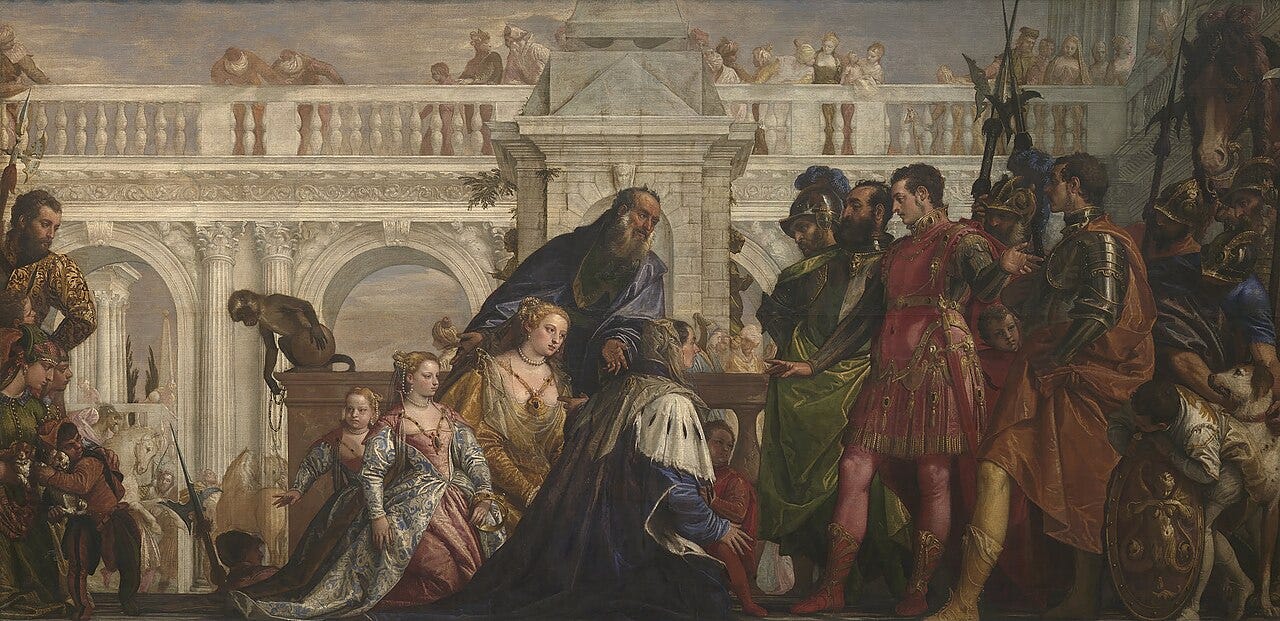
Among his history pictures, one of the most admired is The Family of Darius before Alexander, painted in the 1560s for the Pisani family and now in the National Gallery in London.
It shows the defeated Persian queen kneeling to the wrong man, mistaking Alexander's companion for the king, while Alexander graciously forgives the error.
Veronese dresses the ancient story in sixteenth century Venetian clothes and sets it before a row of pale columns.
The Pisani kept it for two hundred years, and London bought it in 1857 for what was then a very high price.
The mythologies for far off courts
Alongside the altarpieces and banquets, Veronese painted stories from ancient myth for private collectors across Europe. Pictures of Venus and Mars, of Perseus rescuing Andromeda, and a set of allegories of love now in the National Gallery in London show him at his most sensual.
These were luxury objects, made to hang in the palaces of princes rather than churches. Their reputation spread his name well beyond Venice while he was still alive, and rulers competed to own one.
Even here he cannot resist the trappings of wealth. The gods wear Venetian silk and stand among Venetian marble, as if Olympus had a branch on the lagoon.
The painters who never forgot him
Veronese's afterlife was long. When Peter Paul Rubens came to Italy he studied the Venetians closely, and the sweep and colour of Veronese fed straight into the Baroque.
In the following centuries the Venetian Giambattista Tiepolo took up his airy ceilings and pale skies as a direct inheritance. In France, Eugene Delacroix filled his journals with notes on the Venetian colourists and returned to Veronese again and again.
For a painter often filed under decoration, that is a remarkable line of pupils across three hundred years. The feasts kept teaching long after the guest of honour had gone.
The workshop that outlived him
Veronese ran a large family workshop, the Haeredes Pauli, the heirs of Paolo. His brother Benedetto and his sons Carletto and Gabriele worked alongside him and carried on after his death.
That is why paintings kept appearing under his name into the 1590s. The firm finished commissions the master had begun and signed them for the family.
The procession that killed him, and where to see him now
Veronese died in Venice in 1588. By tradition he caught a fever after walking in a religious procession, and he was buried in the church of San Sebastiano, which he had spent much of his life decorating.
San Sebastiano is still the place to feel his full range, ceilings, walls and organ shutters by one hand. Beyond it, the Louvre holds the Cana, London the Family of Darius, and the Villa Barbaro keeps its frescoes.
The party never stops in a Veronese. That was the point.
The Paolo Veronese questions that keep coming up
What is Paolo Veronese famous for?
Enormous, luxurious feast scenes like the Wedding at Cana.
Why was he tried by the Inquisition?
For filling a sacred Last Supper with dogs, dwarfs, jesters and drunkards. Summoned in 1573, he refused to repaint it and simply renamed it The Feast in the House of Levi.
What is Veronese green?
A cool green named after his love of the colour. See allegory in art for his decorative themes.
How big is The Wedding at Cana? About 6.7 by 9.9 meters, the largest painting in the Louvre, looted from Venice by Napoleon in 1797 and hung facing the Mona Lisa, whose crowds stand with their backs to it.
Did Veronese ever get in trouble for his style? Famously: summoned by the Inquisition in 1573 over a Last Supper crowded with dwarfs, dogs, and German soldiers, he refused to repaint anything and simply retitled it The Feast in the House of Levi.
Where can I see Veronese? Venice, in San Sebastiano and the Doge's Palace, the Louvre for the Wedding at Cana, and the National Gallery in London for the Family of Darius.
More secrets to unlock


Why the feasts still pull crowds
Veronese made painting a feast for the eyes and defended the artist's freedom to invent, in front of the Inquisition no less. His lavish banquets still set the standard for sheer visual abundance.
The Wedding at Cana measures nearly seven metres tall and ten metres wide, so big that it hangs in the Louvre directly across the room from the tiny Mona Lisa, mostly ignored by the crowds.