
Pattern in art is a motif repeated across a surface: dots, tiles, flowers, grids. Some painters use it as decoration, some as obsession, some as the entire subject. Here are thirteen works built on pattern; the most recent, still under rights, appear in words only.
Pattern in 30 seconds
A pattern is repetition organized to fill a surface. It sits; a rhythm moves. We covered the difference in our page on rhythm in art.
Geometric patterns repeat exact shapes: tiles, grids, tessellations. Natural patterns repeat with variation: petals, waves, leopard spots.
Pattern can serve the picture, as wallpaper behind a figure, or eat it, swallowing the figure whole.
Whole civilizations made pattern the highest art form. The Western habit of ranking it below figures is the exception, not the rule.
The eye loves pattern because it loves prediction. Painters exploit that, then break the repeat exactly where they want your attention.
The Dipylon amphora (c. 750 BC): pattern before pictures
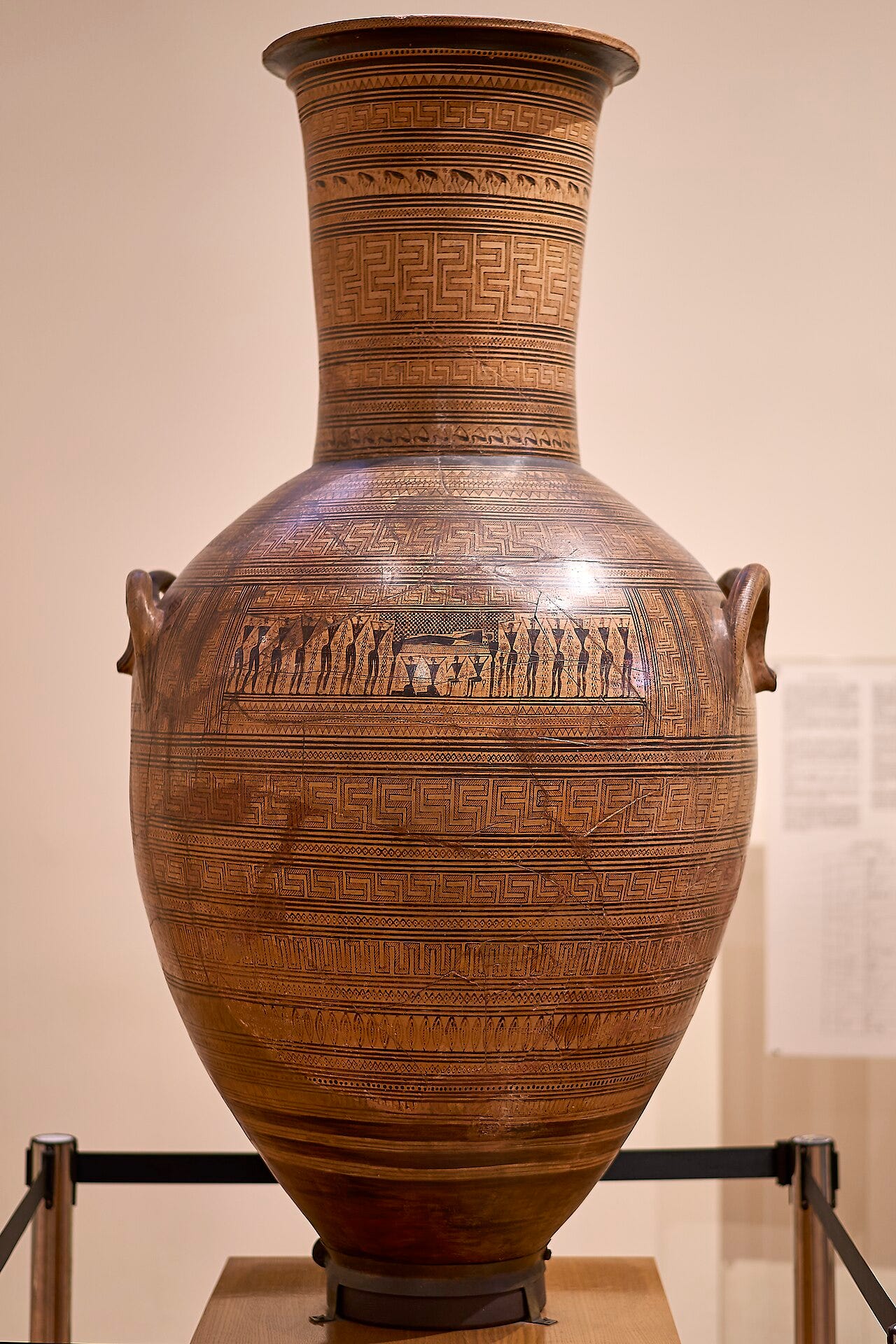
An entire era of Greek art is named the Geometric period, and this grave marker shows why: bands of meanders, zigzags, and checkers wrap the vase, with the human figures reduced to pattern themselves.
The famous Greek key pattern on this pot still runs around picture frames, sneakers, and hotel carpets, twenty-seven centuries later.
The Alhambra tilework (14th century): the infinite repeat
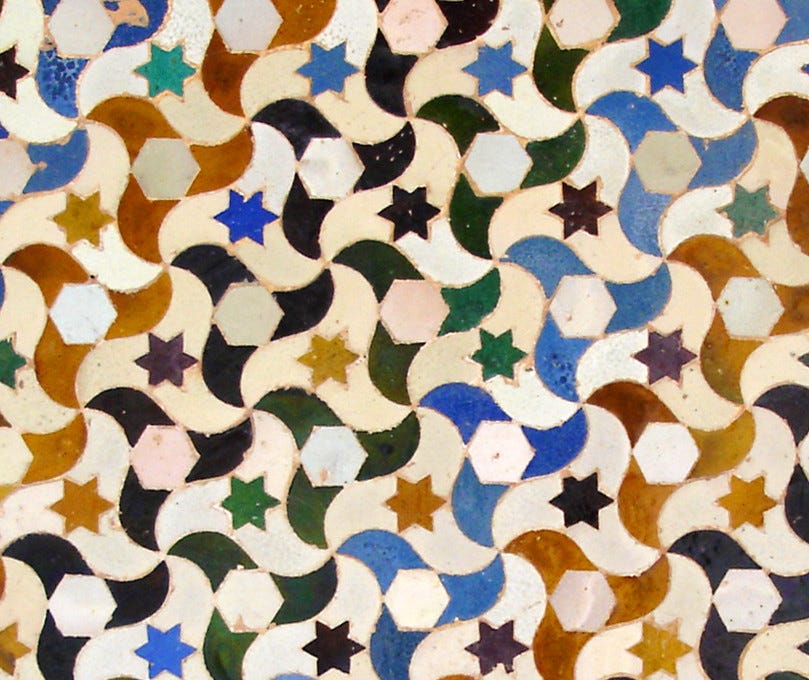
Islamic geometric ornament turns mathematics into devotion: star polygons and interlacing bands that could extend forever, with no beginning, no end, and no image of any living thing.
Centuries later a young Dutch printmaker named M. C. Escher copied these walls for days, and left with the obsession that would fill his life.
The Lady and the Unicorn (c. 1500): a thousand flowers
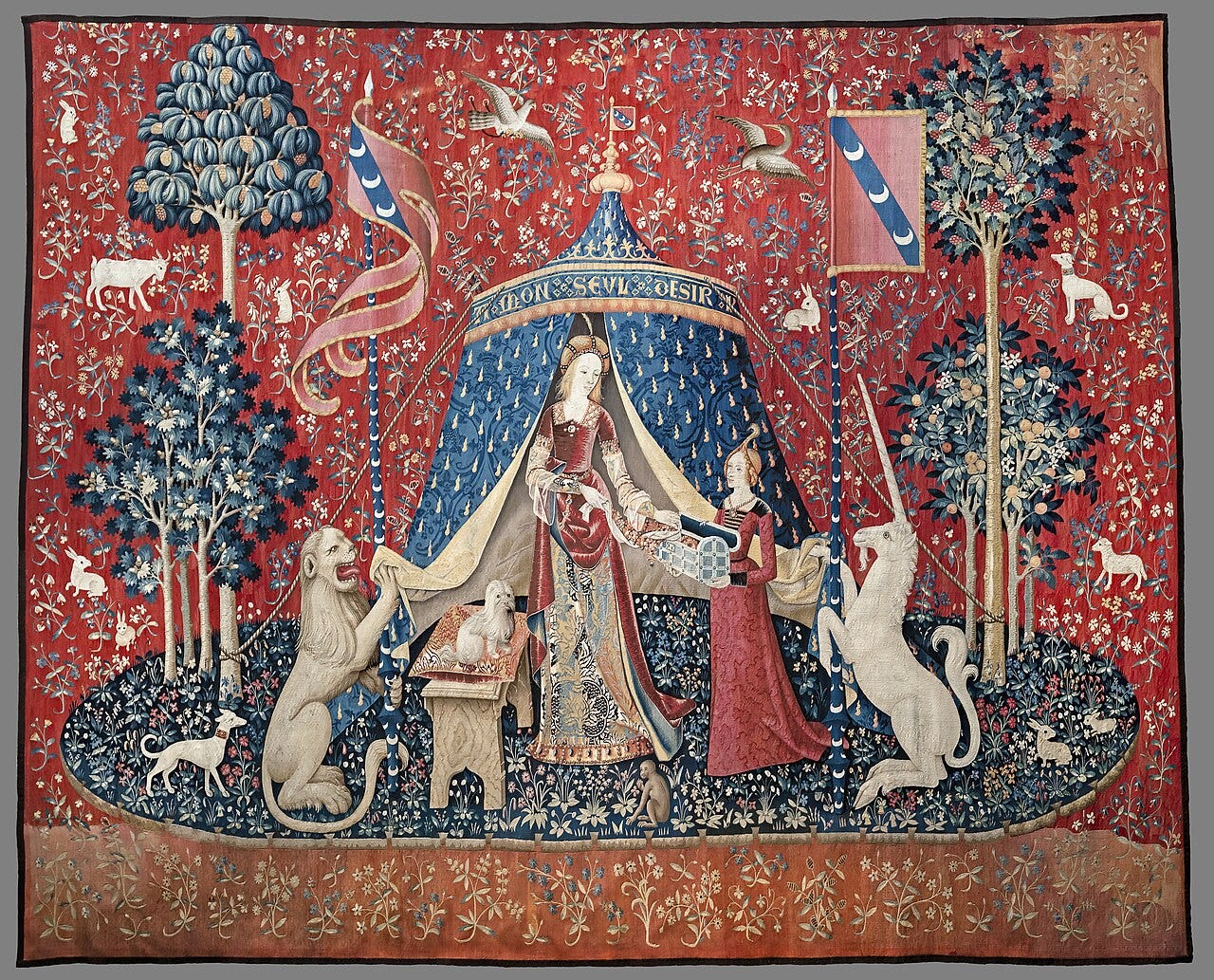
The six tapestries float their lady, lion, and unicorn on a red field sown with flowering plants, the style called millefleurs, a thousand flowers. The background is not behind the scene; it is the scene.
The set hung forgotten in a damp castle until the novelist George Sand helped make it famous in the 1840s. Damp and rats had eaten at the borders; the flowers survived.
Learn art the fun way


William Morris, Strawberry Thief (1883): pattern with a plot
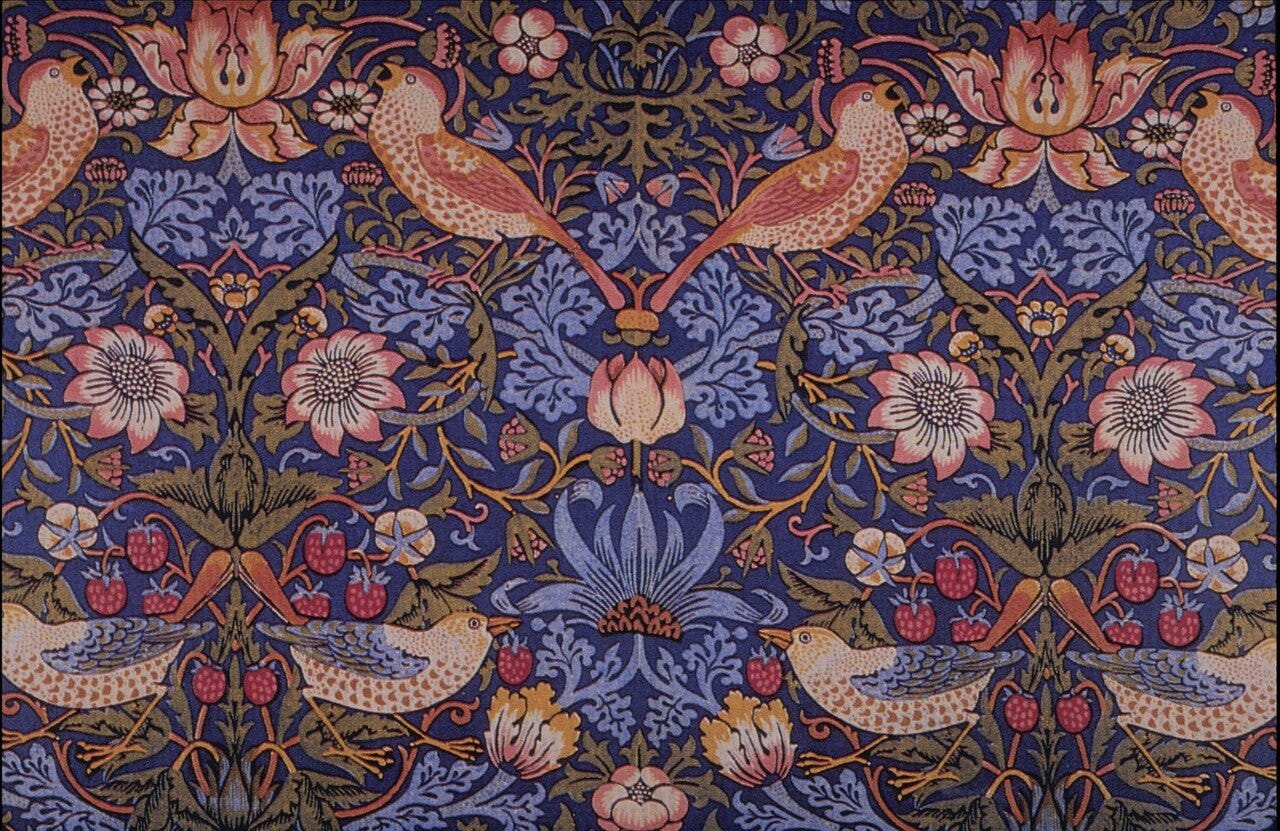
Thrushes tilt through curling strawberry plants in a repeat you could read like a comic strip: the birds are stealing the fruit, as they really did in Morris's garden at Kelmscott.
He insisted on the slow indigo-discharge method to print it, ruined batch after batch, and made it his most expensive fabric. It became the bestseller anyway.
Klimt, Adele Bloch-Bauer I (1907): the pattern that ate the sitter
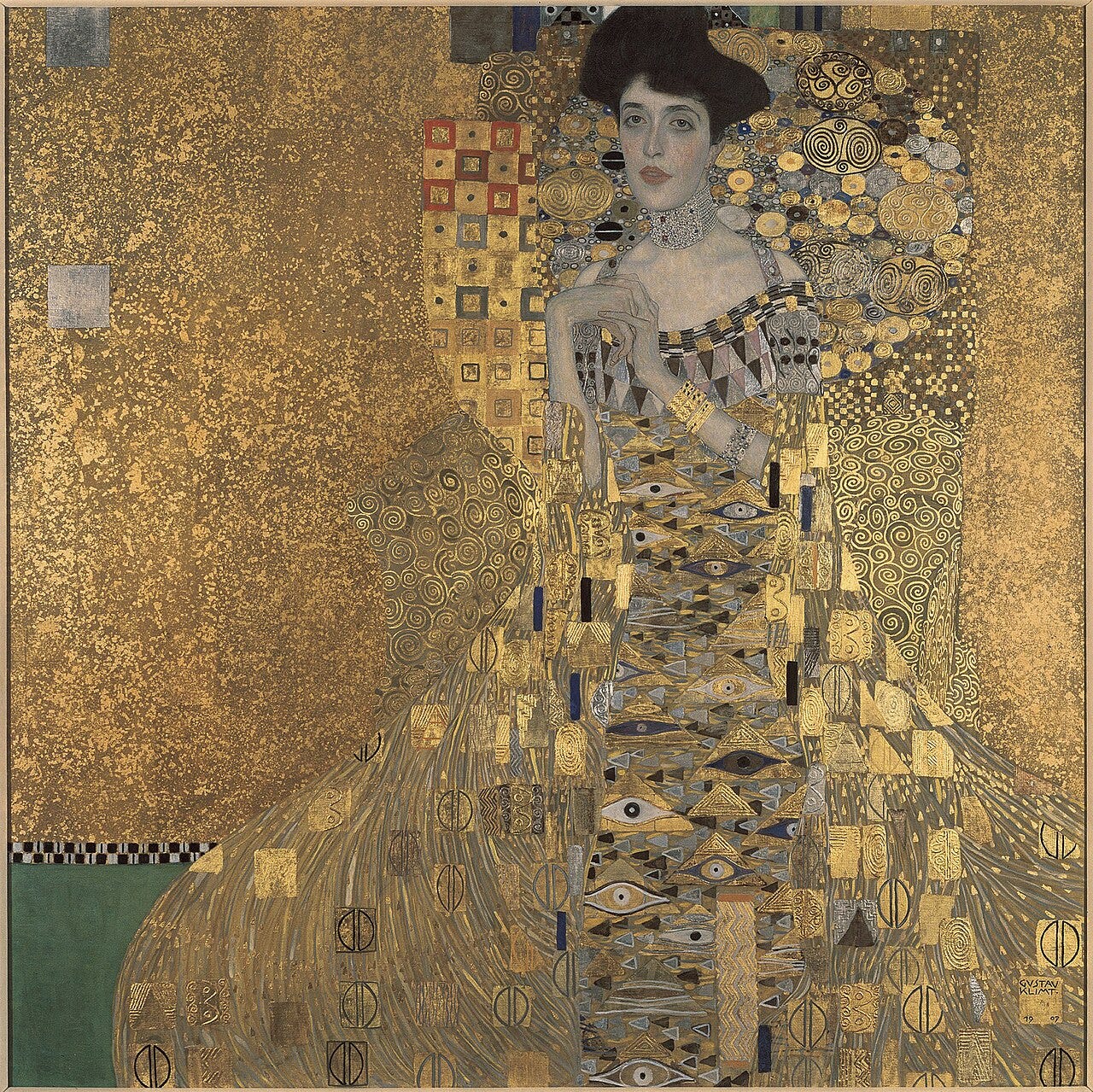
Adele's face and hands float on a sea of gold spirals, eyes, and squares; where the dress ends and the chair begins is anyone's guess. Klimt let ornament swallow everything but the woman's gaze.
Looted by the Nazis, reclaimed by her niece Maria Altmann after eight years of lawsuits, and sold in 2006 for 135 million dollars, then the highest price ever paid for a painting.
Vuillard, the patterned interiors (1890s): camouflage at home
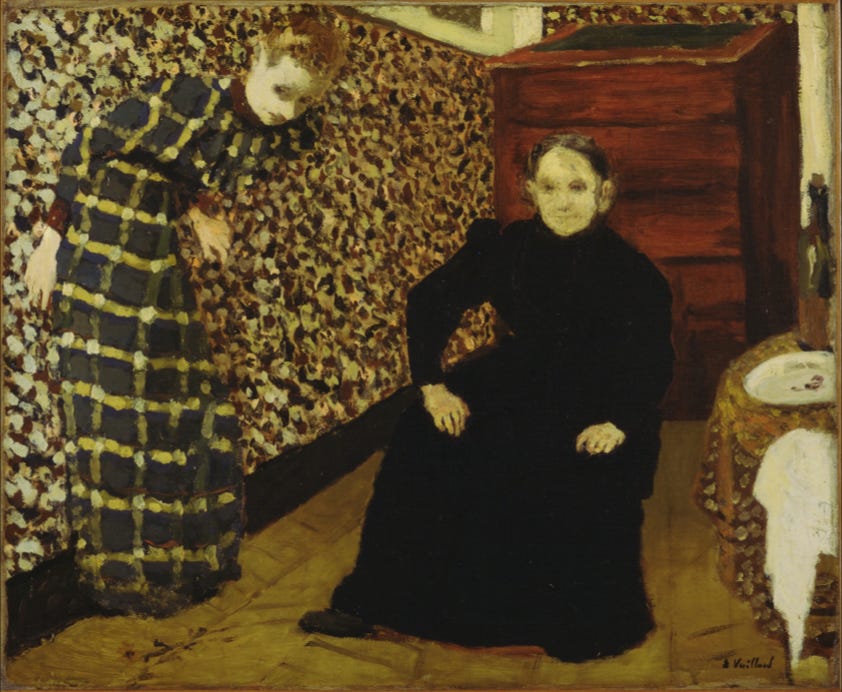
Wallpaper, dresses, tablecloths, and upholstery merge into one flickering field, and his figures half-dissolve into the furnishings. Vuillard grew up in his mother's dressmaking workshop, surrounded by bolts of printed fabric, and painted the world as textile.
Beardsley, The Peacock Skirt (1893): pattern as costume
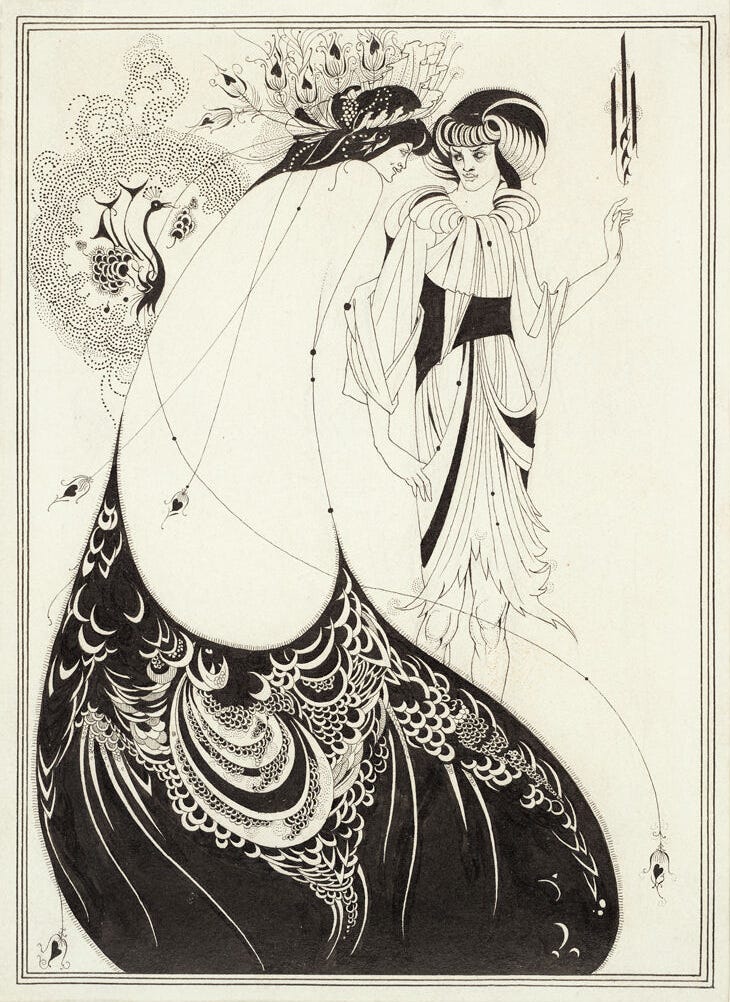
The skirt is one enormous peacock-feather pattern, drawn in pure black on white, and it upstages both figures. Beardsley understood that a strong repeat can carry a whole image.
Matisse: the arabesque takes over
From Moroccan textiles to his final paper cut-outs, Matisse filled canvases with arabesques, printed cloths, and wallpapers until figure and ground traded places. Reproduction rights are still enforced in some countries, so no image here.
His Red Studio and Harmony in Red are the textbooks: entire rooms flattened into pattern, with the furniture drawn on top like embroidery.
Escher: the tessellation machine
After his Alhambra visits, M. C. Escher spent decades on tessellations, interlocking birds, fish, and lizards that tile the plane with no gaps, pattern with the rigor of proof. His estate guards the images closely, so words must do.
The moderns: dots, stripes, and grids
Yayoi Kusama has covered pumpkins, rooms, and her own clothing in polka dots since the 1950s, pattern as both obsession and therapy, by her own account. Bridget Riley turned stripe and curve repeats into optical events, Sonia Delaunay ran simultaneous color patterns across canvases and dresses alike, and Warhol let the silkscreen grid repeat a face until it emptied.
All four are recent enough that images stay behind rights. All four prove the point of this whole page: the repeat is never neutral.
You Might Also Like


Pattern is one of eleven principles that organize a composition. See how it connects to the rest in our full guide to the elements and principles of art. It connects closely to variety in art.
Quick answers
What is pattern in art? A motif repeated in an organized way across a surface: geometric like tiles and grids, or natural like petals and spots.
What is the difference between pattern and repetition? Repetition is the act; pattern is the organized result. Repeat a dot once and you have repetition; arrange dots to fill a surface and you have a pattern.
What are natural and geometric patterns? Geometric patterns repeat exact modules: meanders, stars, tessellations. Natural patterns repeat with variation, the way no two leaves on one branch quite match.
Which artists are known for pattern? Klimt, William Morris, Vuillard, and the Islamic ornament tradition among the classics; Escher, Matisse, Sonia Delaunay, Bridget Riley, Warhol, and Kusama among the moderns.
Where to see these works
The Dipylon amphora is in the National Archaeological Museum in Athens, the Alhambra tilework in Granada, and The Lady and the Unicorn at the Musée de Cluny in Paris.
Strawberry Thief is at the V&A in London, Adele Bloch-Bauer I at the Neue Galerie in New York, Vuillard's interiors at MoMA and the Musée d'Orsay, and The Peacock Skirt at the Fogg Museum at Harvard.
One last fact
When Escher first copied the Alhambra tilings, he complained the Moors had been forbidden to use animals in their patterns, and set out to fix that gap himself. One of the great bodies of modern pattern exists because one visitor treated a 600-year-old wall as an unfinished assignment.