
Paul Delaroche (1797 to 1856) was a Parisian painter famous for scenes of kings, queens and children just before their deaths. His best-known pictures are The Execution of Lady Jane Grey and The Princes in the Tower.
In the 1830s, Delaroche drew the biggest crowds at the Salon, the official art exhibition in Paris, and his fame spread to Britain.
A century later, his paintings had fallen out of fashion, and his most famous canvas lay rolled up in a London basement for forty-five years, believed destroyed.
Cool Stories About Art is a newsletter to learn art the fun way.
Join 200,000+ readers and get:
10 new art stories / month
The entire archive of content (140+ articles)
Comment, ask questions, and chat with other readers
On February 12, 1554, Lady Jane Grey, a young woman of seventeen, stood blindfolded inside the Tower of London, the royal fortress and prison beside the River Thames. She was about to be beheaded.
With the cloth over her eyes, Jane could not find the block, the wooden stump where she had to lay her neck. She felt for it with her hands and asked where it was.
Seven months earlier, Jane had been queen of England. Her young cousin, King Edward VI, a Protestant, had named her his heir to keep the crown from his Catholic half-sister, Mary. Nine days after Jane was proclaimed, the royal council switched sides, and Mary took the throne.
In early 1554, Jane's father joined a rebellion against the new queen. While Jane lived, rebels could try to crown her again, so Mary let Jane's death sentence for treason be carried out.
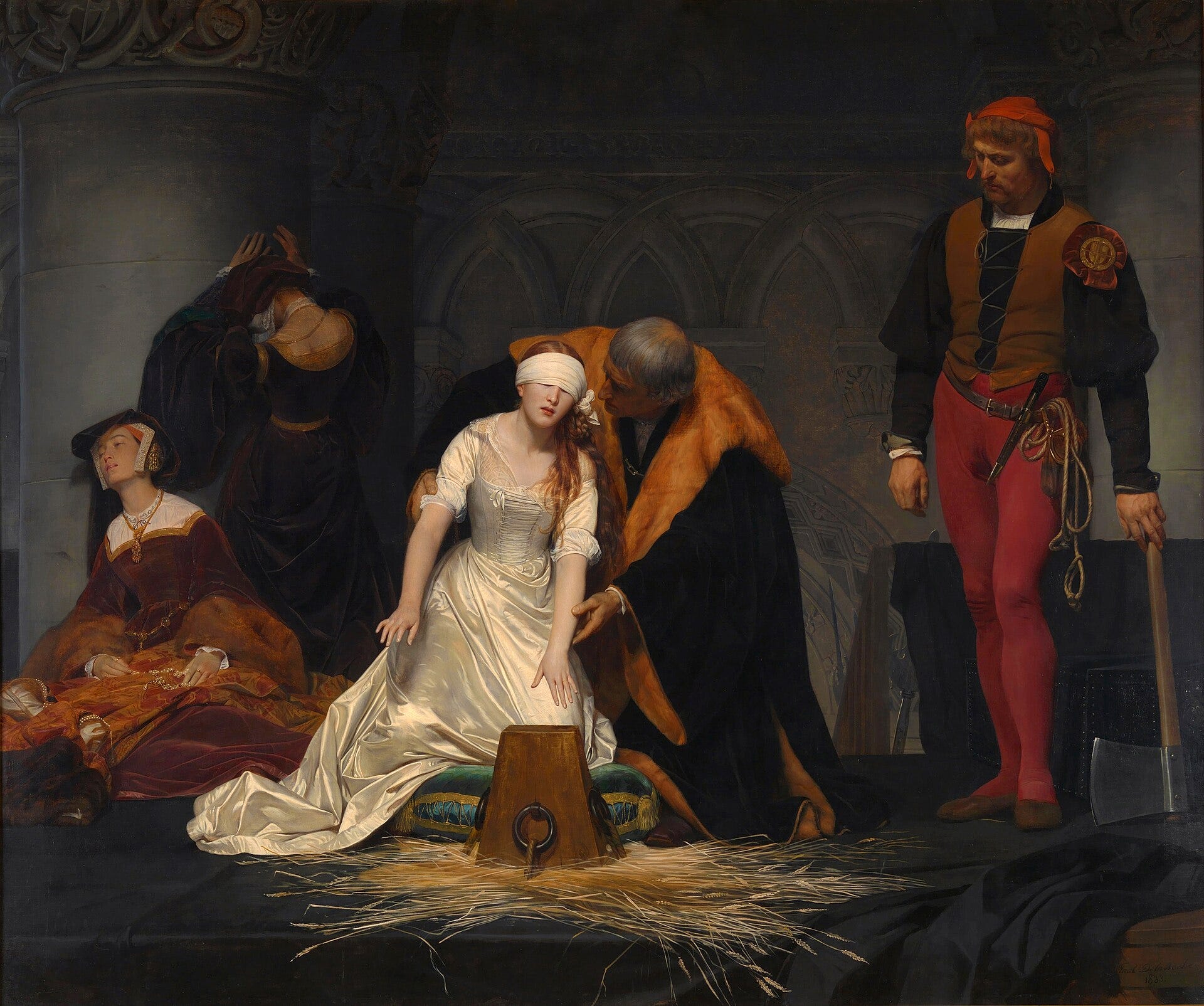
In 1833, Paul Delaroche painted Jane's last moment on a canvas almost ten feet wide. The lieutenant of the Tower, the officer in charge of the prison, guides her toward the block.
Two of Jane's ladies-in-waiting, the women who served her, cannot bear to watch. One has collapsed, holding the outer gown Jane took off before the execution. The other has turned to the wall. On the right, the executioner waits with his ax.
Delaroche showed the painting at the Salon of 1834, and crowds pushed forward to see it. At thirty-six, he was hailed as the leader of French history painting, the art of great scenes from the past.
How did a painter cheered by such crowds lose his public so completely that nobody went looking for his greatest picture?
In the rest of the story, you'll find out:
how the set builders of the Paris Opera helped Delaroche paint a scene that never happened
why the star of the Salon stopped showing his work there
who first claimed that Delaroche said "painting is dead," and what he really wrote about photography
who found the lost canvas under a table in 1973, and why nobody had unrolled it