
The peacock carries two meanings that flatly contradict each other. In early Christian art its flesh was believed not to rot, so it stands for eternal life. In Dutch painting the same bird, plucked and on a table, stands for pride about to be eaten.
The five second version
Early Christians painted peacocks on tombs because the flesh was thought to be incorruptible.
The hundred eyes in the tail belonged to Argus, the giant Hera set as a guard and Zeus had killed.
A whole London dining room was painted as a peacock scheme, and the owner and the painter never spoke again.
In Dutch pronk still life the peacock pie is the loudest possible way to say rich.
The feather is bad luck indoors in some countries, for the same reason it is holy in others.
Learn art the fun way
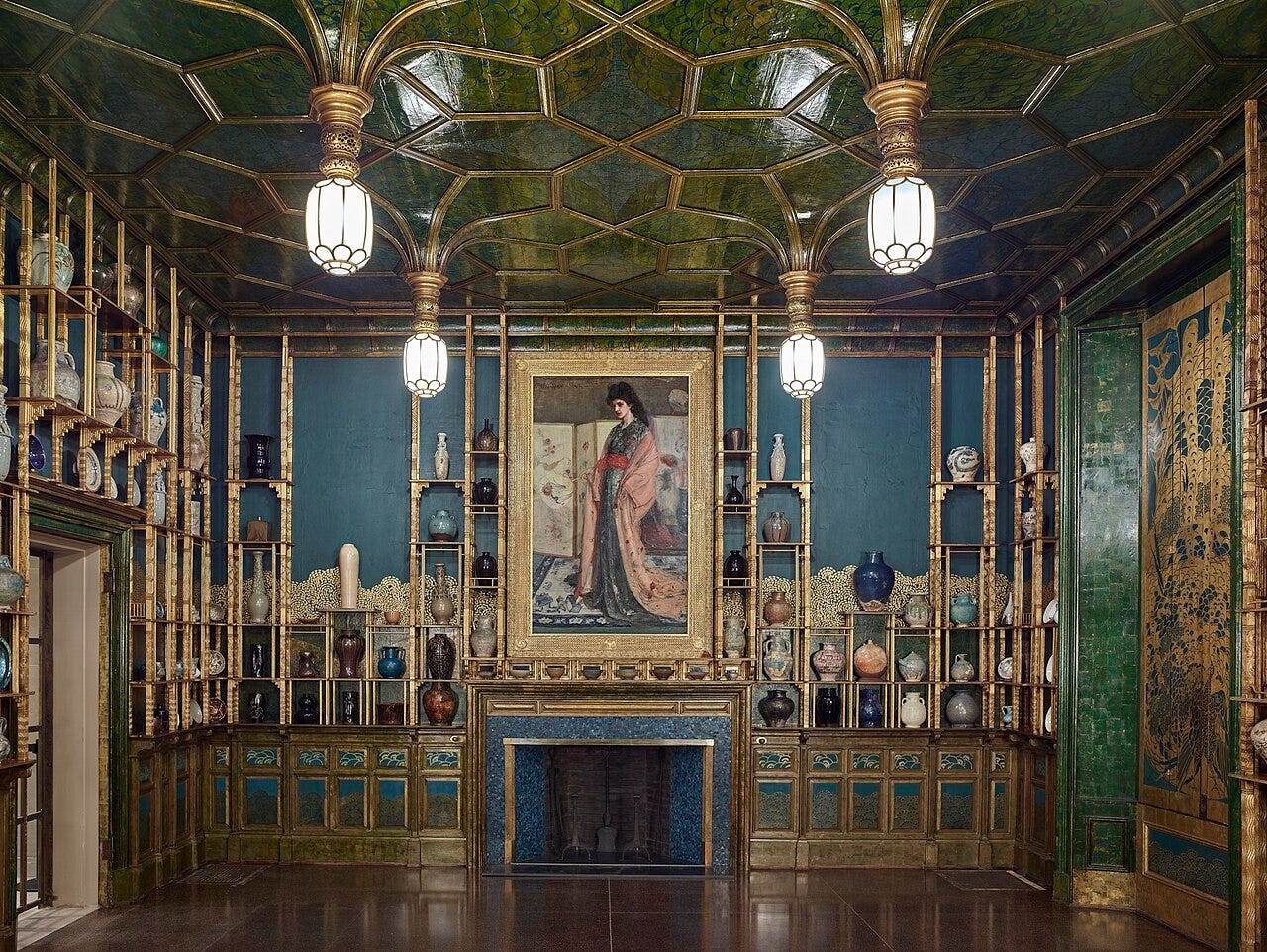
1 | The Peacock Room, James McNeill Whistler (1876 to 1877)
Whistler was asked to make small adjustments to a dining room in Kensington and repainted the entire thing in blue and gold, with fighting peacocks on the shutters.
The owner Frederick Leyland paid half the fee, and the two men never reconciled. More in James McNeill Whistler.
2 | Juno and the hundred eyes
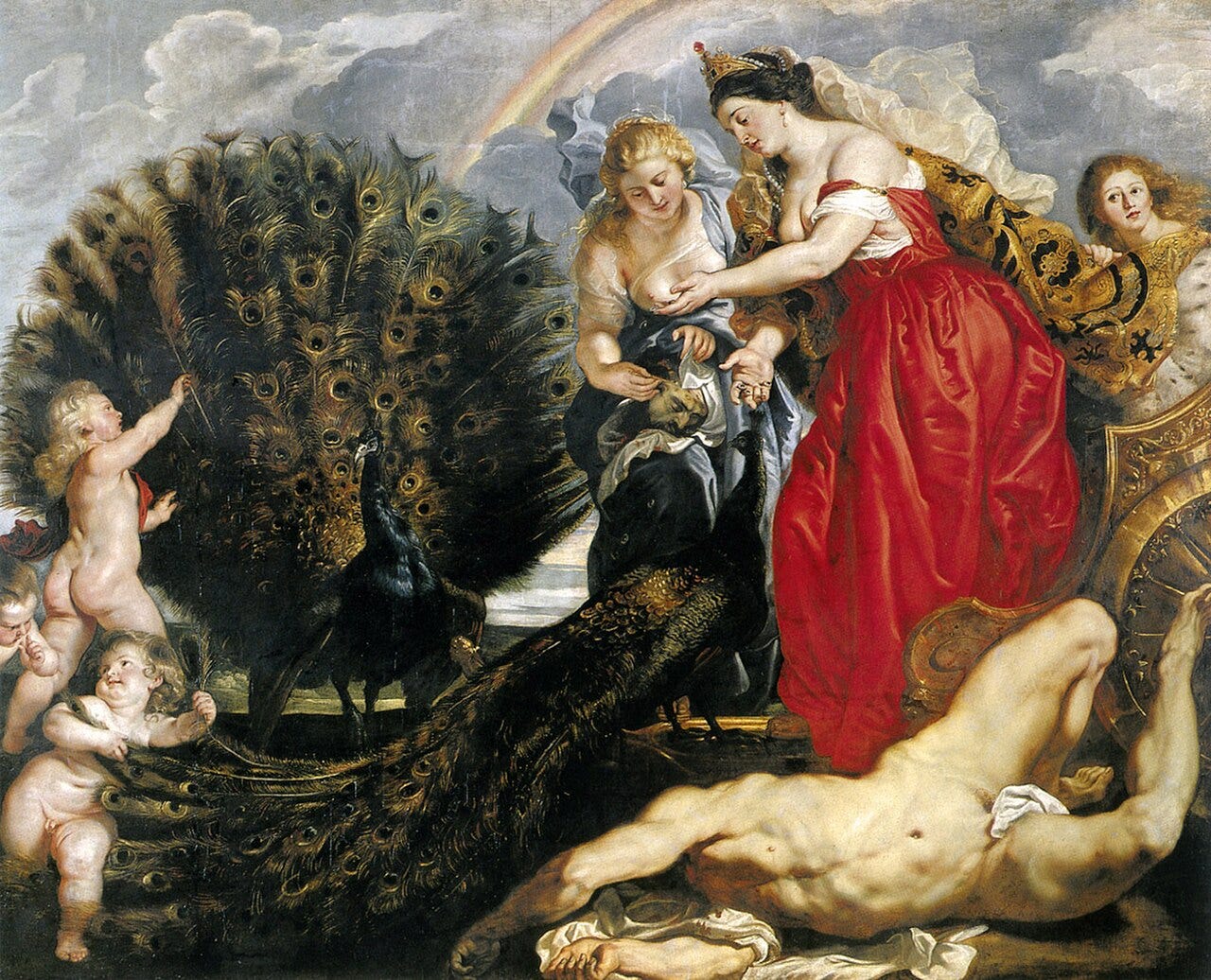
Hera set the giant Argus, who had a hundred eyes, to guard Io. Zeus sent Hermes to kill him, and Hera then moved the eyes into the peacock’s tail.
That is why a peacock at a goddess’s feet identifies her instantly. More in Greek mythology in painting.
3 | Peacock pie in the pronk still life
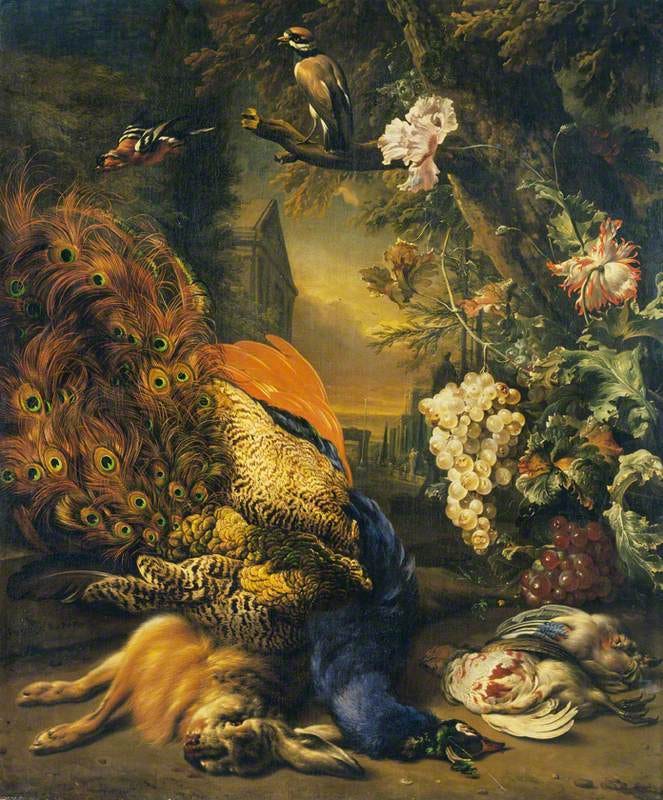
Dutch banquet pieces stage a roast peacock with its own feathers put back on, standing over silver and lemon peel. It is a boast and a warning in the same object.
More on the genre in what is still life painting.
The bird was skinned, roasted, then sewn back into its own plumage and served upright, sometimes with the beak gilded. It tasted poor, which everyone knew, and that was not the point.
4 | Peacocks on early Christian tombs
Catacomb painting and early mosaics put peacocks beside vines and fountains, on the strength of the belief that peacock flesh did not decay.
The reading system is set out in what is iconography.
Augustine wrote in the City of God that he had tested peacock flesh himself and found it did not rot. The claim is wrong, but it is why the bird appears on sarcophagi and in the mosaics of Ravenna.
5 | The peacock as pride
In series of the seven deadly sins, Pride rides or stands with a peacock. The bird was such a clear shorthand that no caption was needed.
You will find one in almost any Northern print cycle of the vices.
The seven deadly sins were usually given animal mounts, and Pride rides the peacock. Bruegel’s engraved Superbia of 1558 puts one in the foreground with a mirror, in case anyone missed it.
6 | Klimt and the ornament
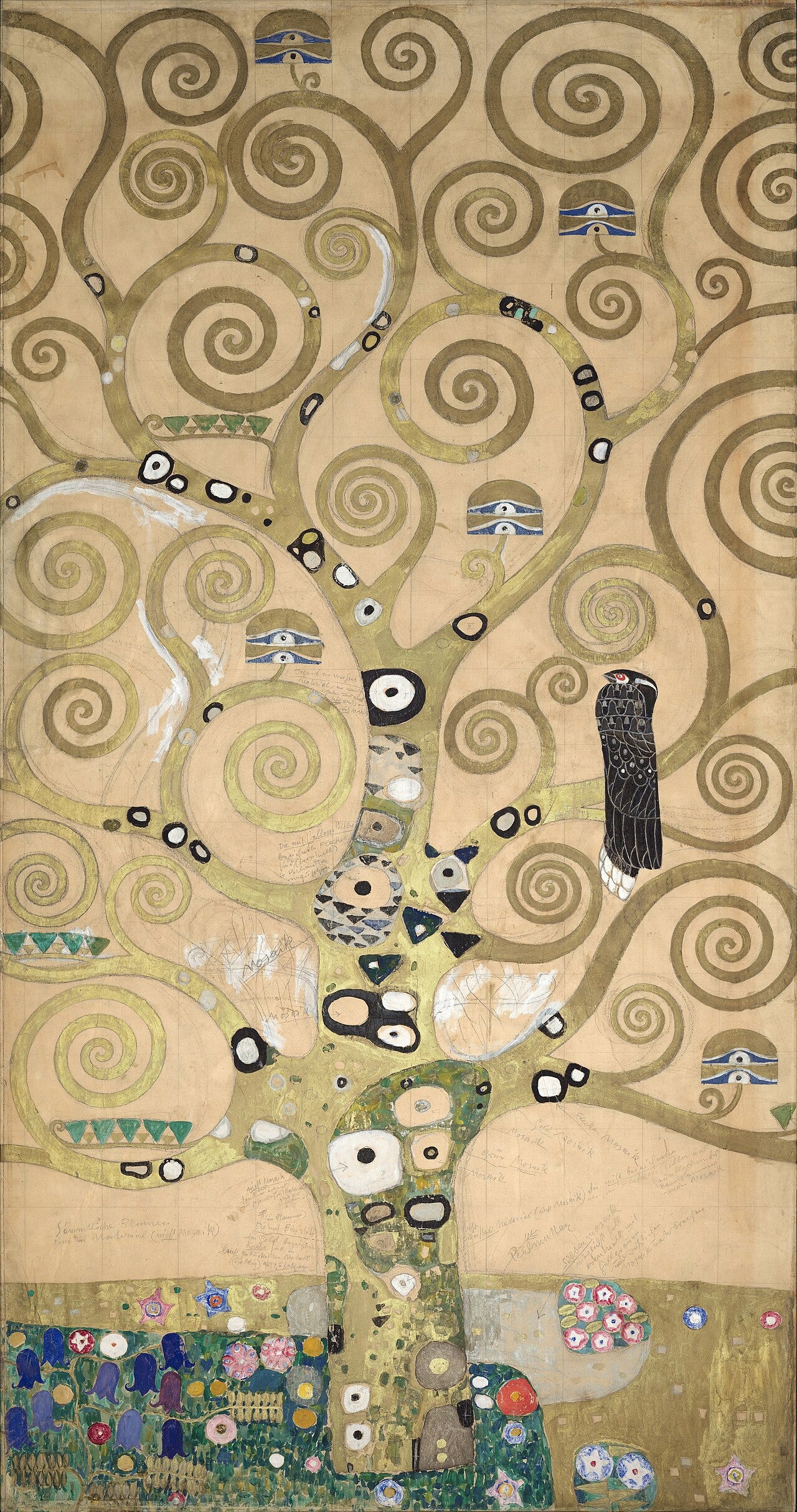
Klimt used peacock eyes as flat pattern rather than as narrative, spreading them across gold ground until the bird dissolves into decoration.
More on him in Gustav Klimt.
Klimt hides things in the gold. I point some of them out in 7 secrets hidden in famous paintings.
7 | Mughal and Persian peacocks
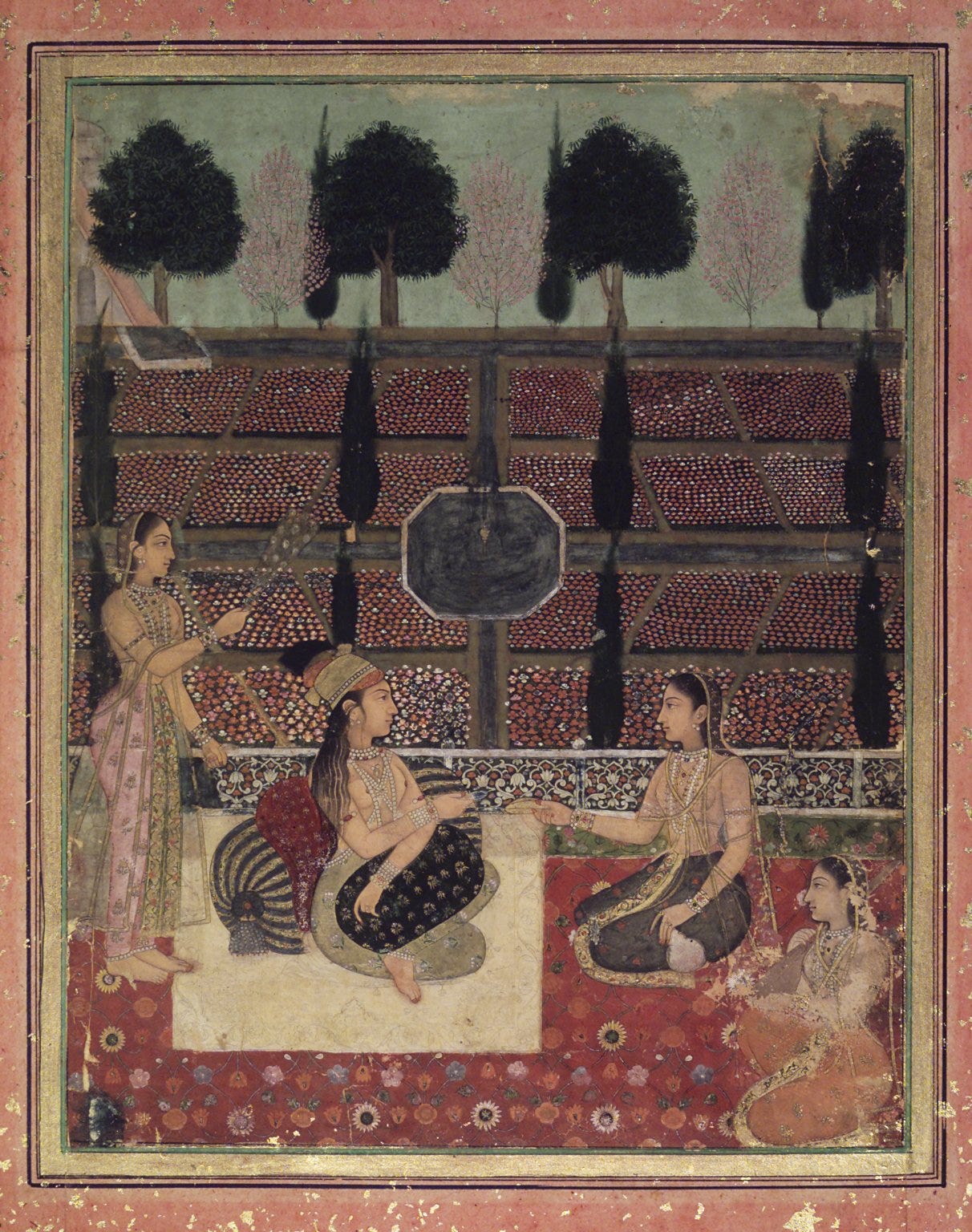
In Mughal painting the peacock is a garden bird and a royal sign, and the Mughal throne itself was called the Peacock Throne, taken from Delhi in 1739.
More on the format in what is miniature painting.
The Peacock Throne was built for Shah Jahan and took seven years, finished around 1635. Nader Shah carried it off from Delhi in 1739 and it was broken up after his assassination.
8 | Peacocks in Art Nouveau
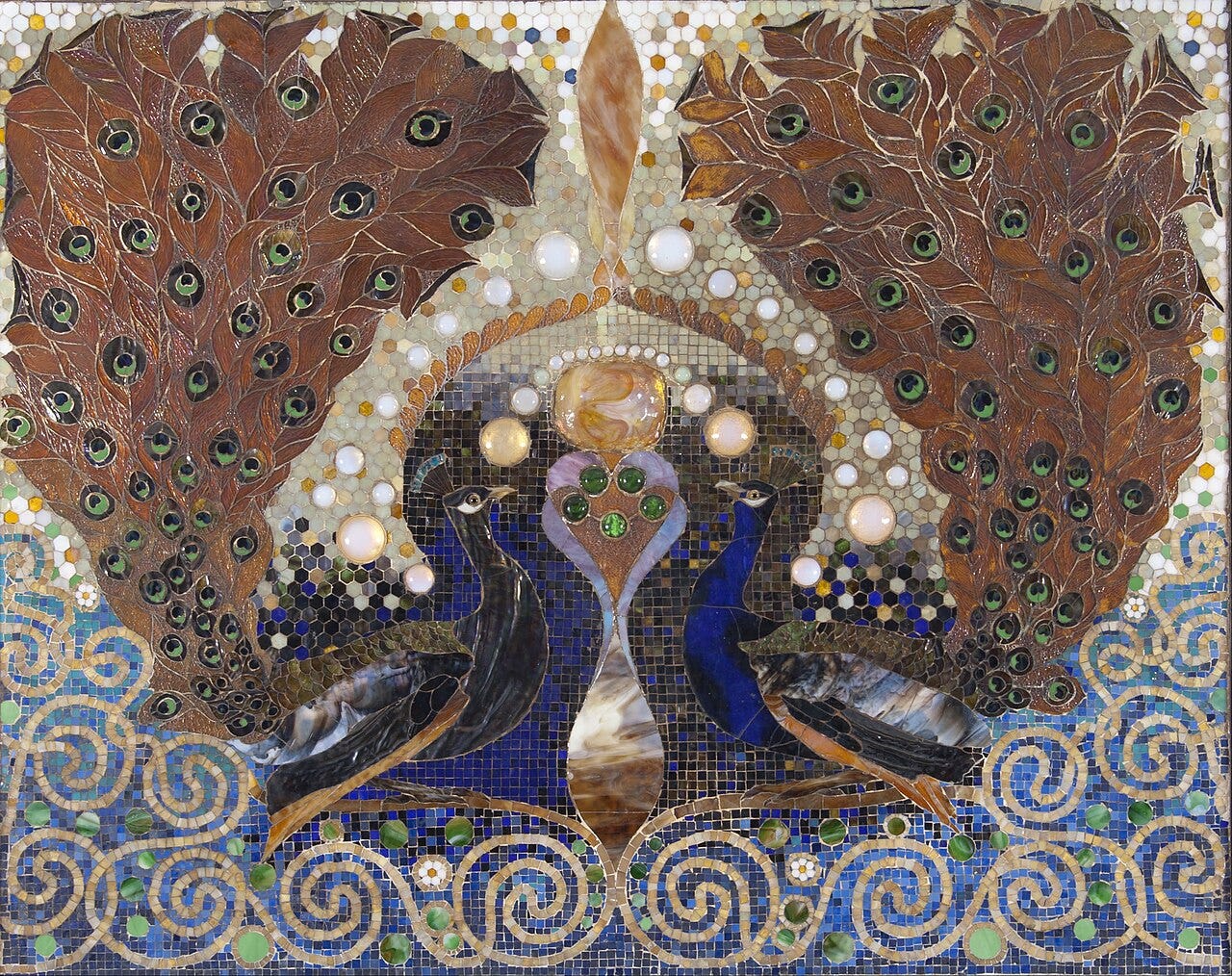
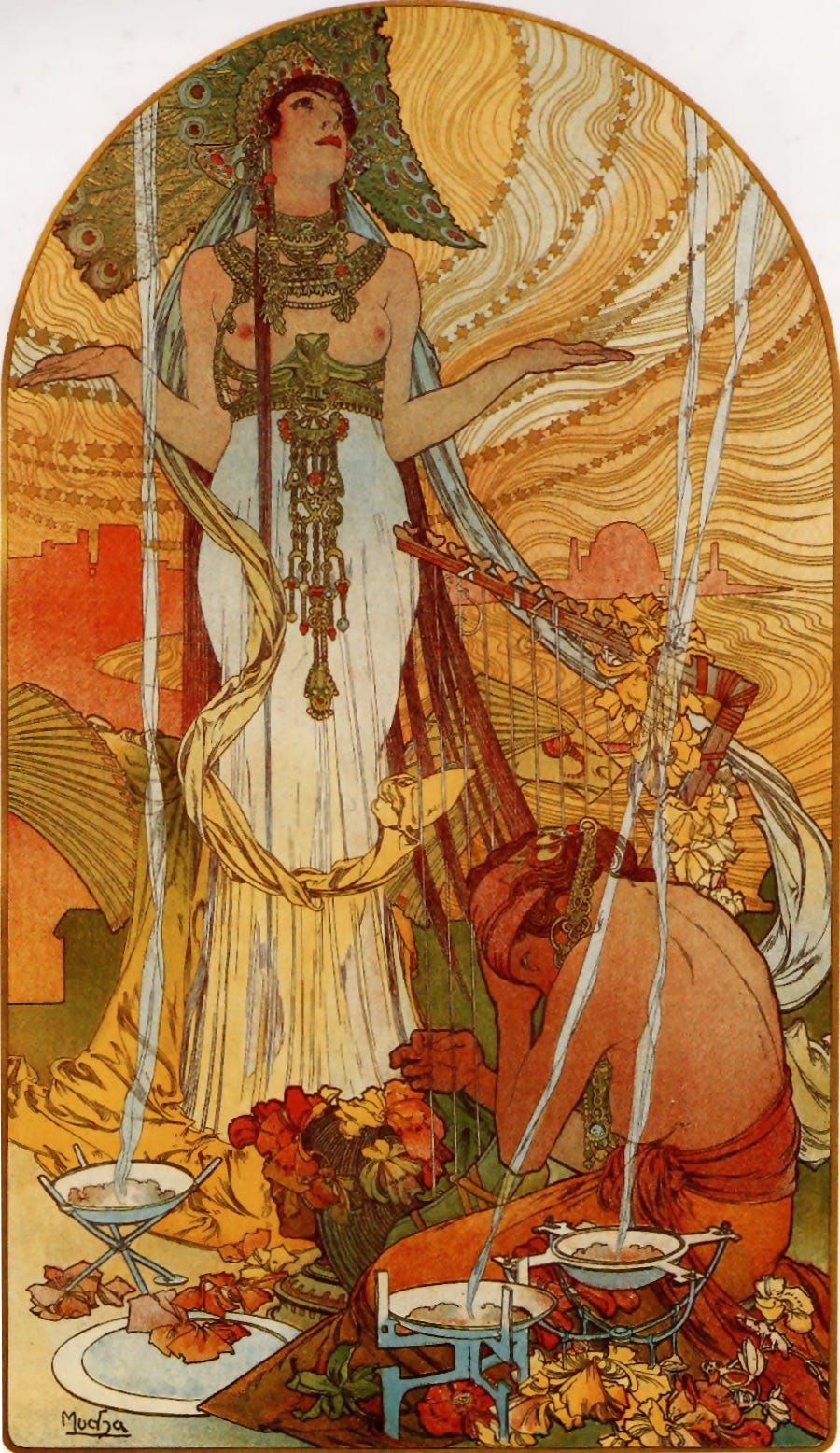
Around 1900 the feather became a design unit: on Tiffany glass, on Liberty fabrics, on posters and on book covers, stripped of any moral reading.
More on that world in Alphonse Mucha.
Tiffany used the feather as an iridescent glass motif from the 1890s, and Liberty of London sold peacock printed silks. The pattern travels from Japan through Whistler into commercial design in about twenty years.
9 | The feather in the eye
Painters loved peacock feathers because they let a person show off two hard things at once: iridescence and repeated pattern that must stay in perspective.
The colour is not pigment. It comes from the structure of the feather bending light.
The colour is structural. Microscopic melanin rods in the barbules interfere with light, so the blue changes with the angle you stand at and disappears in powder form.
10 | The unlucky feather
In parts of Europe and in the theatre it is unlucky to bring peacock feathers indoors, on the argument that the eye is the evil eye watching.
The same eye that means eternal life on a tomb means bad luck in a hallway.
11 | Peacocks in the garden portrait
Eighteenth century country house portraits use a peacock on the terrace the way a modern photograph uses a car in the drive.
It is land, leisure and imported animals in one bird.
12 | Why the bird works so well
A peacock gives a painter a whole palette in one object, and gives a moralist a whole sermon. Very few things in nature do both.
Look at whether the tail is open. Open means display, closed means something else is going on.
Five things people get wrong about peacocks
What does a peacock symbolise in art? Eternal life in early Christian imagery, because the flesh was thought not to decay, and pride or vanity in later European painting.
Why does the tail have eyes? In Greek myth Hera set Argus to guard Io, Zeus had Hermes kill him, and Hera moved his hundred eyes into the peacock’s tail.
What is the Peacock Room? A dining room Whistler repainted entirely in blue and gold between 1876 and 1877, now reinstalled at the Freer Gallery in Washington.
Are peacock feathers unlucky? In parts of Europe and in theatre superstition, yes, because the eye is read as the evil eye.
Where is The Peacock Room today? The Freer Gallery for the Peacock Room, the Rijksmuseum for Dutch banquet pieces, Ravenna for early mosaics.
Peacock feathers have almost no blue pigment. The colour comes from microscopic structures splitting light, which means every painter who copied that blue was inventing it.
Both of these hold far more of it than any list can: the Met and the Rijksmuseum.