
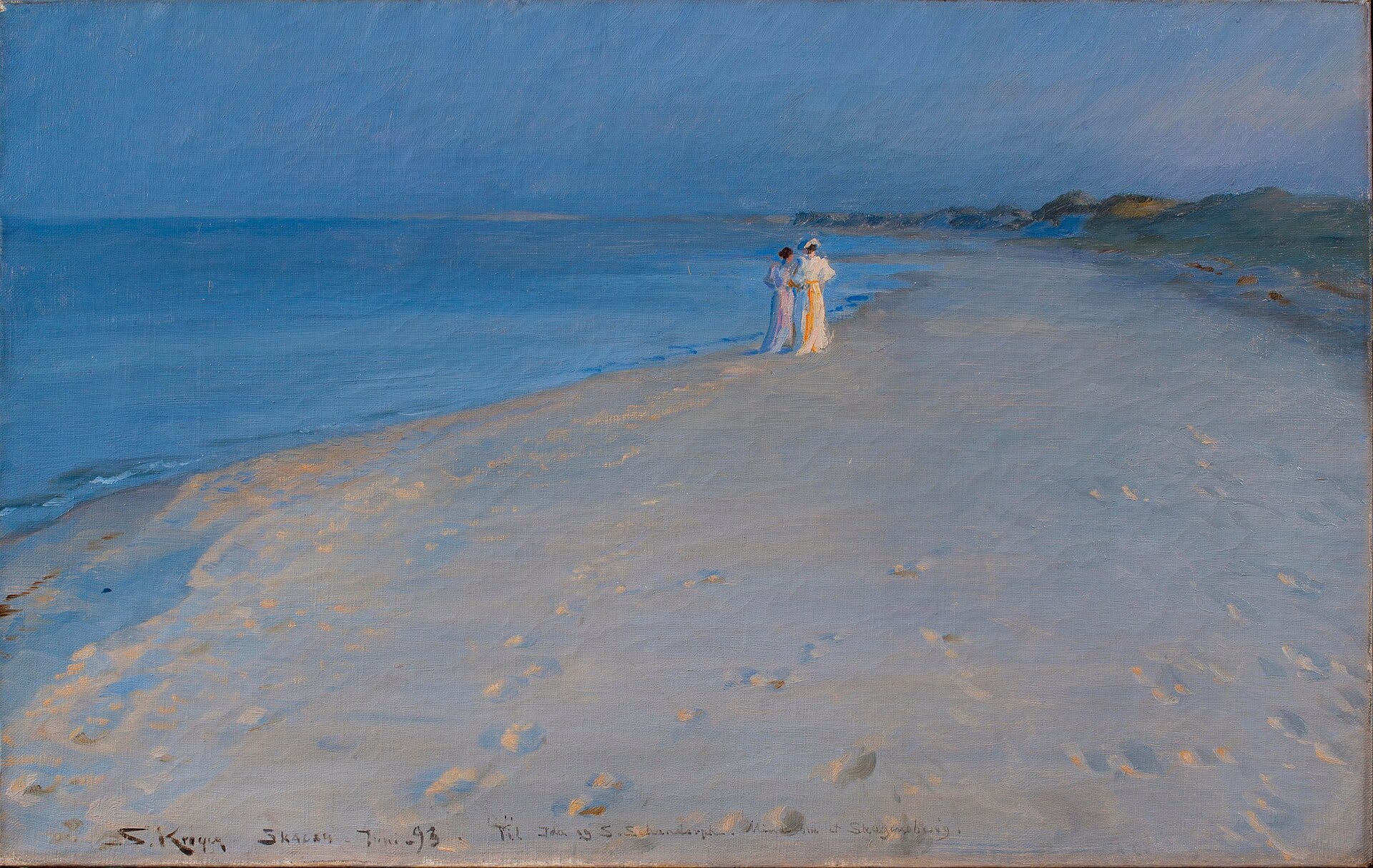
Peder Severin Krøyer (1851 to 1909) was the most talked-about Danish painter of his time. He painted Skagen, a fishing village at the northern tip of Denmark: the sunlit toast of Hip, Hip, Hurrah! and the blue dusk of Summer Evening on Skagen's Southern Beach.
Cool Stories About Art is a newsletter to learn art the fun way.
Join 200,000+ readers and get:
10 new art stories / month
The entire archive of content (140+ articles)
Comment, ask questions, and chat with other readers
Krøyer painted summer as a party: friends raising their glasses in a sunny garden, his wife Marie walking on the beach at dusk. His last party, a bonfire on the beach of Skagen, was begun in 1892 and finished only in 1906, in the hardest years of his life.
Peder Severin Krøyer was born on July 23, 1851, in Stavanger, a port on the west coast of Norway. His mother, Ellen Cecilie Gjesdal, was not married, and she was too ill to raise him.
The baby was taken to Copenhagen, the capital of Denmark, and raised by his mother's sister, Bertha, and her husband, Henrik Nikolai Krøyer, a zoologist, a scientist who studies animals. The boy took his uncle's name.
In 1864, while still a boy, Krøyer entered the Royal Danish Academy of Fine Arts, the official art school of the country. At nineteen, he had finished his studies.
His first buyer was Heinrich Hirschsprung, a tobacco manufacturer who collected Danish art. In 1874, Hirschsprung bought four of the young painter's watercolors, all of them pictures of fishermen. He remained Krøyer's friend for more than thirty years.
Hirschsprung's money helped send Krøyer across Europe for four years, from 1877. In Paris, the young Dane studied with the portrait painter Léon Bonnat and saw the work of the Impressionists, the new French painters of light and open air.
On the way, Krøyer painted people at work: the workers of a sardine cannery in Brittany, in western France, then the hat makers of an Italian village.
In June 1882, Krøyer arrived in Skagen for the first time. More than half of the villagers lived from fishing, and painters had been coming for a few years to paint them at work on the long beaches.
The painters stayed at Brøndum's, a family inn that later grew into a hotel. Anna, the innkeeper's daughter, was a painter herself, married to another painter, Michael Ancher. Krøyer joined their circle and came back to Skagen almost every summer for the rest of his life.
Why did the painter of Skagen's happiest summers need fourteen years to finish one last party?
In the rest of the story
Which friends Krøyer called back to Skagen, one by one, to pose for him.
Which summer evening gave Krøyer the idea for his most famous painting.
Whom Krøyer painted beside a fishing boat at the back of his bonfire scene.
What Krøyer founded with his friends at the village inn in 1908.