Six seeds. That is the whole accounting.
Persephone ate six pomegranate seeds in the underworld, and in the most commonly cited version of the myth, each seed cost her one month below ground every year. Six seeds, six months with Hades, six months on earth. Spring arrives when she does.
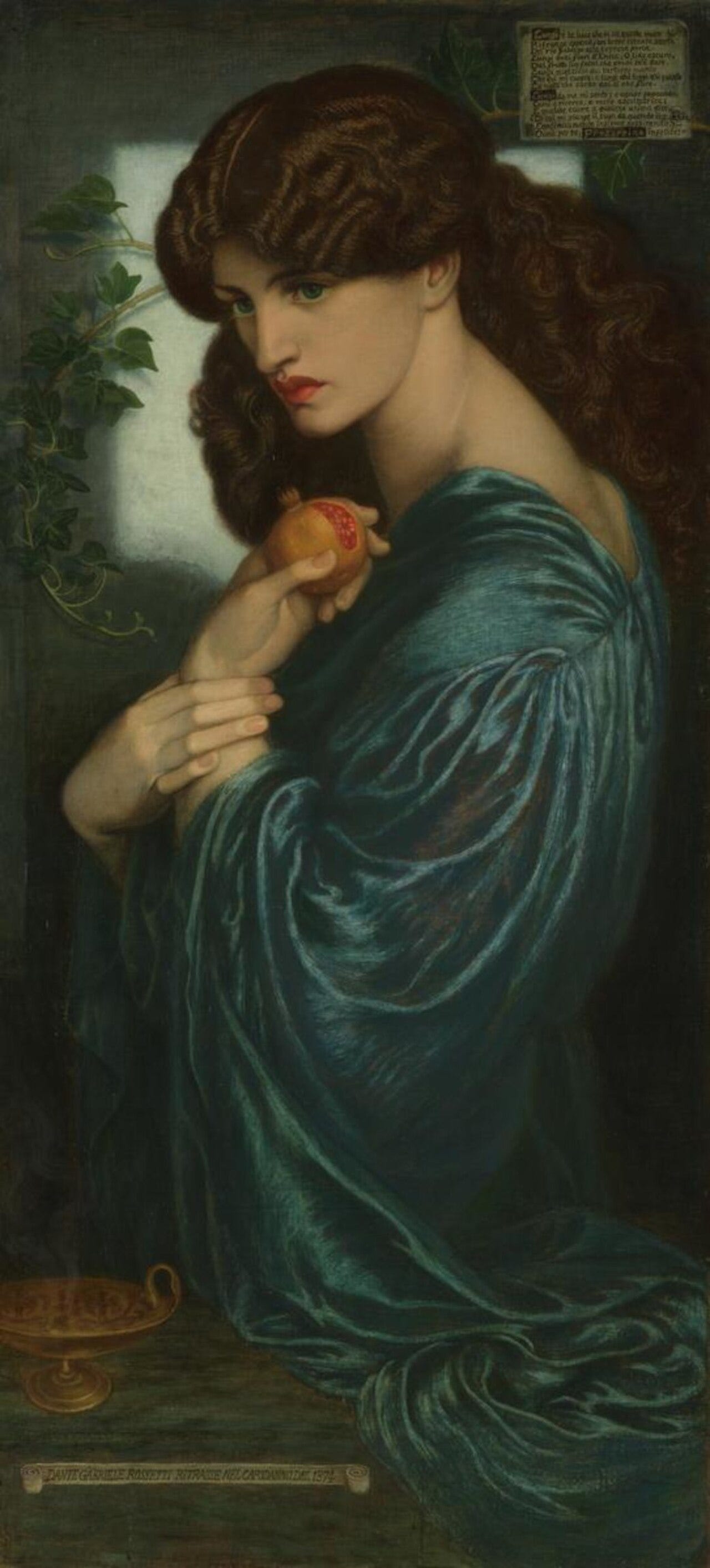
The two defining paintings of the Persephone myth are Dante Gabriel Rossetti's Proserpine (1874, Tate Britain), where the sliced pomegranate marks her captivity as Empress of the Underworld, and Rembrandt's The Abduction of Proserpina (circa 1631, Gemaldegalerie, Berlin), which shows the violent kidnapping itself.
Between those two canvases sits the entire arc of the story: the moment she is taken, and the long aftermath of what she ate.
Rossetti's Proserpine: eight versions of the same prisoner
Rossetti painted Proserpine at least eight times between 1871 and 1882, the year he died. The 1874 version in Tate Britain is the best known.
He uses her Roman name, Proserpine, and he skips the abduction entirely. She stands in a gloomy corridor of her palace in the underworld, pensive, holding a pomegranate that has already been partly sliced. The fruit is the whole plot in one object. She ate it, so she stays.
Rossetti designed the frame himself. Its roundels, the circular carved details, are shaped to resemble a cross section of a pomegranate, so the frame repeats the fruit she holds inside the picture.
One more decision ties it together. The color of the pomegranate flesh is matched to the color of her lips. The thing that trapped her and the mouth that ate it share the same red.
Rembrandt's Abduction of Proserpina: the fight Ovid left out
Two and a half centuries earlier, around 1631, a young Rembrandt painted the other end of the story on an oak panel. The Abduction of Proserpina now hangs in the Gemaldegalerie in Berlin.
It is considered one of the earliest significant depictions of the abduction scene in Northern European painting. And it refuses the calm that earlier treatments allowed.
Ovid describes a more passive abduction. Rembrandt paints a real physical struggle: Hades drives his chariot away while Persephone fights back and tries to push him off. She is not draped decoration on the arm of a god. She is losing a fight and still fighting it.
The myth in full
Persephone, called Proserpina by the Romans, was the daughter of Demeter and Zeus. She was gathering flowers when Hades, god of the underworld, abducted her. In most versions Zeus had given his prior consent, and Demeter knew nothing.
Demeter searched for her daughter. In grief and anger, the goddess of the harvest caused crops to fail across the earth.
Zeus intervened and ordered Hades to release her. But Persephone had eaten six pomegranate seeds, and eating the food of the underworld bound her to it. A compromise was struck: six months below with Hades, six months on earth with her mother.
This was the ancient Greek explanation for the seasons. Demeter lets the earth flourish when her daughter is with her, and lets it lie barren in grief during the months Persephone is below. Every spring is a homecoming.
How to read any Persephone painting
Across centuries of painting, one object identifies her more reliably than anything else: the pomegranate, whole or sliced, in her hand or nearby. Find the fruit and you have found Persephone.
Then look at what is happening. A chariot, a struggling woman, a male figure driving her away: that is the abduction moment, Rembrandt's type.
A solitary figure, static, indoors, with the pomegranate as the focus and no action at all: that is the captivity moment, the queen of the underworld, Rossetti's type. The first scene shows the crime. The second shows the sentence.
FAQ
Why does Persephone eat the pomegranate seeds?
The myth holds that anyone who eats the food of the underworld is bound to it. In the most commonly cited version, Persephone ate six seeds, which is why she must spend six months of each year with Hades, one month per seed.
What is the difference between Persephone and Proserpina?
They are the same goddess. Persephone is her Greek name, Proserpina her Roman one. Rossetti used the Roman form, Proserpine, for his paintings.
Why did Rossetti paint Proserpine so many times?
He returned to the subject at least eight times between 1871 and 1882, the year of his death. The 1874 oil version, now in Tate Britain, is the best known of the group.
Where is Rembrandt's Abduction of Proserpina?
In the Gemaldegalerie in Berlin. It was painted around 1631, in oil on an oak panel, early in Rembrandt's career.
One number to remember
Rossetti painted at least eight versions of Proserpine between 1871 and 1882. He was still returning to the woman with the pomegranate in the last year of his life.