Perseus and Andromeda in Painting: Titian to Rembrandt

Every painter who takes on this myth faces the same decision before the first brushstroke. Do you show the whole rescue in motion, hero, monster, and captive all at once, or do you strip everything away and paint only the girl chained to the rock?

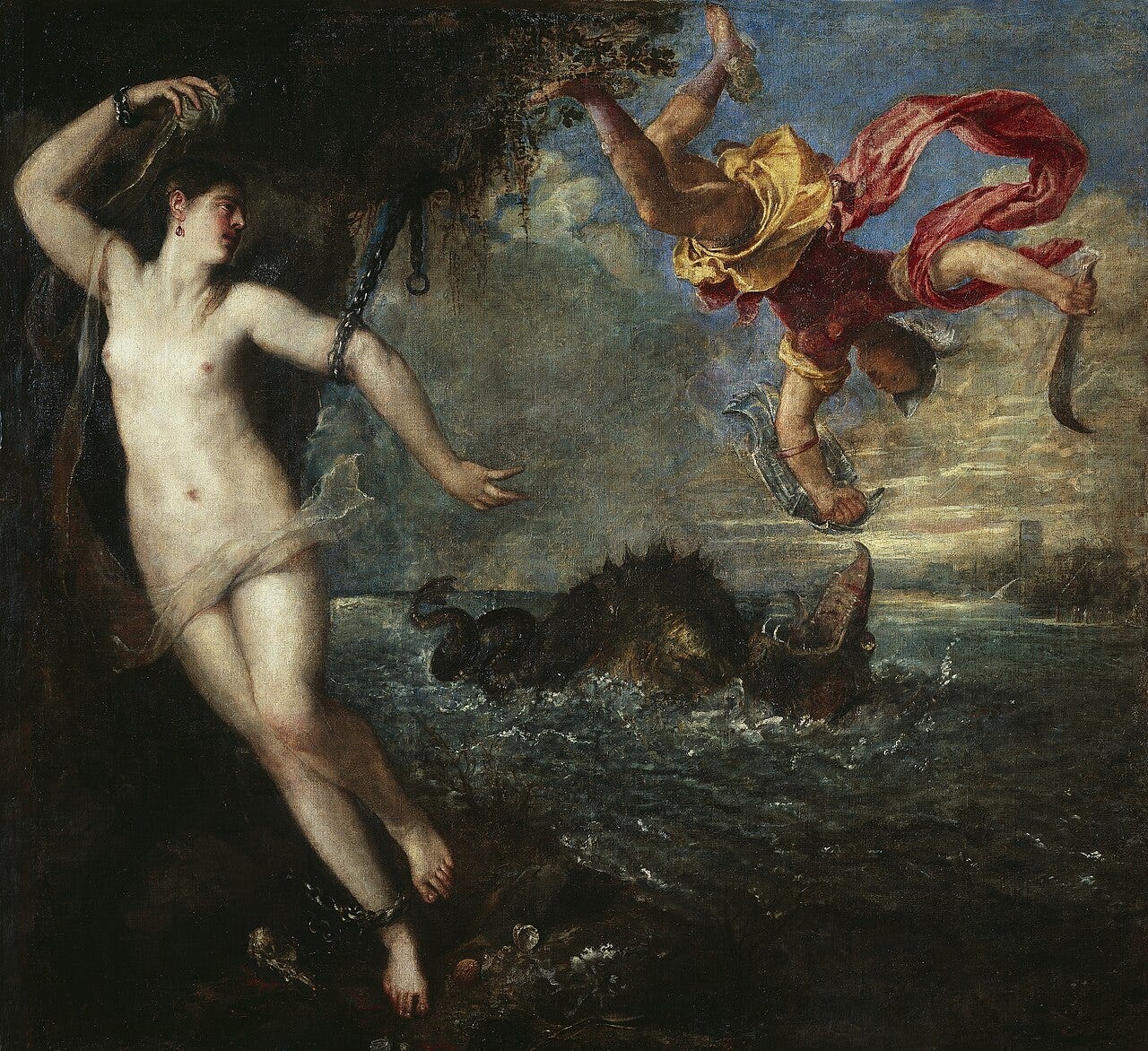
Titian's Perseus and Andromeda, Perseus diving through the air at the sea monster
Titian, Perseus and Andromeda, 1554 to 1556, Wallace Collection, London

Titian, Rembrandt, and Edward Burne-Jones each answered that question differently. Their three solutions map out almost everything painting can do with a story.

The two most contrasting approaches are Titian's Perseus and Andromeda (1554 to 1556, Wallace Collection, London), which compresses the entire rescue into one airborne action scene, and Rembrandt's Andromeda Chained to the Rocks (circa 1630, Mauritshuis, The Hague), which shows Andromeda alone, with no hero and no monster.

Titian: The Whole Rescue in One Frame

Titian's version is pure action. Perseus dives through the air on the winged sandals given to him by Hermes, weapon raised, attacking the sea monster sent to kill Andromeda.

She is chained to a rocky cliff by the sea, placed there as a sacrifice, watching her own rescue unfold.

The painting belongs to Titian's poesie, a series of large mythological canvases made for King Philip II of Spain between the 1550s and 1560s. Titian treated these as painted poems, and this one reads like the climax of the story delivered in a single image.

Rembrandt: Andromeda Alone

Rembrandt's Andromeda chained and terrified, with no Perseus or monster in the frame
Rembrandt van Rijn, Andromeda Chained to the Rocks, about 1630, Mauritshuis, The Hague

Around 1630, Rembrandt made the opposite choice. His small oil on panel shows only Andromeda, chained and terrified.

No Perseus. No sea monster. Nothing to reassure the viewer that rescue is coming.

By cutting the hero out of the frame, Rembrandt shifts the entire subject of the painting. It stops being about heroics and becomes about fear, a young woman alone at the moment she believes she is going to die.

That isolation of a single emotional figure, rather than a staged narrative, is characteristic of how Rembrandt approached mythological subjects in general.

New here? Learn art the fun way. Free stories every week, no boring lectures.

Burne-Jones: The Rescue in Two Paintings

Piero di Cosimo's Perseus rescuing Andromeda, the crowd watching from the shore
Piero di Cosimo, Perseus Freeing Andromeda, about 1510 to 1513, Uffizi Gallery, Florence

The British Symbolist Edward Burne-Jones (1833 to 1898) found a third answer. His Perseus Cycle, an extended series originally planned as ten works for a patron's house, tells the whole Perseus story across multiple canvases.

For the rescue of Andromeda, he refused to choose between emotion and action. He split the episode into two separate paintings.

The first shows Perseus discovering the chained, forsaken Andromeda. The second, painted separately, shows his battle with the sea monster.

Where Titian compresses the whole rescue into one dynamic composition, Burne-Jones treats the discovery and the combat as two different pictorial subjects. The quiet meeting gets its own canvas, and so does the fight.

The Myth Behind the Paintings

Andromeda was the daughter of King Cepheus and Queen Cassiopeia of Aethiopia. Cassiopeia boasted that her daughter, or in some versions she herself, was more beautiful than the Nereids, the sea nymphs.

The boast angered Poseidon. He sent a sea monster, Cetus, to ravage the coast, and an oracle declared there was only one remedy: Andromeda had to be sacrificed to the monster, chained to a rock by the sea.

Perseus was flying home on the winged sandals of Hermes, fresh from killing Medusa, when he spotted her. He fell in love at first sight, fought and killed the monster, and freed her.

They married. The rescue that painters keep returning to is also the beginning of a wedding.

How to Recognize a Perseus and Andromeda Scene

Ingres's knight on a hippogriff rescuing a chained nude, an Andromeda type scene
Jean Auguste Dominique Ingres, Roger Delivering Angelica, 1819, Musee du Louvre, Paris

The core identifier is simple: a nude or partly nude woman chained to a rock or cliff face by the sea. That chained pose is the near universal signature of the subject, and it separates Andromeda at a glance from scenes like Diana and Actaeon, where multiple figures bathe together.

Then check who else is in the frame.

If a winged or airborne male figure appears, or a sea monster rises from the water, you are looking at the rescue itself. That is Titian's type.

If Andromeda appears alone, chained, with no monster and no hero visible anywhere, the painting isolates her ordeal. That is Rembrandt's type, and its subject is her fear rather than her rescue.

FAQ

How does Perseus and Andromeda connect to the Medusa myth?

Directly. Perseus was flying home after killing Medusa when he spotted Andromeda chained to the rock. The winged sandals of Hermes, which made the Medusa mission possible, are the same sandals that carry him into the rescue, which is why painters like Titian show him attacking from the air.

Where can I see Titian's Perseus and Andromeda?

At the Wallace Collection in London. It is an oil on canvas painted between 1554 and 1556 as part of the poesie series for King Philip II of Spain.

Where is Rembrandt's Andromeda?

At the Mauritshuis in The Hague. It is an oil on panel from circa 1630, sometimes titled Andromeda Chained to the Rocks and sometimes simply Andromeda.

Why is Andromeda always chained to a rock?

Because the chains are the plot. An oracle declared that sacrificing Andromeda to the sea monster was the only way to end Poseidon's punishment, so she was bound to a rock by the sea. The chained figure became the visual shorthand painters used to identify the whole story.

Enjoyed this? Join the readers who learn art the fun way, free every week.

Titian's Perseus and Andromeda hangs today in the Wallace Collection, London, one of the poesie painted for King Philip II of Spain between 1554 and 1556.

Related reading