Pietro Perugino: The Complete Story

Pietro Perugino was the serene master of the Umbrian Renaissance and the teacher who shaped Raphael. His paintings are calm, balanced and gentle, sweet faced saints standing in airy, perfectly ordered space under soft skies.

That clear, harmonious style passed straight to his star pupil and helped define the High Renaissance.

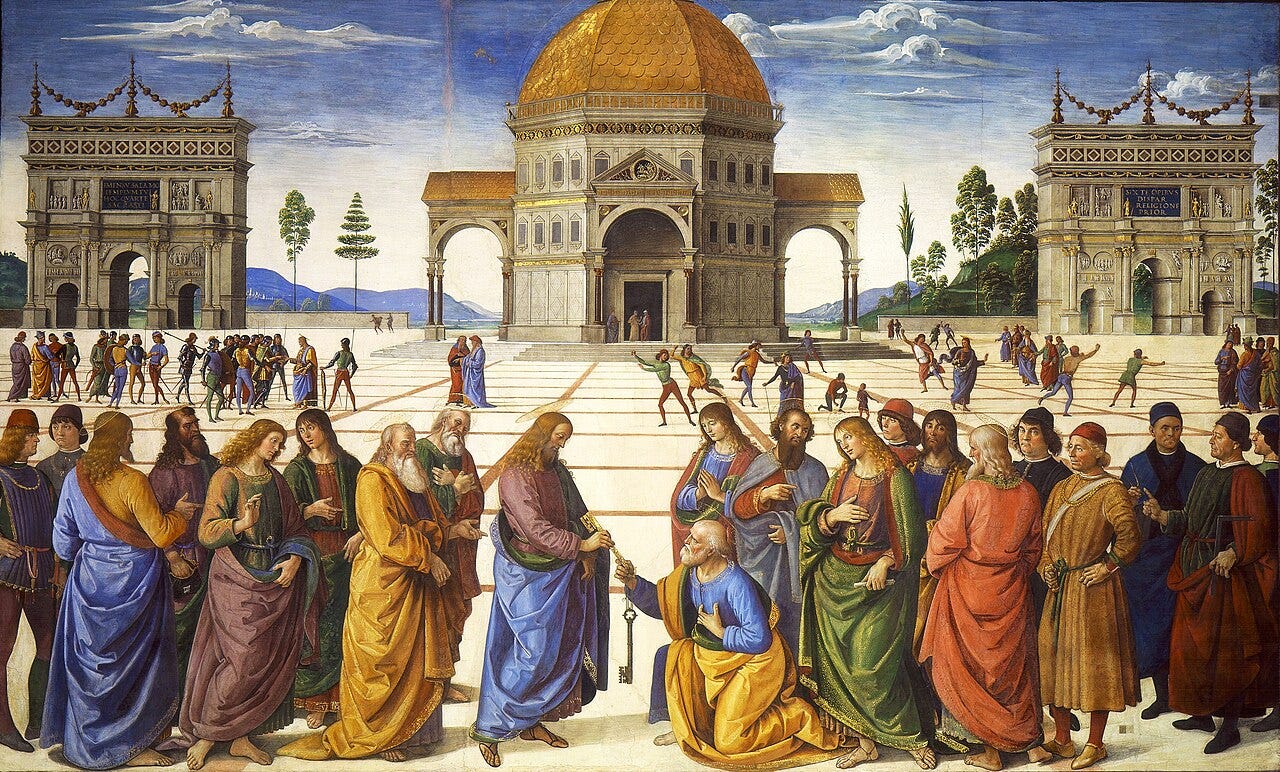
Delivery of the Keys by Perugino
Pietro Perugino, Delivery of the Keys to Saint Peter, 1481 to 1482.

He painted a wall of the Sistine Chapel decades before Michelangelo touched the ceiling.

  • Born: near Perugia, Italy, around 1446

  • Known for: serene Umbrian style, teaching Raphael, calm balanced space

  • Died: Fontignano, Italy, 1523


Hooked on Pietro Perugino? Get more art secrets and stories in your inbox, free.


For the long version

Three that take a single painting apart, properly:


Calm, space and sweetness

Perugino's gift was serenity. He arranged figures with gentle symmetry in deep, clear landscapes, leaving generous quiet air around them. Everything feels settled and at peace. See what is renaissance art.

His Delivery of the Keys to Saint Peter sets the scene in a wide, sunlit piazza built on careful perspective, a model of balance that painters studied for generations.

The wall before the ceiling

Assumption of the Virgin by Perugino
Pietro Perugino, Assumption of the Virgin.

In the early 1480s, long before Michelangelo, Perugino was one of the leading painters called to decorate the walls of the Sistine Chapel. His frescoes there were among the most admired in Rome. See what is fresco painting.

Some of his work was later destroyed to make room for Michelangelo's Last Judgement, a quiet symbol of how taste moved on from his gentle calm to a fiercer drama.

The teacher of Raphael

Devotional panel by Perugino
Pietro Perugino, a devotional panel.

Perugino ran a busy, successful workshop, and the young Raphael trained in it. Early Raphael can be hard to tell from his master, the same sweetness, the same balance. See what is oil painting.

Raphael absorbed everything Perugino knew about space and grace, then carried it to new heights. The pupil outgrew the teacher, but the foundations were Perugino's.

The workshop run like a business

Perugino ran his art like an enterprise, keeping busy workshops in both Perugia and Florence and reusing the same graceful poses and cartoons across many commissions to keep up with demand.

That efficiency made him rich but later fed the charge that he repeated himself. His frescoes in the bankers hall of Perugia, the Collegio del Cambio, include a proud self portrait set into the wall, the confident face of a man at the top of his trade.

Pietro Perugino, your questions answered

Composition by Perugino
Pietro Perugino, a Renaissance composition.

What is Pietro Perugino famous for?

Serene, balanced Umbrian Renaissance paintings and for teaching Raphael.

Did he work on the Sistine Chapel?

Yes, he painted admired frescoes on its walls in the 1480s, before Michelangelo's ceiling.

How is he linked to Raphael?

Raphael trained in his workshop and absorbed his calm, harmonious style.

When did he die?

In 1523, in the Umbrian countryside, during an outbreak of plague.

Why the calm still counts

Late in life Perugino was mocked as old fashioned and repetitive, recycling the same sweet poses while more daring painters surged ahead.

Yet without his clear, peaceful order there is no Raphael as we know him, which makes the gentle Umbrian one of the quiet foundations of the whole Renaissance.


Read by 110,000 people who love a good art story. Join free.


One last detail. His Umbrian home city of Perugia honours him in its very streets: the heart of the town, the Corso, and a grand fountain area sit near where his calm frescoes still glow in the old bankers hall he decorated.


Learn art the fun way. Get the next story in your inbox, free.