
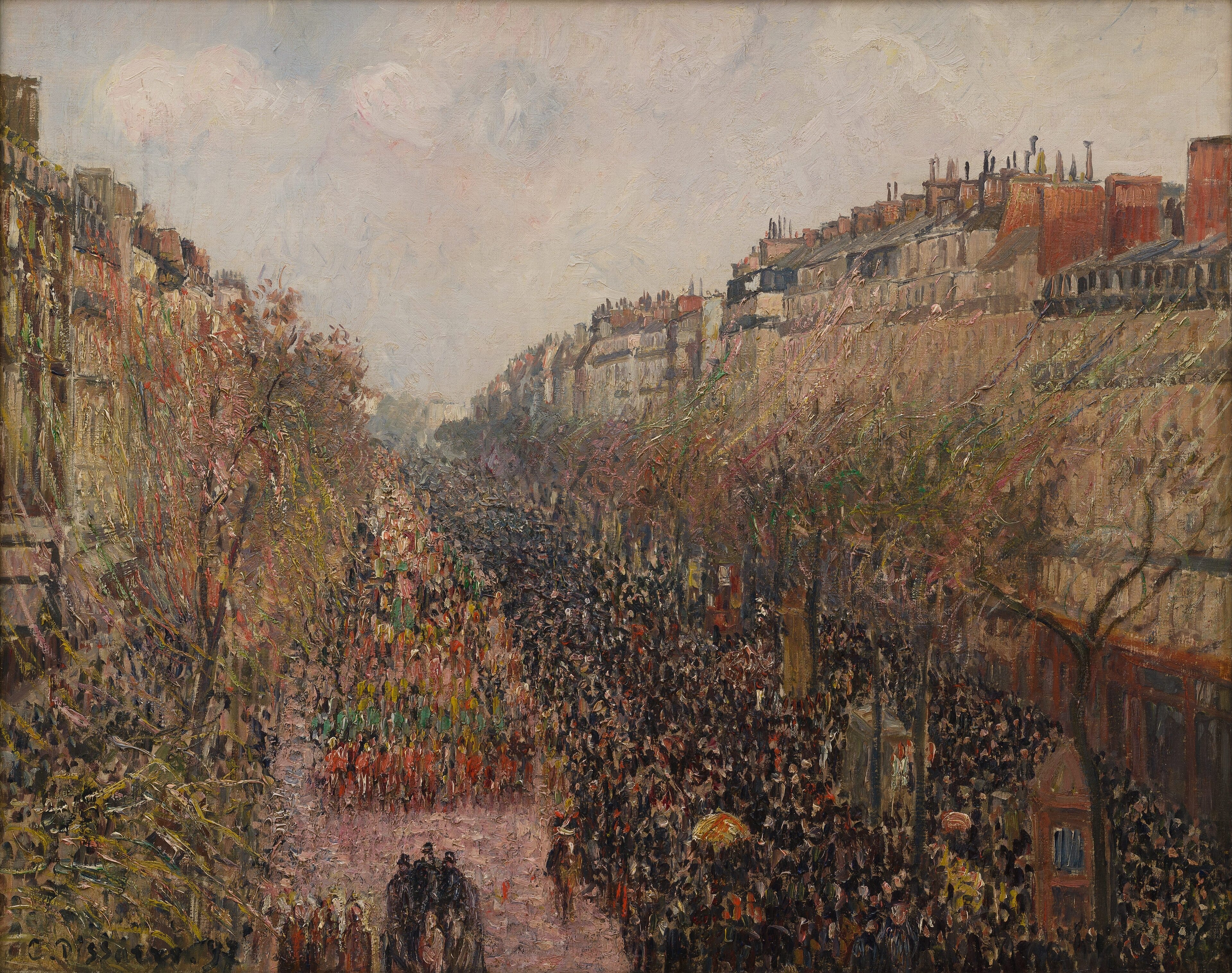
Camille Pissarro painted the Boulevard Montmartre fourteen times in early 1897, always from a rented room at the Grand Hôtel de Russie in Paris. His eyesight was failing and painting outdoors had become hard, so he worked from a window, in every kind of weather.
He took the room in February and stayed into April. Besides the fourteen views of the Boulevard Montmartre, he painted two of the neighboring Boulevard des Italiens, which is why some counts say sixteen.
Cool Stories About Art is a newsletter to learn art the fun way.
Join 200,000+ readers and get:
10 new art stories / month
The entire archive of content (1,000+ articles)
Comment, ask questions, and chat with other readers
The eyesight story is the one that gets repeated, and it explains the window. It does not explain the fourteen. A man who only needed a place to sit could have painted the street once, or twice. On 8 February 1897 Pissarro told his son Lucien that he had taken the room, and that his dealer, Paul Durand-Ruel, liked the idea of a series of boulevard paintings. Five days later he wrote to another son, Georges: "I have begun my series of boulevards."
The word that mattered there was series. The National Gallery in London, which owns the night view, says he meant to show the boulevard in snow, rain, fog, mist and sunlight, and at morning, afternoon, sunset and night. I read the eyesight story as only half of it: the window solved a problem, and the list gave him a reason to keep going back to it.
He kept to that list for over two months. Then the canvases left his hands one by one, and the set came apart.
What You'll Discover
What he wrote to his sons.
What the window really showed him.
The only night scene.
Where the canvases ended up.
The one sold in 1935.