Portraiture and the human figure in art cover posed faces from Leonardo to Sargent, self portraits from Durer to Van Gogh, women as both subject and painter, the two parts of the body painters found hardest, hands and feet, and the tricks of the hidden self portrait and the figure with its back turned.
That is the territory of this page. A king commissioning his own likeness and a painter smuggling his face into someone else's crowd scene are doing very different things with the same subject, the human body.
How this guide works
This pillar page organizes seven deep guides published on Cool Stories About Art, each one a standalone article on a single way painters have handled the human figure. Every section below summarizes one of them and links to the full piece.
The order runs from the face straight on, in the formal portrait and the self portrait, through the painted woman as a category of her own, down to the parts of the body painters struggled with most, and out to the tricks of hiding a face or turning one away entirely.
Portraits: a face deciding how it will be remembered
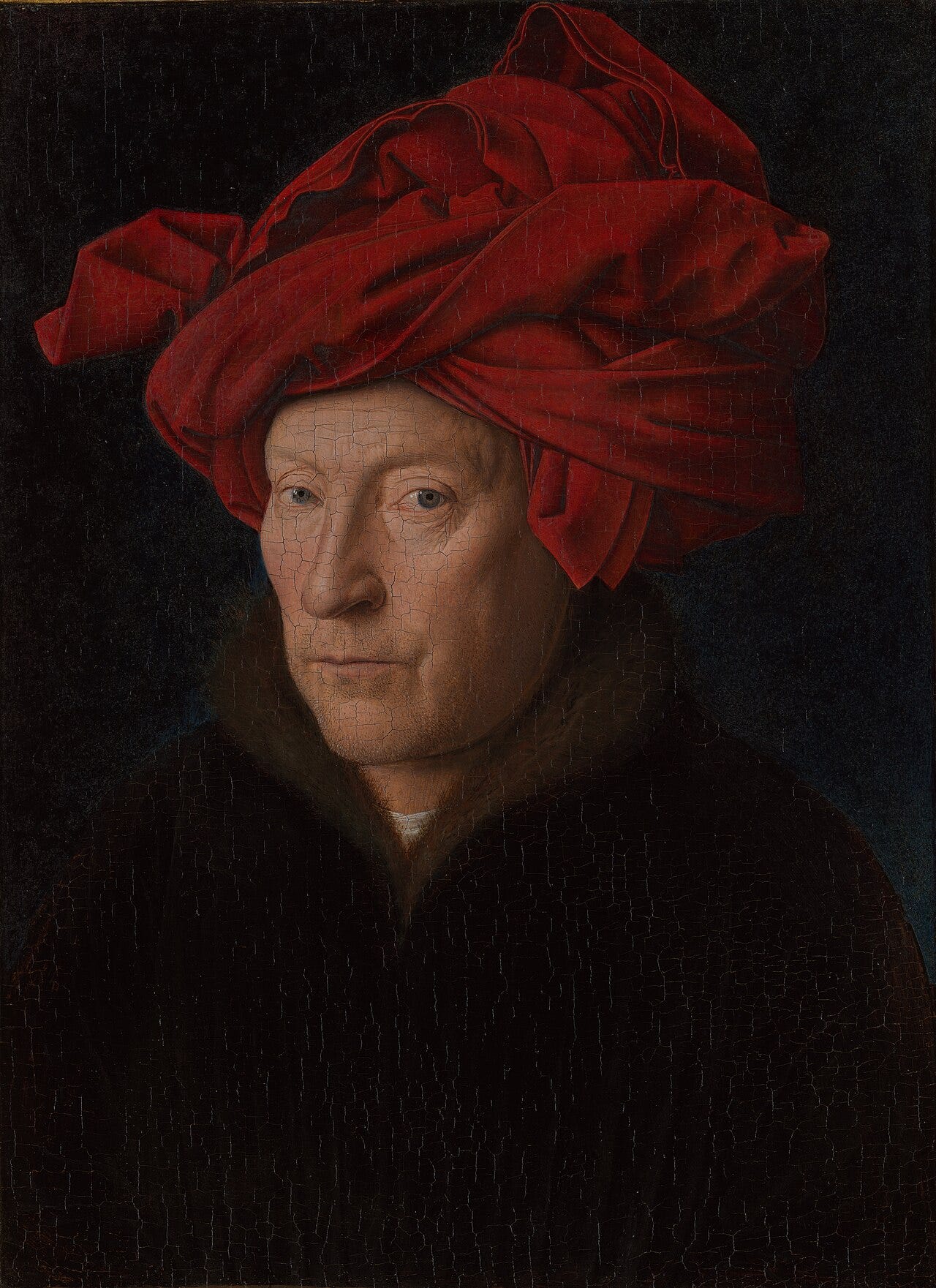
A portrait was rarely just a likeness. Jan van Eyck turned a stranger's face toward the viewer in his Portrait of a Man in a Red Turban of 1433, when sitters had gazed politely off to the side, and Hans Holbein built Henry the Eighth into a wall of muscle around 1537 so convincing that the king's public image still descends from it, even though the original wall painting burned in 1698.
Some portraits changed hands for record sums. Van Gogh's Portrait of Dr Gachet sold for eighty two and a half million dollars in 1990, and Gainsborough's Blue Boy left Britain for California in 1921 for a sum that caused a small national heartbreak.
Twelve of these faces, from Velazquez's Pope Innocent the Tenth to Goya's faintly ridiculous Spanish royal family, are in Famous Portrait Paintings: 12 Faces That Shaped History.
Self portraits: the cheapest model a painter ever had
A self portrait argues as much as it records. Albrecht Durer painted himself frontal and symmetrical in 1500, a pose reserved for images of Christ, and no painter had aimed it at himself before, a claim close to blasphemy at the time.
Rembrandt made the habit into a lifelong project, painting himself roughly eighty times across paintings, etchings and drawings, right up to the aging, unguarded Self Portrait with Two Circles of about 1665. Van Gogh sent a self portrait home to reassure his mother, in his own churning blue.
Twelve painters who turned the mirror into a subject, from Parmigianino's warped convex self portrait to Gauguin casting himself as both saint and serpent, are in Famous Self Portraits: 12 Painters and the Stories Behind Them.
Painted women: an idea shaped almost entirely by men
For centuries the female face was the most painted subject in art, and almost always painted by men. Leonardo's Mona Lisa, most likely a merchant's wife named Lisa Gherardini, was admired but not yet a global star until a thief stole her from the Louvre in 1911 and two years of headlines did the rest.
A few sitters escaped being only a man's idea of them. Virginie Gautreau became a scandal reduced to a single letter as Sargent's Madame X, and Adele Bloch Bauer's portrait by Klimt, looted by the Nazis, returned to her family in 2006 and sold for about one hundred thirty five million dollars.
Twelve faces across five hundred years, including Vermeer's unnamed girl with a pearl earring and Grant Wood's American Gothic, where the stern woman is the farmer's sister and not his wife, are in Famous Paintings of Women: 12 Faces That Defined an Ideal.
Hands: the second hardest thing to paint after the face
Painters have long ranked hands just behind faces for difficulty, and some built a picture's entire meaning around them. Michelangelo left two fingers not quite touching on the Sistine Chapel ceiling around 1512, and the gap between God's hand and Adam's is the whole idea, life not yet passed.
Caravaggio pushed the device further, painting a finger sunk directly into a wound in The Incredulity of Saint Thomas around 1602. Durer's 1508 ink study Praying Hands, made only as preparation for an altarpiece that later burned, became one of the most reproduced images in the world.
Twelve hands that carry a painting's whole argument, from the Arnolfini couple's clasped fingers to the pickpocketing hand in Georges de la Tour's Fortune Teller, are in Famous Hand Paintings: 12 Gestures That Changed Art.
Feet: the part that caused more trouble than nudity
Feet got painters into more arguments than bare skin ever did. Caravaggio's Madonna of Loreto of 1606 put a cracked, dirty sole in the foreground of an altarpiece, and contemporaries treated it as indecent for a sacred image.
Andrea Mantegna solved a different problem by cheating scale. In The Lamentation of Christ, around 1480, a body lies feet first toward the viewer, and drawn at true size in that perspective the feet would have swallowed the panel, so he shrank them.
Van Gogh painted the same pair of worn boots at least seven times, a picture the philosopher Heidegger read as a peasant woman's shoes and the art historian Meyer Schapiro answered were Van Gogh's own. Twelve works built around the body's least glamorous part are in Feet in Painting: 12 Works and the Trouble They Caused.
Backs turned: the figure that borrows your face
A figure with its back to the viewer has a German name, Ruckenfigur, and one painter owns the device. Caspar David Friedrich put a man on a rock facing cloud in Wanderer above the Sea of Fog around 1818, hiding the expression so the viewer has to supply it.
The trick existed earlier as a stage device, a repoussoir at the edge of a crowd, in works like Velazquez's Las Meninas of 1656. Friedrich made the back turned figure the whole subject rather than a device at the margin, and Edward Hopper later stripped out the romanticism and kept the loneliness.
How the device was invented, borrowed and eventually turned into a joke by Magritte is in Backs Turned: The Ruckenfigur in Painting.
Hidden self portraits: the painter smuggled into someone else's picture
Painters have signed their own faces into other people's stories for centuries. Michelangelo put his face on a flayed skin held by Saint Bartholomew in the Last Judgment of 1541, the least flattering self portrait in art, and Caravaggio gave his own features to the severed head in David with the Head of Goliath in 1610, painted while he was under sentence of death and sent to Rome as a plea for pardon that arrived too late.
Some hid in plain sight inside a crowd. Botticelli turns to look straight out of his own Adoration of the Magi of about 1475, and Benozzo Gozzoli wrote his name on his own hat in a Florentine chapel fresco of 1459, in case anyone missed him.
Twelve painters who smuggled themselves into their own pictures, including Jan van Eyck's likely presence in the Arnolfini Portrait's mirror, are in Hidden Self Portraits in Famous Paintings: 12 Painters Who Signed Themselves In.
One face, three appearances
Jan van Eyck turns up across three separate corners of this cluster, and not by coincidence. His Portrait of a Man in a Red Turban of 1433 helped invent the direct gaze that defines the portrait genre, the same picture is read by most historians as one of the earliest surviving self portraits, and the tiny reflected figure in the Arnolfini Portrait's convex mirror is likely van Eyck again, watching the scene he painted.
FAQ
What is the difference between portraiture and the human figure in art?
A portrait names a specific sitter and usually shows the face. The human figure is the wider subject, and it includes parts of the body treated on their own, hands, feet, a back turned to the viewer, without a named face attached at all.
Why do hands and feet get their own pages instead of counting as part of a portrait?
Because painters have used them to carry meaning a face cannot. A gesture like the almost touching fingers in The Creation of Adam or a dirty sole in a Caravaggio altarpiece works independently of who the sitter is, sometimes without a face in the picture at all.
Is a hidden self portrait still a self portrait?
Yes, but a disguised one. Instead of presenting his own face directly, as Durer and Rembrandt did again and again, a painter like Caravaggio or Michelangelo puts his own features on someone else's body inside a larger scene.
What is a Ruckenfigur, and why is it not a portrait?
A figure painted from behind, facing into the scene rather than out at the viewer. It is the opposite of a portrait's whole purpose, since the face, the one thing a portrait exists to show, stays hidden on purpose.
Who painted the most self portraits?
Rembrandt, with roughly eighty across paintings, etchings and drawings, the longest continuous self portrait project in Western painting.
What the same face can be worth
Van Gogh's Portrait of Dr Gachet, one man's face painted in 1890, sold at auction for eighty two and a half million dollars in 1990, a record for the artist at the time.