
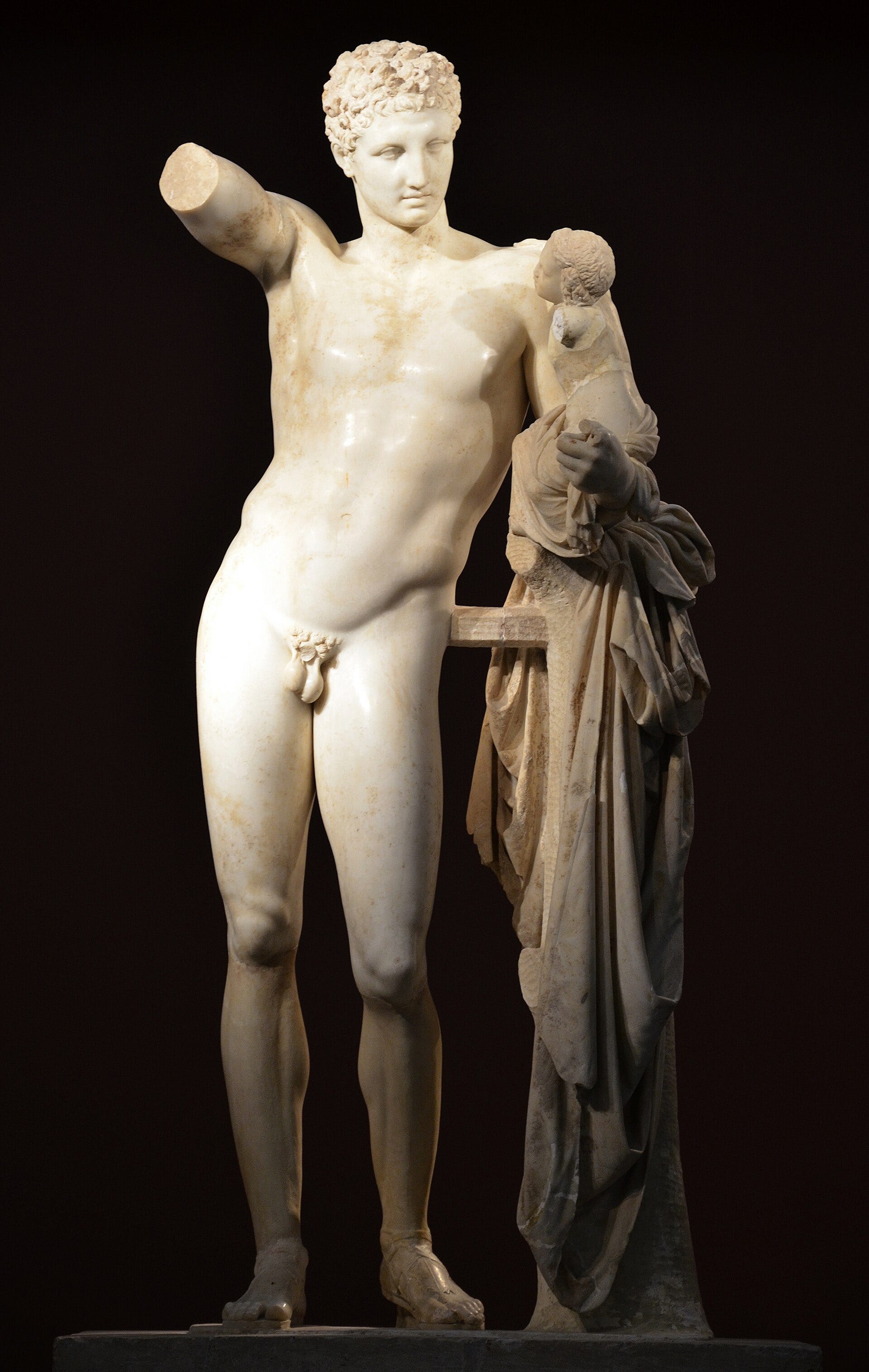
According to an old Greek tale, Phryne, a famous woman of Athens, Greece, staged a fake fire alarm to learn which of her lover's statues he valued most. Her lover was Praxiteles, a Greek sculptor who worked in Athens from about 370 to 330 BC. His Aphrodite of Knidos was among the first Greek statues of a nude woman at life size.
Cool Stories About Art is a newsletter to learn art the fun way.
Join 200,000+ readers and get:
10 new art stories / month
The entire archive of content (140+ articles)
Comment, ask questions, and chat with other readers
Praxiteles was one of the most admired sculptors of the ancient world. Yet his most famous statue was a nude goddess that one Greek city turned down, and that a neighboring city then kept at any cost.
Almost nothing is known of the sculptor's own life, and not one statue survives that he certainly carved himself. What remains are copies and stories.
Long after the death of Praxiteles, Rome conquered Greece. Wealthy Romans ordered marble copies of famous Greek statues in great numbers, and writers of Roman times collected tales about the Greek artists, four or five centuries after their deaths.
The best known of those tales begins in Athens around 360 BC, when Praxiteles carved two statues of Aphrodite, the Greek goddess of love and beauty, whom the Romans called Venus.
Pliny the Elder, a Roman writer of the first century AD, tells the story of the two statues in his Natural History, a vast encyclopedia of the ancient world. According to Pliny, Praxiteles offered both goddesses for sale at the same price. One Aphrodite was clothed. The other was nude.
For about three hundred years, Greek sculptors had carved nude men: athletes, warriors and gods. A goddess was almost always shown clothed, and a nude goddess at life size was something new.
The people of Kos, a Greek island off the coast of what is now Turkey, had the first choice. They took the clothed Aphrodite, which they found serious and modest.
The nude goddess went to Knidos, a Greek city at the tip of a long peninsula, a short sail from Kos. Knidos paid for the statue that its neighbor had refused.
After the death of Praxiteles, a king tried to buy the nude goddess from Knidos. The king was Nicomedes, ruler of Bithynia, a kingdom on the northwestern coast of what is now Turkey.
How did the goddess that Kos turned down become the statue King Nicomedes could not buy?
In the rest of the story
Which famous woman was said to have posed for the goddess.
How a false alarm made Praxiteles name his favorite statues.
How one of his statues sailed to Rome twice.
What King Nicomedes offered Knidos in exchange for the goddess.