
Prisons in art run from Piranesi’s impossible staircases to Van Gogh copying a Dore engraving from inside an asylum. Twelve works about confinement, including one painted by a man who had just been jailed himself, and one prison that never existed.
The cell block, in five lines
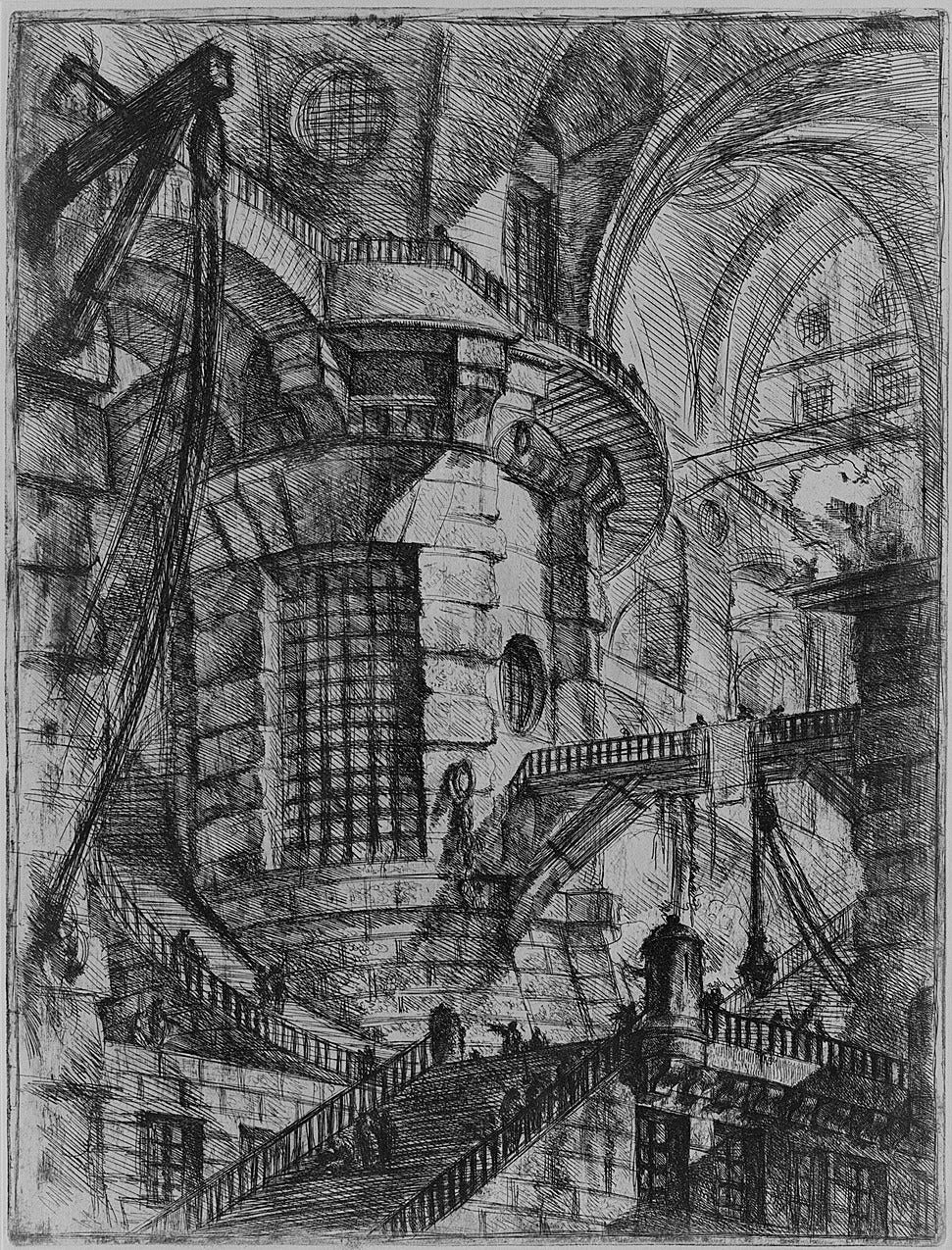
One set of prison etchings shows architecture that cannot physically exist.
One painter was jailed for mocking the king, and drew prisoners for the rest of his life.
One artist spent his last decades in Bethlem and Broadmoor, and made his best work there.
One famous execution scene invented the room it happens in.
Learn art the fun way
1 | The Imaginary Prisons, Giovanni Battista Piranesi (1750)
Sixteen etchings of vaults, staircases and gantries that lead nowhere. Follow any stair with your eye and it fails to connect to the level it should reach.
Piranesi reworked the plates in 1761 to make them darker and heavier. Escher, Borges and half of modern cinema descend from them. The medium is explained in what is etching.
2 | The Prison Courtyard, Vincent van Gogh (1890)
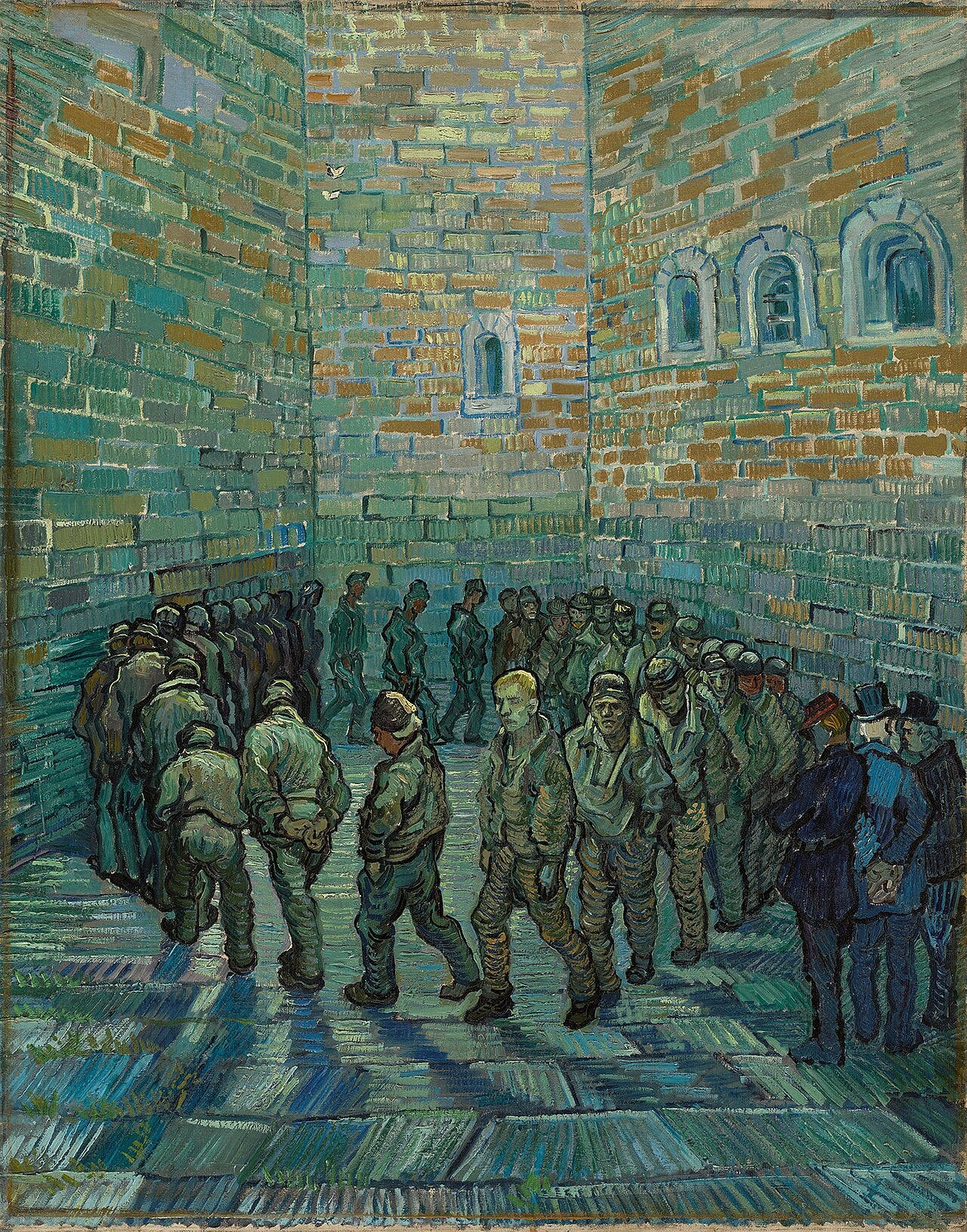
Prisoners walk in a circle inside high brick walls. Van Gogh painted it in February 1890 from inside the asylum at Saint Remy, copying an engraving by Gustave Dore.
The pale figure looking out at us is generally read as Van Gogh himself. He died five months later. His last weeks are in The Last Day of Vincent van Gogh.
3 | Newgate, the Exercise Yard, Gustave Dore (1872)
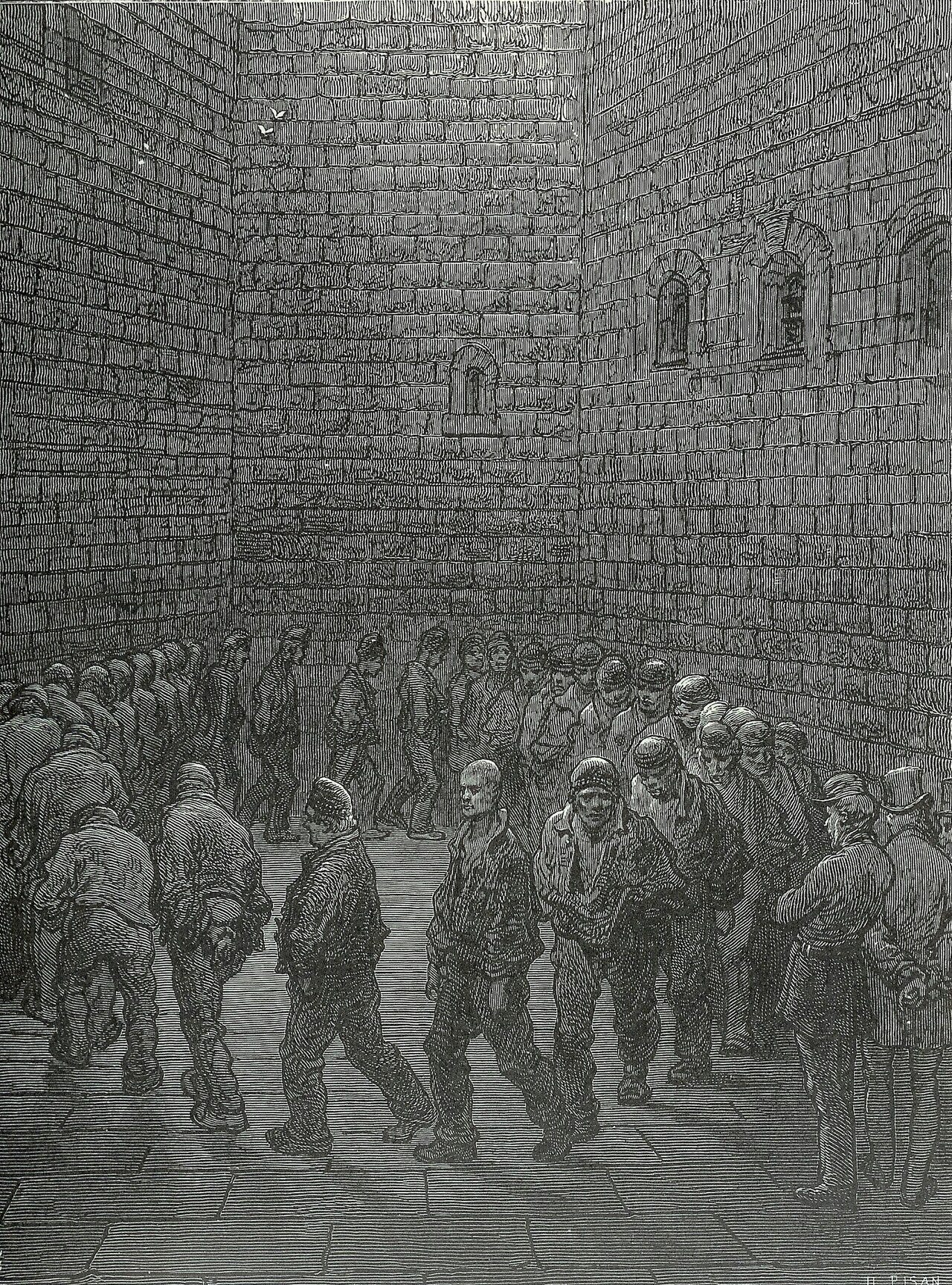
The engraving Van Gogh copied. Dore toured London with a journalist and drew the slums, the docks and the prisons for a book called London: A Pilgrimage.
Critics accused him of showing only the misery. I go into his whole story in Gustave Dore.
Dore drew it for London: A Pilgrimage, published in 1872 with text by Blanchard Jerrold. Van Gogh copied the print in oil in 1890 while he was himself confined at Saint Remy, and put his own face on one of the prisoners.
4 | Daumier, six months in Sainte Pelagie (1832)
Honore Daumier was jailed for a caricature showing the king as Gargantua swallowing bags of gold taken from the poor.
He came out and drew lawyers, courtrooms and the accused for forty years. More on him in Honore Daumier. A caricature was enough to jail Daumier. Caravaggio really did kill a man, and spent his last years a fugitive instead of a prisoner.
He was sentenced in 1832 for a caricature showing Louis Philippe as Gargantua swallowing taxes, and served six months, part of it in a mental asylum. He went straight back to the same job on release.
5 | The Fairy Feller’s Master Stroke, Richard Dadd (1855 to 1864)
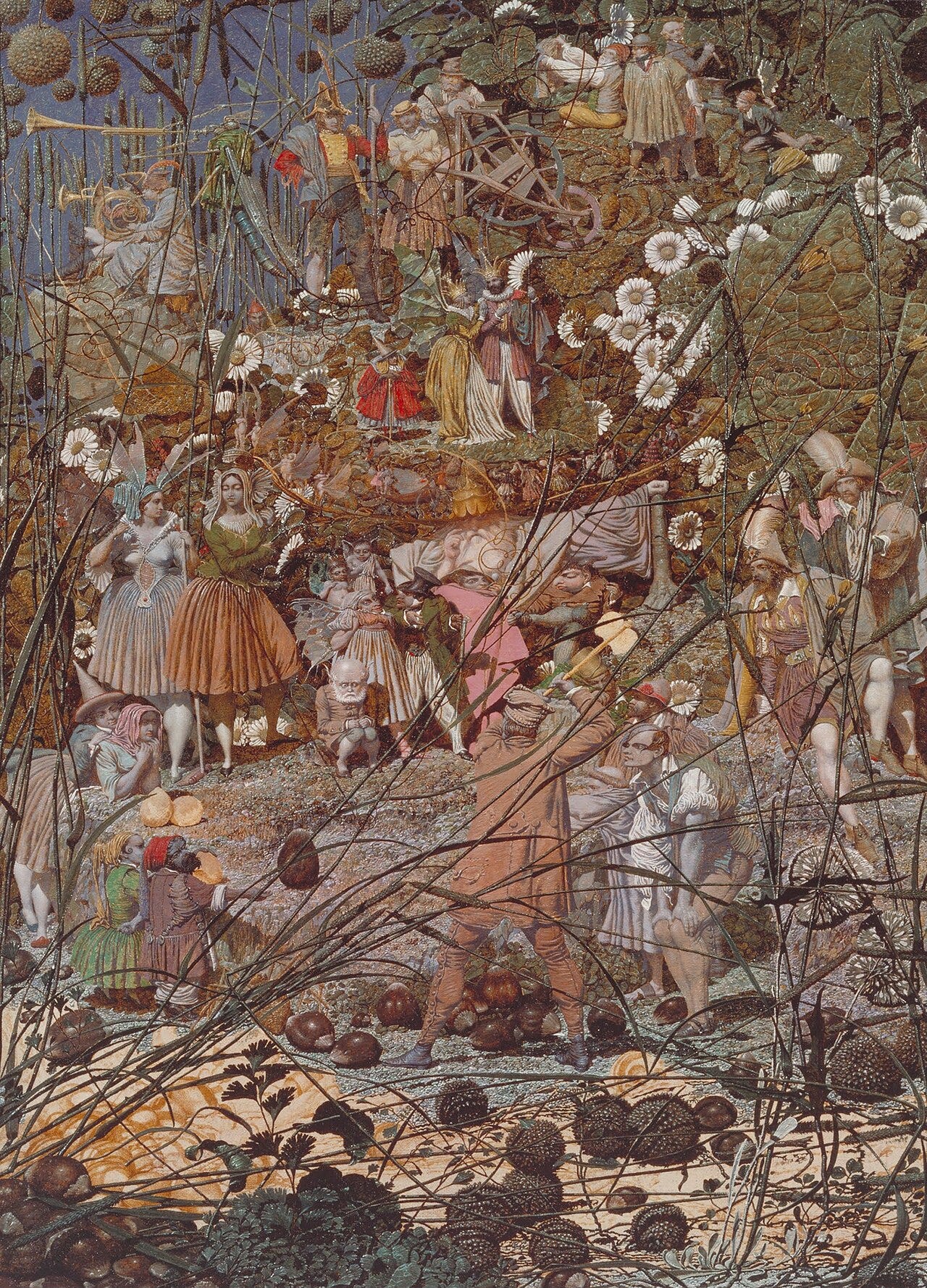
Painted with single hair brushes over nine years inside Bethlem and Broadmoor. Dadd had killed his father during a psychotic episode in 1843 and never left institutional care.
The hospital gave him paint. More of that world is in madness in painting.
Dadd killed his father in 1843 and spent the rest of his life in Bethlem and then Broadmoor. He painted the picture for the head steward, worked on it for nine years, and never finished it.
6 | The Execution of Lady Jane Grey, Paul Delaroche (1833)
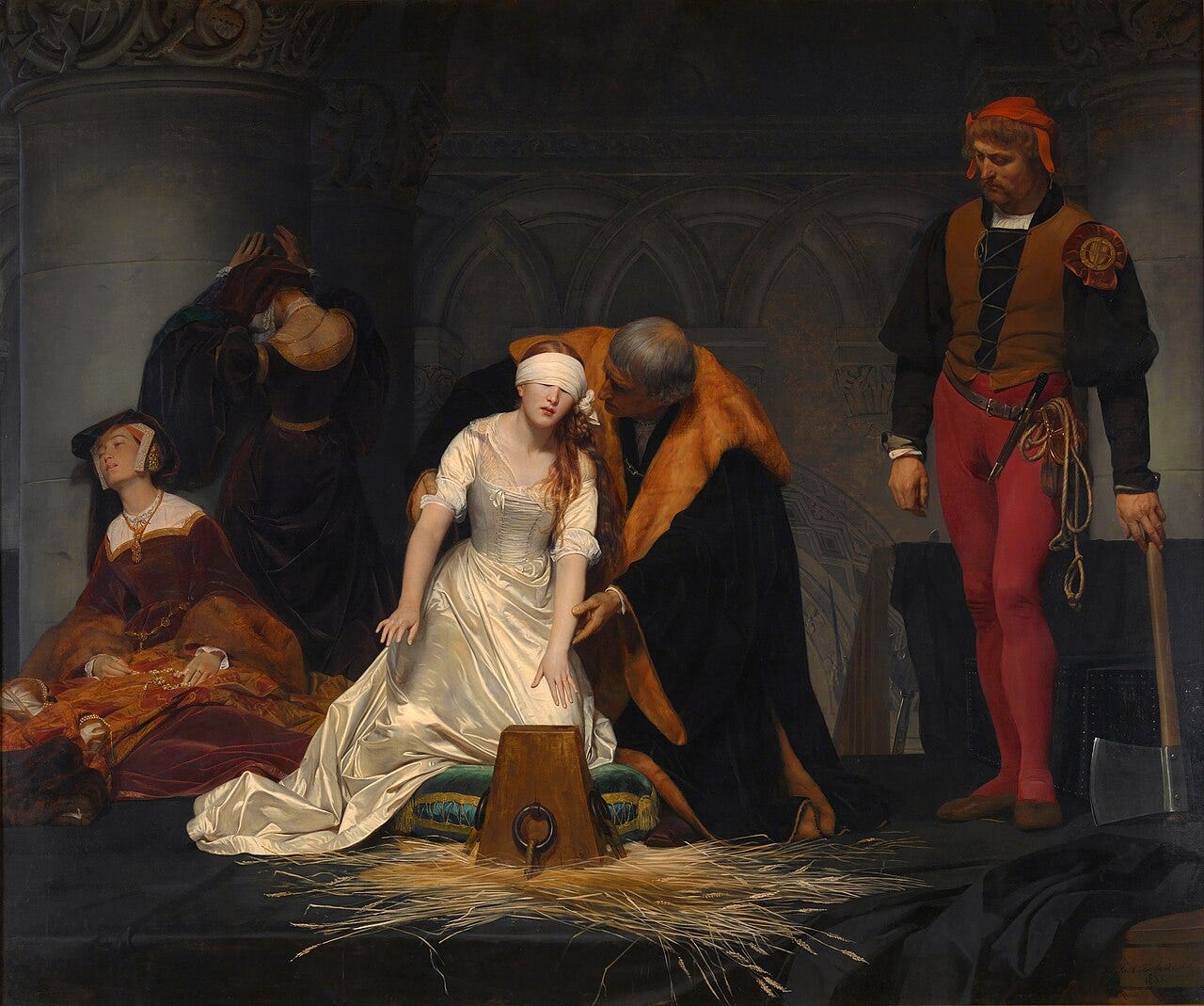
A blindfolded teenage queen gropes for the block inside the Tower of London. Delaroche invented the interior: the real execution took place outdoors.
The painting was thought destroyed in a 1928 flood and was rediscovered in a Rijksmuseum store room in 1973.
Delaroche painted it in 1833, showing her blindfolded and groping for the block. She was sixteen or seventeen when she was beheaded in February 1554, after nine days as queen, and the execution was indoors, not on Tower Green.
7 | The Prisoner of Chillon and the Romantic dungeon
Byron wrote the poem in 1816 after visiting the castle on Lake Geneva and carving his name on a pillar, which is still there behind glass.
Delacroix painted the scene, and the Romantic dungeon became a fixture: chains, one shaft of light, a figure who has stopped fighting.
8 | Saint Peter Freed from Prison, Raphael (1514)
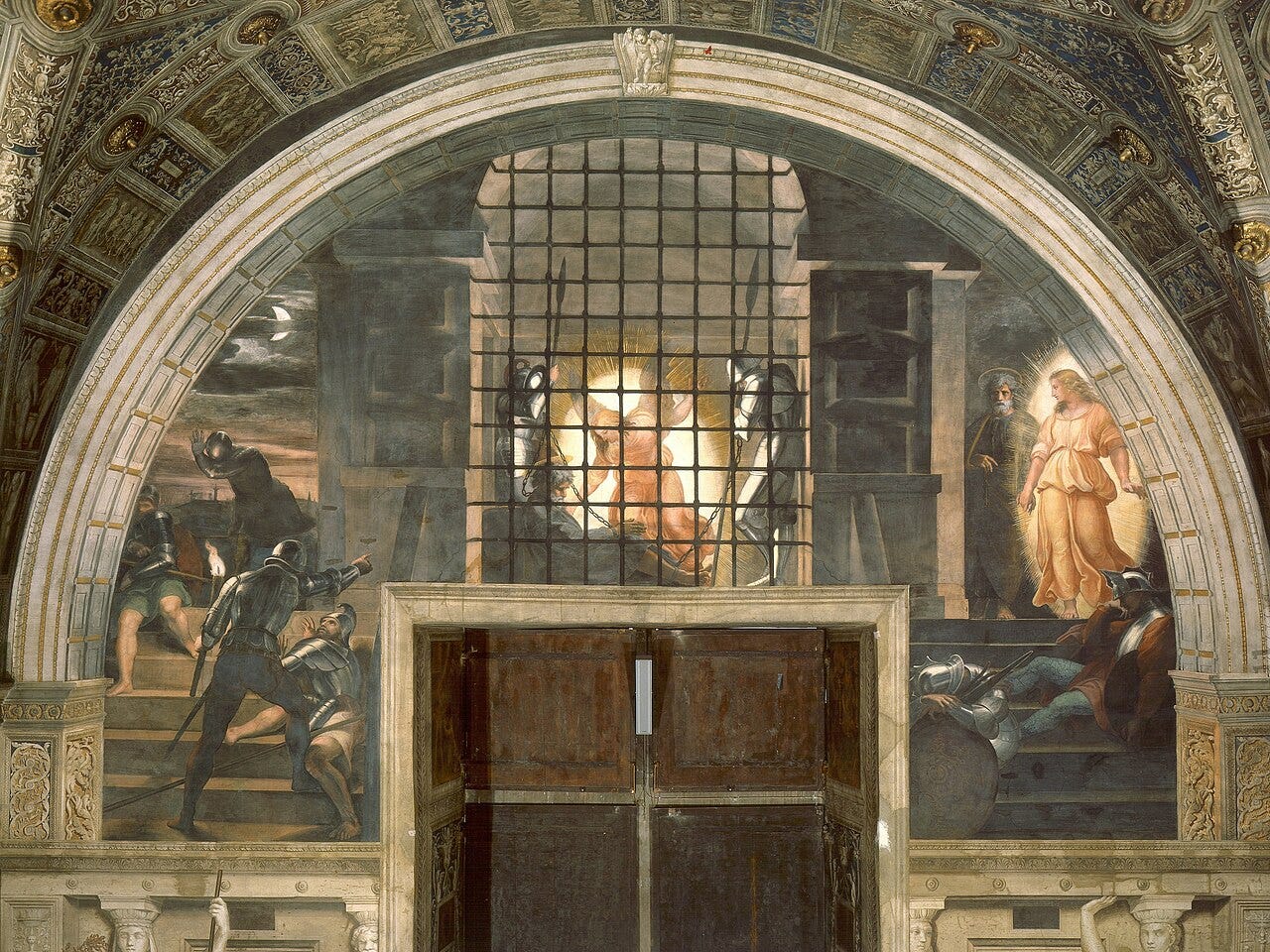
An angel fills a Vatican wall with light while guards sleep in armour. Raphael painted it above a real window so daylight and painted light meet.
It is one of the earliest great night scenes in Western art. The rest of his life is in Raphael.
9 | Goya, the Inquisition and the cells
Goya painted rooms of the confined again and again: the Inquisition tribunal, the madhouse, prisoners in irons under a low vault.
The small prison panels were painted for himself, not for sale. I cover him properly in Francisco Goya.
His Inquisition scenes were painted around 1812 to 1819 and never exhibited in his lifetime. He kept them, along with the Disasters of War, because publishing them would have been dangerous.
10 | The Bastille, painted after it fell
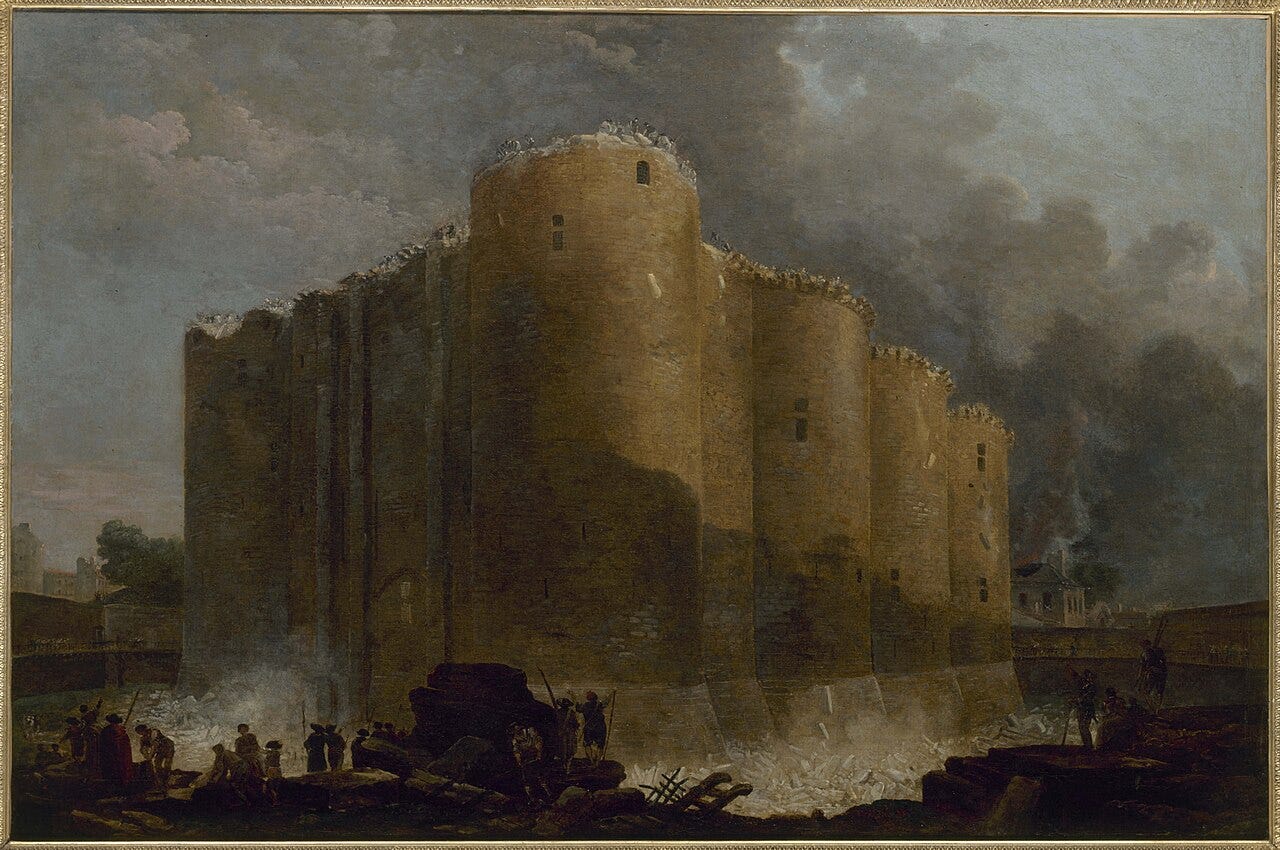
Hubert Robert painted the demolition of the Bastille in 1789 from the site itself. He was later arrested during the Terror and painted on plates and walls inside his own cell.
The building became a stone quarry, and pieces of it were carved into souvenir models. More of that year is in French Revolution paintings.
11 | The debtors’ prison in Hogarth’s hands
Hogarth’s father was jailed for debt when the painter was a boy, and the Fleet prison turns up in A Rake’s Progress as the stop before the madhouse.
Nothing in that sequence is neutral. His full story sits in William Hogarth.
Hogarth’s father was imprisoned for debt in the Fleet for five years, and the family lived inside the rules of the prison. The Rake ends in the Fleet and then Bedlam, which is a route Hogarth knew personally.
12 | The Bridge of Sighs, sold as a view
Venice built a covered bridge in 1600 to carry the condemned from the courtroom to the cells. Byron named it the Bridge of Sighs and the view painters sold it to tourists.
Turning a prison into a postcard is its own kind of trick. Canaletto More of it in Canaletto.
Behind the walls: what readers ask
Which of these is the icon? Piranesi’s Imaginary Prisons, followed by Van Gogh’s Prison Courtyard.
Did Van Gogh paint a real prison? He copied a Dore engraving of Newgate while confined in the asylum at Saint Remy in 1890.
Why are Piranesi’s prisons impossible? The staircases and vaults do not connect. He drew architecture that reads as coherent until you follow it.
Which artist was actually imprisoned? Daumier, six months in 1832 for caricaturing the king, and Hubert Robert during the Terror.
Where do I find them in person? The Rijksmuseum for Delaroche, the Van Gogh Museum for the Prison Courtyard, and the Met for Piranesi.
One detail worth carrying away: Hubert Robert walked out of prison on 4 August 1794, a week after the fall of Robespierre. The story that a man with a similar name went to the guillotine in his place has never been confirmed and probably came from Robert himself. He lived another 14 years, painting.
This subject is one thread in a wider theme. See how it fits into War and Power in Art.