
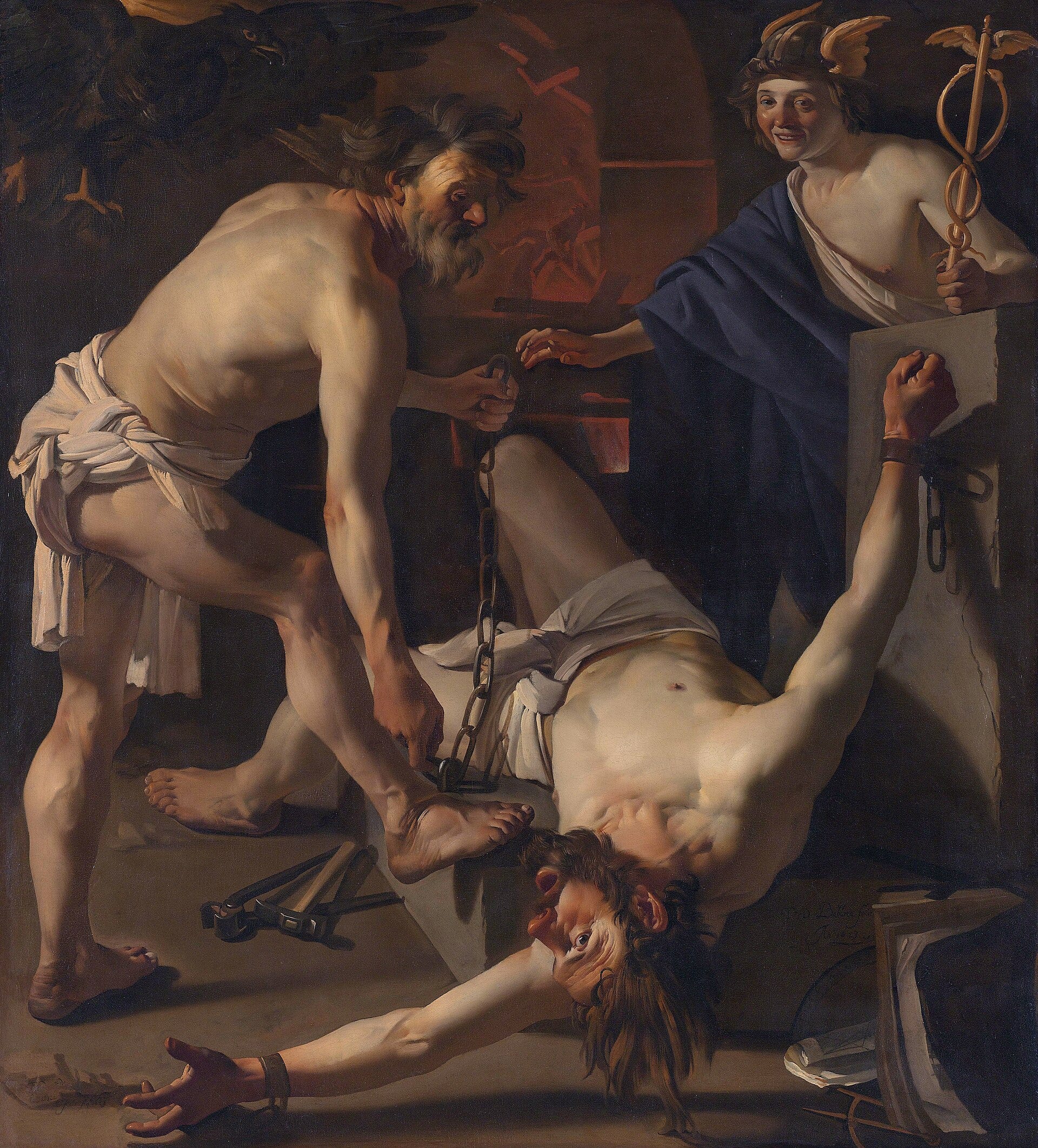
For four centuries, painters who took on Prometheus kept coming back to the same moment, the Titan chained to a rock while an eagle tears at his liver. The few who looked elsewhere found stranger scenes, like a god laughing at the prisoner, and one of their canvases spent years rolled up and forgotten in a royal palace.
Cool Stories About Art is a newsletter to learn art the fun way.
Join 200,000+ readers and get:
10 new art stories / month
The entire archive of content (140+ articles)
Comment, ask questions, and chat with other readers
Why Painters Kept Coming Back to Prometheus
Prometheus is the Titan of Greek myth who took fire from the gods and handed it to humans. Zeus punished him by having him chained to a mountain, where an eagle came every day to eat his liver, and every night the liver grew back.
For painters, that punishment offered a giant male body twisted in pain, a stern test of how well an artist knew anatomy. Over time it also took on meanings. In 1818, Mary Shelley subtitled Frankenstein The Modern Prometheus, and the Titan came to stand for anyone who defies power and pays for it.
Each work here shows Prometheus himself at one moment of his story, and one of them is carved in marble. The detail worth watching is the torch. It is the stolen fire, and several artists keep it in view as proof of the crime.
12. Carl Bloch, Prometheus Unbound (1864)
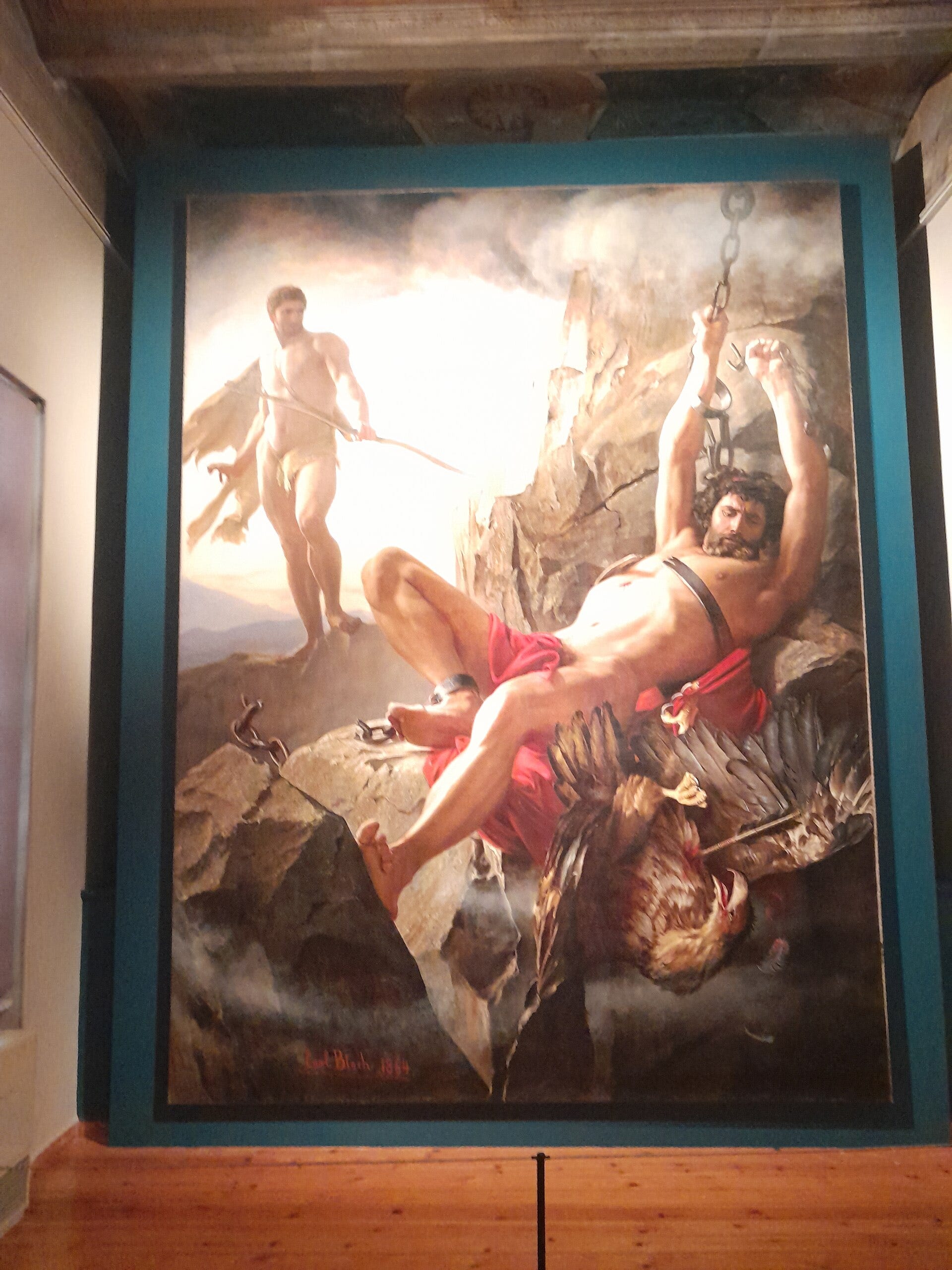
A dead eagle tumbles toward the lower edge, an arrow through its body. Above it, Prometheus pulls one arm free of the last chain, and on the left Heracles, the hero who shot the bird, still holds his bow. Carl Bloch, a Danish painter, chose the end of the story and called the picture Prometheus Unbound.
The commission came from a young king. Bloch worked on it in Rome in 1864 for George I of Greece, a Danish prince who had been made king of the Greeks the year before, at seventeen. Before it left for Athens, the picture was shown in Copenhagen in 1865, and the Danes lined up to see it. Denmark had just lost its war of 1864 against Prussia, and the Danes saw in a Titan breaking his chains an image of their own country.
In Athens, the painting probably hung on the great staircase of the royal palace. It came back to Copenhagen for exhibitions in 1910 and 1932, and after that the public lost sight of it. For decades, it was known only from black and white photographs.
In 2012, conservators from the Greek Ministry of Culture found it at Tatoi, the old summer palace of the Greek kings, taken off its stretcher and rolled around a wooden cylinder, torn, stained by water and spotted with mold. In 2024, a hundred and sixty years after Bloch finished it, the canvas painted for a Greek king was finally shown to the Greek public.
At a Glance
Artist: Carl Bloch (1834 to 1890)
Painted: 1864
Medium: Oil on canvas
Size: 398 × 277 cm (156.7 × 109.1 in)
Where to see it: Tatoi Estate collection, Hellenic Ministry of Culture, Athens
11. Nicolas-Sébastien Adam, Prometheus Chained (1762)
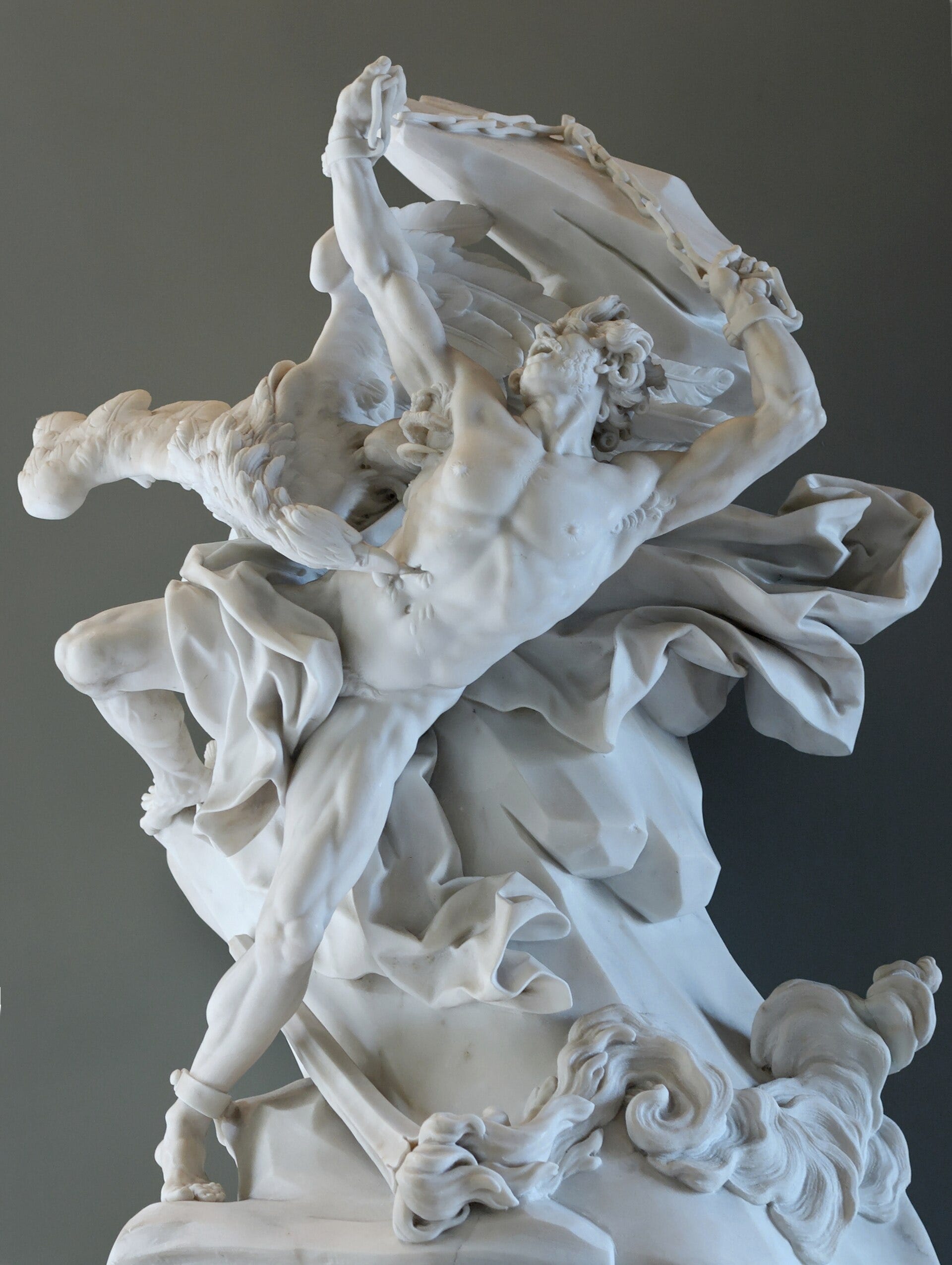
Prometheus twists backward on his rock, one arm chained above his head, while the eagle digs into his side. This marble group began as an entrance exam. Around 1738, Nicolas-Sébastien Adam offered the French Royal Academy a small clay sketch of the subject to be accepted as a candidate, and the Academy then waited twenty-four years for the marble.