Qi Baishi: The Complete Story
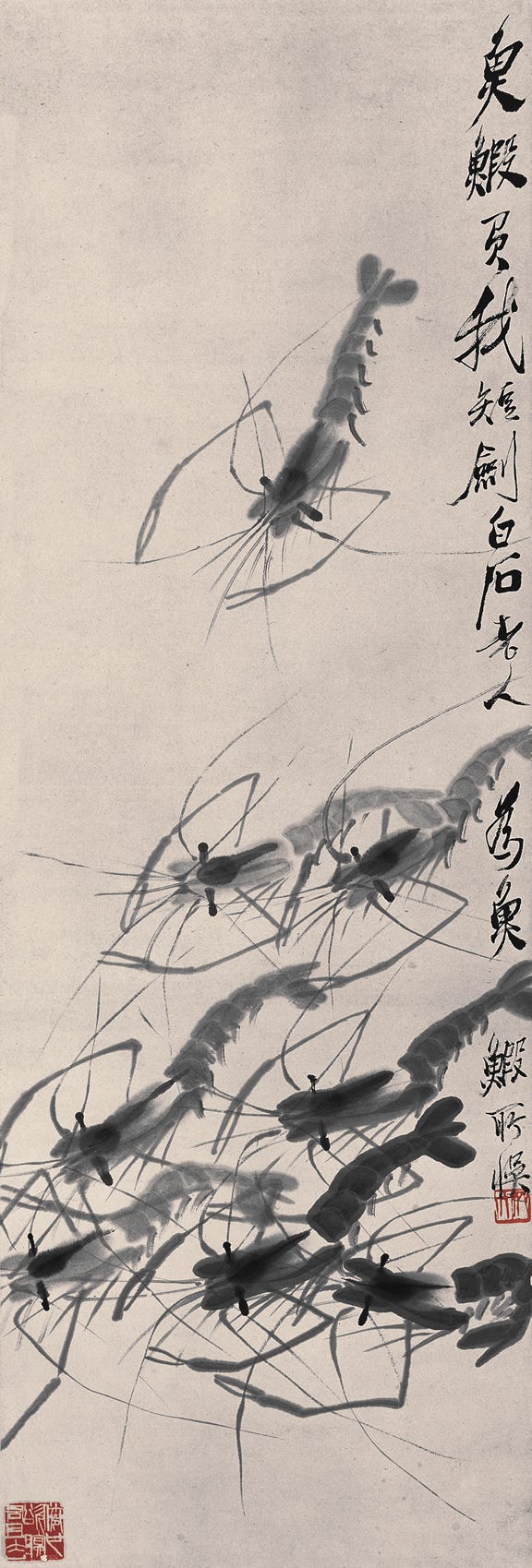
A few quick strokes of black ink, and a cluster of shrimp seems to swim across the paper, translucent and alive. Qi Baishi spent decades perfecting that simplicity, and became the most beloved Chinese painter of the modern age, a man who started life as a poor village carpenter.
He was a Chinese artist famous for lively ink paintings of shrimp, crabs, insects and flowers, who rose from humble beginnings to national fame.
Where the real detail lives
These go past the caption and into what actually happened:
Was Monet really the first Impressionist, the painting that may have got there first
The secret behind Monet Magpie, one bird in the snow, and why it matters
Lady with an Ermine, detail by detail, why she is holding that animal
The life in a few strokes
Qi Baishi worked in the tradition of Chinese brush and ink, capturing creatures and plants with a few swift, exact marks that suggest movement and life.
His handling of ink and wash on paper, close in spirit to watercolour, made the simplest subject feel full of energy.
Shrimp and small creatures
He is most loved for his shrimp, painted with grey ink so they look wet and almost transparent, but he also painted crabs, frogs, insects and flowers.
This focus on small living things, a kind of still life of the natural world, made high art out of the humblest pond and garden.
The carpenter who became a master
Qi Baishi was born into a poor farming family and trained first as a carpenter, carving furniture, before teaching himself to paint and seal carving.
He did not find real fame until late in life, proof that a great artist can rise from the most ordinary beginnings.
A national treasure
In his later years Qi Baishi became a revered figure in China, honoured by the new government and celebrated as a people artist.
He painted into his nineties, and his work became a symbol of Chinese art carried proudly into the modern world.
Common questions about Qi Baishi
What is he known for?
Lively ink paintings of shrimp, insects, crabs and flowers.
What was his background?
He began as a poor village carpenter before becoming a painter.
When did he find fame?
Late in life, after decades of work.
When did he die?
In 1957, in his nineties.
Why his simple creatures endure
Qi Baishi proved that a lifetime of practice could make a few brushstrokes feel effortless and alive, and that the smallest subject could carry the greatest skill.
His paintings now sell for enormous sums at auction in China, an extraordinary fate for the work of a man who began by carving chairs.
One of his works became, for a time, among the most expensive paintings ever sold in China, fetching a price in the tens of millions, a sign of how completely his nation took him to heart.
He kept the directness of his village roots all his life, signing himself with humble names and painting the creatures of the countryside he never forgot.
His mastery came from relentless practice, painting the same shrimp thousands of times until a few strokes could hold all their movement and light.
Honoured by his nation and loved by ordinary people, he became a bridge between the ancient brush traditions of China and the modern age, and his work now anchors the great Chinese museum collections.
His seals and calligraphy were prized almost as highly as his paintings, and he is now counted among the handful of artists who define Chinese art for the modern world.
He travelled and exhibited widely in his final decades, and a meeting between him and the visiting Picasso, who admired his brushwork, became a celebrated moment in the meeting of Chinese and Western art.