
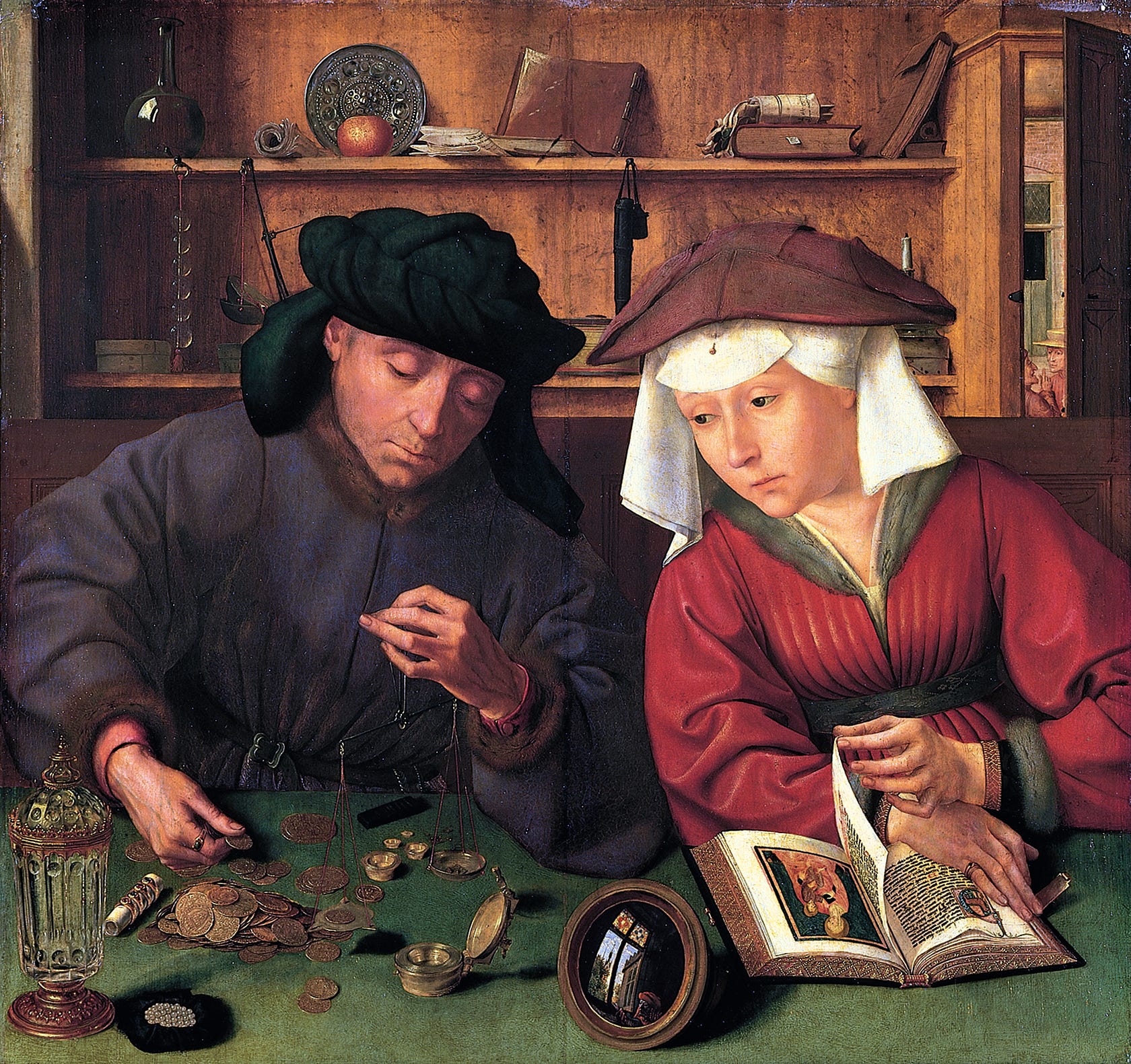
Quentin Matsys (about 1466 to 1530) was a Flemish painter, from the north of today's Belgium, who worked in Antwerp. He is famous for The Moneylender and His Wife, at the Louvre in Paris, and for the old woman nicknamed "The Ugly Duchess."
Cool Stories About Art is a newsletter to learn art the fun way.
Join 200,000+ readers and get:
10 new art stories / month
The entire archive of content (140+ articles)
Comment, ask questions, and chat with other readers
Antwerp, the port city where Quentin Matsys spent his working life, remembers him through a love story about a blacksmith and a girl. What has actually stayed in Antwerp for five centuries is a painting he made for its joiners, the city's woodworkers.
Quentin Matsys, whose name is also spelled Massys or Metsys, was born around 1466 in Leuven, a university town east of Brussels, in the Low Countries, today Belgium and the Netherlands.
His father was a smith, a craftsman who shaped iron at a forge. Of Quentin's own youth, almost nothing is known, not even who taught him to paint.
In 1572, about forty years after his death, his portrait appeared in a book of engraved portraits, pictures cut into metal plates and printed on paper.
Under the portrait, a scholar from the Flemish city of Bruges wrote a Latin poem in which the dead painter tells how he began.
In the poem, Quentin says he was once a smith and loved a girl. A painter was courting her too, and she preferred the silent brush to the thunder of hammers. "Love made me a painter," the poem has him say.
In 1604, the Flemish painter Karel van Mander retold the tale of the smith in love in his book of painters' lives, and added a second one. In that version, Quentin worked at the forge until about twenty, then fell ill and grew too weak for the work.
In bed, he began to copy little printed pictures of saints. Van Mander thought both stories could be true.
His father's trade is a fact. Quentin's own years at the forge belong to the stories.
Antwerp chose the legend. About a hundred years after his death, a rich collector had the painter's remains moved from a monastery into Antwerp Cathedral. A Latin inscription at the cathedral tells the story in one line: "Connubialis amor de Mulcibre fecit Apellem."
Married love made Mulciber, the Roman god of blacksmiths, into Apelles, the most famous painter of ancient Greece.
The real Quentin Matsys became the first important painter of Antwerp. For the joiners' altar in its main church, he painted a huge altarpiece, a painting set above an altar, the table where the priest says Mass.
So how did that altarpiece stay in Antwerp, when even a king of Spain wanted it?
In the rest of the story
Why Europe's most famous scholar sent his own face to England.
What the moneylender's little mirror shows that the couple never sees.
Which famous children's book borrowed the look of "The Ugly Duchess."
Which queen also tried to buy his great altarpiece.