
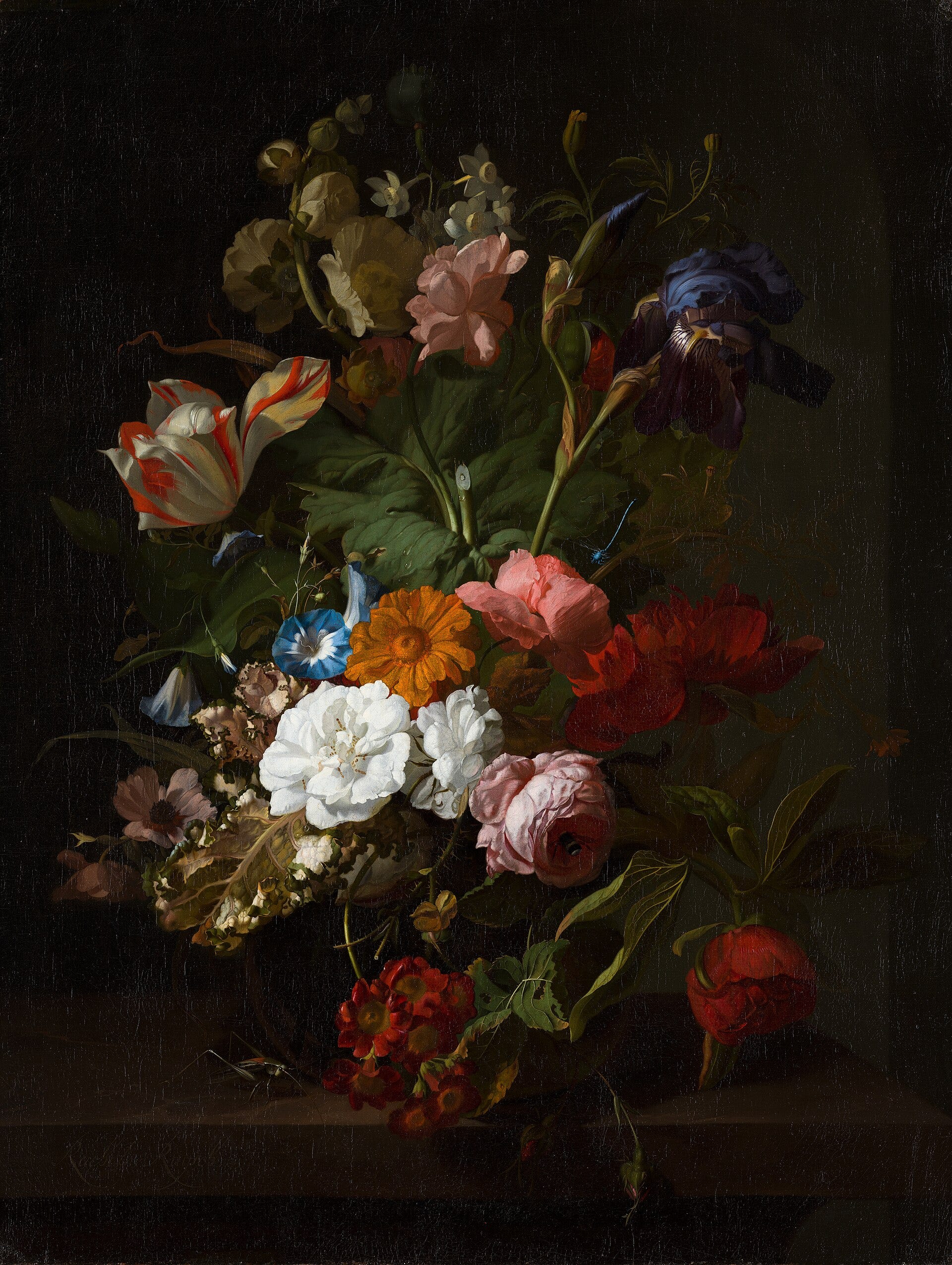
Rachel Ruysch (1664 to 1750) was a Dutch painter of still lifes, pictures of flowers, fruit and other objects that do not move. Her bouquets, like Vase with Flowers at the Mauritshuis museum in The Hague, gather blooms that never flowered in the same season.
Cool Stories About Art is a newsletter to learn art the fun way.
Join 200,000+ readers and get:
10 new art stories / month
The entire archive of content (140+ articles)
Comment, ask questions, and chat with other readers
Collectors paid Rachel Ruysch far more for a bouquet than most Dutch painters of her time could ask. Then, in 1723, after more than forty years of work, she became rich overnight without lifting a brush.
Rachel Ruysch was born in The Hague in 1664 and grew up in Amsterdam, the great trading port of the Dutch Republic, the country that is now the Netherlands. Her father, Frederik Ruysch, was a doctor who taught anatomy, the study of the human body through dissection.
Frederik Ruysch had a secret method to preserve human bodies and organs. He injected colored wax into the veins, then soaked the body parts in a liquid of his own recipe. The organs kept their colors and looked alive.
Visitors paid at the door of the Ruysch house to see his collection, which grew to more than 2,000 specimens, body parts, animals and plants kept for study. Among them were babies who had died before or soon after birth.
As a girl, Rachel helped her father prepare his displays. She made the lace and the small flowers that decorated them, and she drew the insects and plants of his collection. Frederik Ruysch drew and painted too, as an amateur, often his own specimens.
Rachel's drawings convinced her parents to let her train as a painter. At about fifteen, she became the apprentice of Willem van Aelst, the leading flower painter of Amsterdam and a friend of the family.
Willem van Aelst taught her to set flowers along curves, so that a bouquet looked as if it had been picked by chance.
In 1681, at seventeen, Rachel signed and dated her first known painting, a garland of flowers and fruit. From then on, she painted for a living, until a lottery ticket made her family wealthy.
What would Rachel Ruysch do once she no longer needed to sell a single painting?
In the rest of the story
The challenge written into a portrait of Rachel Ruysch in her studio.
What her husband, a painter too, told a curious visitor about her.
Why a family portrait painted for a German prince never reached him.
Which ruler bought her father's entire collection, secret recipe included.