
200 000+ readers learn art the fun way.
This is a preview. Paid subscribers get the full story.
You’ll also get:
10 new stories / month
The full archive (140+ Art stories)
Your personal art guide. Comment, ask questions, DM me anytime
Apple user? Subscribe at coolstoriesabout.art, not via the app. Apple adds 30% to the price.
On a night in 1510, darkness closes in around the Vatican. The paths are empty. A thin mist clings to the yew trees and the half-built columns. Beneath an archway, a young man stands waiting, perfectly still.
His shallow breathing and the way his fingers clutch at his cloak give away how nervous he is.
A figure steps into the glow of a torch, nods, and whispers: “Raphael, follow me.”
The young painter knows that voice. Donato Bramante. The greatest architect in Italy, the man rebuilding Rome stone by stone, the master of a new architecture. Both men are from Urbino.
Raphael lost his mother there when he was 8, and his father, a painter at the duke's court, when he was 11. Bramante has taken him under his wing.
They pick their way through the scaffolding. Planks are stacked against freshly raised columns. Heavy winches hang overhead, their ropes tangled in the dark. The place is changing before their eyes.
Time has worn it down, and Pope Julius II is finishing the job. The basilica Constantine, the first Christian emperor, raised over Saint Peter's tomb more than a thousand years ago is coming down.
Julius II wants a basilica on his own scale. Grand. Imposing. A monument to the glory of God, and to his own reign. He is nothing like the popes who came before him.
He took his name in honor of Julius Caesar, and the choice says everything about his ambition: to restore Rome to its imperial greatness. A man of the sword, more at home in armor than in vestments.
He has surrounded himself with the finest minds of his day. Engineers. Artists. Scholars. Poets. He rules them with an iron hand. And he has put Bramante in charge of rebuilding St. Peter's.
At the papal court, no one carries more weight in matters of art than Bramante. It was Bramante who recommended Raphael to the pope. The young painter is 27.
He made his name in Florence, and for three years now he has been dazzling Rome. People call him the marvel of the age.
Know someone who would love these stories? Give them a month or a year, with a note from you. 🎁
Bramante walks ahead. He alone can go anywhere in the Vatican. In his hand is the key to the one forbidden work site, the one not even the pope may enter. Michelangelo's.
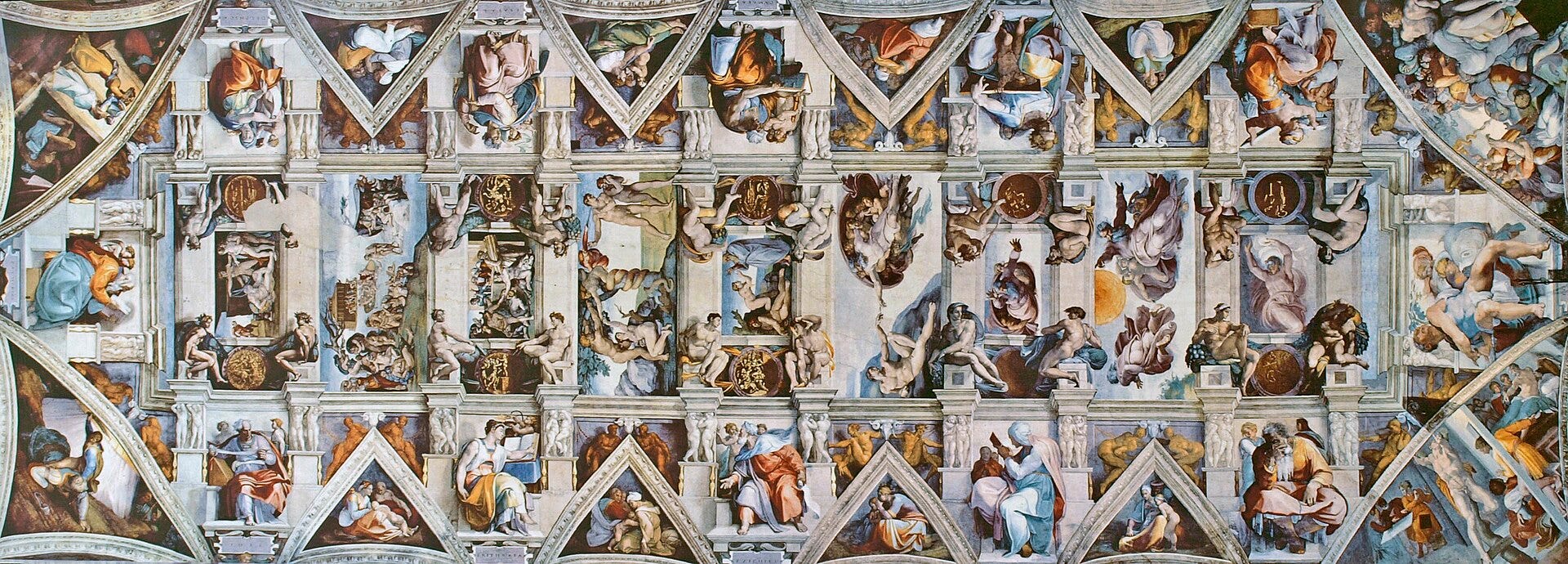
Years earlier, it was Bramante who had maneuvered Julius II into giving the Florentine the ceiling of the Sistine Chapel. A cunning trap. Michelangelo kept insisting he was a sculptor, not a painter.
At 33, he had never painted a fresco. Hand an immense vault to a man who had never painted a wall, and his pride would break. The insolent rival would be gone for good.
Bramante hates him. Their visions could not be further apart. Bramante believes in classical harmony, balance, the calm of a clean line. Michelangelo bends the rules in pursuit of raw emotion, the force of a gesture, bodies in sweeping motion.
For two years, Michelangelo has been painting up there, and he has let no one see the work.
At the end of a corridor, Bramante takes out his keys. The lock turns. The door creaks open. By torchlight, a vast hall appears, smelling of fresh plaster and damp lime. On the walls, Raphael recognizes frescoes by Perugino, his old teacher in Perugia.
A huge sheet of canvas hides the ceiling. Behind a row of beams, a scaffold rises into the darkness. “Climb,” Bramante murmurs.
The boards creak with every step. Raphael raises his torch, then his eyes.
His breath stops.
What You’ll Discover
The secret Raphael steals from the Sistine
The night that would upend four centuries of painting
Julius II's cruel manipulation
How Raphael humiliates Michelangelo
Michelangelo strikes back
The final duel between the two giants
Who wins the war, and at what cost