Red Paintings: 12 Famous Works and the Story of the Color

The most famous red paintings run from Titian's flame red robes in Venice to David's bloodied bathtub in Brussels and Hokusai's glowing red Mount Fuji.

Red was the color painters reached for when a picture needed blood, power, or a flag, and these twelve pictures carry all three.

Red pigment came easier than blue but was still handled with intent, since a single patch of it can pull the eye across an entire canvas. I have picked twelve pictures where red carries the meaning, from a Venetian altarpiece to a Japanese woodblock print of a mountain at dawn. If you want the full spectrum, color in art covers how painters use every hue, not just this one.

Why red is the loudest color in art:

  • The blood color. Painters reached for red to show violence, martyrdom, and death, from a bathtub in Paris to a general's tent in Bethulia.

  • The power color. Red dye and red robes signaled rank and money, worn by popes, cardinals, and the figures painters wanted to look important.

  • The flag color. A single red flag or red cap could turn a crowd scene into a political statement, as painters of revolutions knew well.

  • The rare stroke of luck. One painter sold exactly one picture in his lifetime, for 400 francs, and it was a field the color of a sunset.


Join 170,000 readers who get the secrets behind the paintings. Free.

1. Titian, Assumption of the Virgin (1516 to 1518)

Titian Assumption of the Virgin red robe altarpiece
Titian, Assumption of the Virgin, 1516 to 1518, Basilica dei Frari, Venice

Titian paints the Virgin rising into a gold sky in a warm red robe, a color he mixed from vermillion layered with a red glaze and returned to again and again across his career. The color became so tied to him that art historians still use the term Titian red for the warm reddish gold he gave his sitters' hair.

The altarpiece was so large, close to seven meters tall, that the friars of the Frari church in Venice worried it would overwhelm their choir screen and asked Titian to lower his price. He refused, the picture stayed exactly where he installed it in 1518, and it remains there today.

2. Rembrandt van Rijn, The Jewish Bride (about 1665)

Rembrandt Jewish Bride red dress painting
Rembrandt van Rijn, The Jewish Bride, about 1665, Rijksmuseum, Amsterdam

Rembrandt builds the woman's dress from thick red paint applied as much with a palette knife as a brush, some of it laid on so heavily it stands up from the canvas in ridges. The red dominates the picture even though the couple's faces and hands stay in soft, quiet light.

Nobody knows for certain who the couple actually is. The nickname Jewish Bride was given by a 19th century collector who guessed at a Jewish wedding scene, a guess that stuck even though scholars have proposed half a dozen other identities since.

3. Jacques Louis David, The Death of Marat (1793)

David Death of Marat red blood bath
Jacques Louis David, The Death of Marat, 1793, Royal Museums of Fine Arts of Belgium, Brussels

David paints the French journalist and political leader Jean Paul Marat just after his murder in his bath, blood already spreading through the bathwater and staining the cloth beneath him. David keeps the palette almost entirely bare except for that one pool of red, so every eye stays on the wound.

David was a friend of Marat and a fellow member of the National Convention, and he painted the scene from memory within months of the killing. The picture hung in the Convention's own meeting hall as political propaganda before it later moved to Brussels, where it still hangs.

4. Eugene Delacroix, Liberty Leading the People (1830)

Delacroix Liberty Leading the People red flag cap
Eugene Delacroix, Liberty Leading the People, 1830, Musee du Louvre, Paris

Delacroix gives the allegorical figure of Liberty a red cap, the same red repeated in the flag she carries and the trousers of the boy beside her, tying the whole composition together across a crowded, smoky scene.

Delacroix painted it within months of the July Revolution of 1830, which he had watched firsthand in Paris. The French government bought the picture soon after, then kept it out of public view for years because officials worried the image itself might encourage further revolt.

5. J.M.W. Turner, The Fighting Temeraire (1839)

Turner Fighting Temeraire red orange sunset
J.M.W. Turner, The Fighting Temeraire, 1839, National Gallery, London

Turner paints an old warship being towed off to be broken up for scrap, dragged by a small black steam tug, the whole sky behind them lit in a deep red and orange sunset. The red sky reads as both a literal sunset and the end of an era of sail.

Turner never revealed which tug actually did the towing, and the ship's position in his painting does not match the historical record exactly. He turned down several offers to buy the picture during his lifetime and left it to the British nation in his will instead.

6. Vincent van Gogh, The Red Vineyard (1888)

Van Gogh Red Vineyard sunset field
Vincent van Gogh, The Red Vineyard, 1888, Pushkin Museum, Moscow

Van Gogh paints a group of workers picking grapes under a red sky, the whole field turned the color of the sunset, with a river running gold and green through the middle of the composition.

It was the only painting Van Gogh sold during his lifetime. The Belgian painter and collector Anna Boch bought it in 1890 for 400 francs, just months before Van Gogh's death, and the picture now hangs in the Pushkin Museum in Moscow.

7. Caravaggio, Judith Beheading Holofernes (1599)

Caravaggio Judith Beheading Holofernes red blood
Caravaggio, Judith Beheading Holofernes, 1599, Palazzo Barberini, Rome

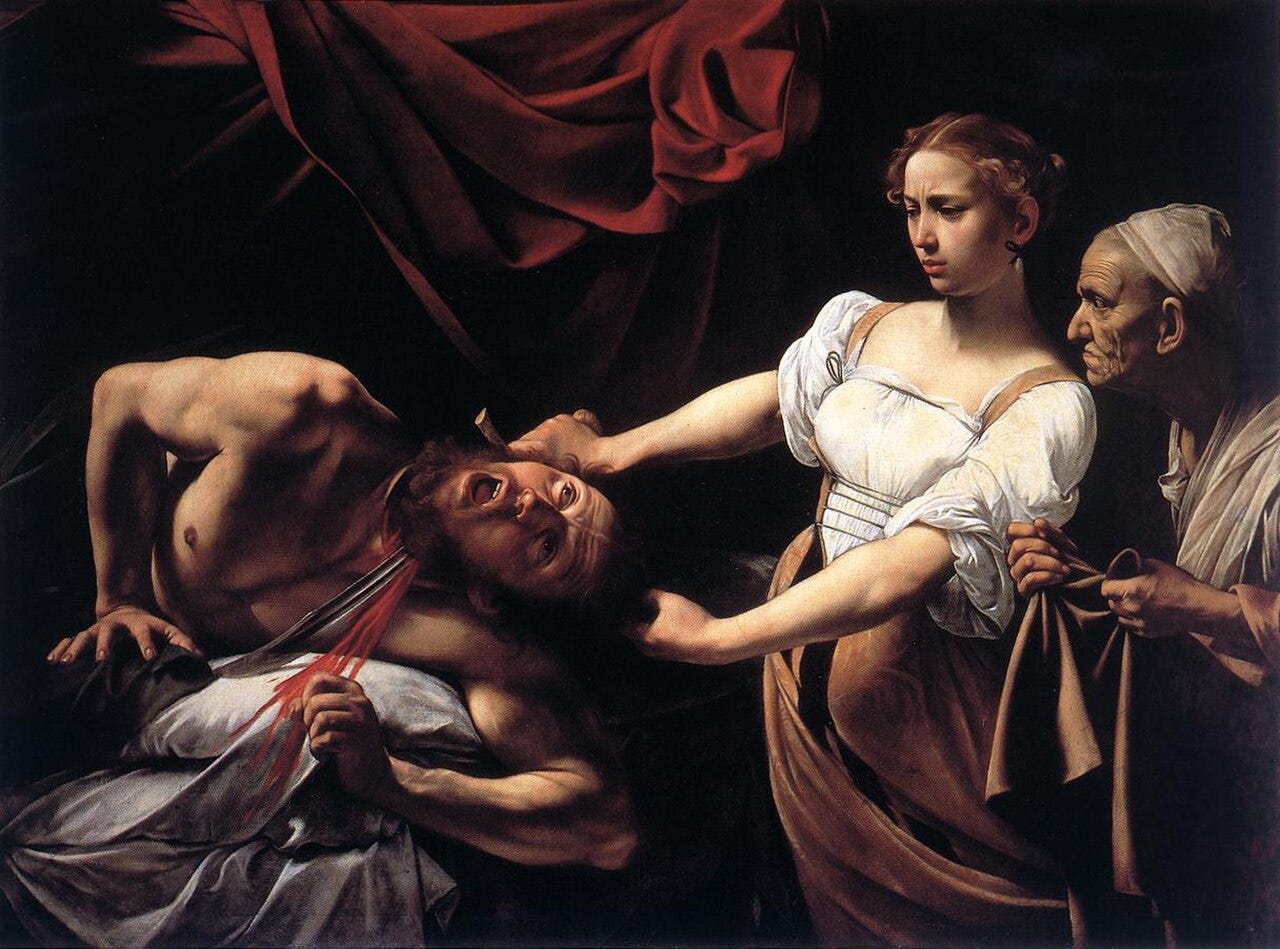
Caravaggio paints the moment of the beheading itself, a jet of red blood arcing from the wound as Judith pulls the sword through the general's neck, her face caught between effort and disgust rather than triumph.

Caravaggio is thought to have used a real Roman courtesan, Fillide Melandroni, as the model for Judith. The painting stayed unknown to modern scholars until it turned up in a private Roman collection in the early 20th century.

8. Diego Velazquez, Portrait of Pope Innocent X (1650)

Velazquez Pope Innocent X red cape portrait
Diego Velazquez, Portrait of Pope Innocent X, 1650, Galleria Doria Pamphilj, Rome

Velazquez surrounds the pope entirely in red, from his cape and cap to the curtain and chair behind him, using at least half a dozen different reds so the fabric never goes flat despite the single dominant color.

When Innocent X first saw the finished portrait he reportedly said it was too truthful, unhappy with how unflattering his own likeness looked. The painting has never left the family that commissioned it and still hangs in the Palazzo Doria Pamphilj in Rome.

9. Artemisia Gentileschi, Judith Slaying Holofernes (about 1620)

Artemisia Gentileschi Judith Slaying Holofernes red blood
Artemisia Gentileschi, Judith Slaying Holofernes, about 1620, Uffizi Gallery, Florence

Gentileschi paints the same subject as Caravaggio but pushes further into violence, blood spraying across the sheets as two women, Judith and her maid, hold the general down together to finish the act.

Gentileschi painted at least two full versions of this composition. She had testified in a rape trial against the painter Agostino Tassi a few years earlier, and art historians have long read the force of these Judith paintings against that history.

10. Peter Paul Rubens, The Elevation of the Cross (1610 to 1611)

Rubens Elevation of the Cross red drapery
Peter Paul Rubens, The Elevation of the Cross, 1610 to 1611, Cathedral of Our Lady, Antwerp

Rubens fills the central panel of this altarpiece with straining red drapery and red robed figures hauling the cross upright, the diagonal composition pulling the eye up through the scene.

Rubens painted it for an Antwerp church soon after returning from eight years in Italy, and the diagonal, muscular composition shows how closely he had studied Caravaggio and Michelangelo while he was there. It still hangs in the Cathedral of Our Lady, the church it was made for.

11. Claude Monet, Poppy Field near Argenteuil (1873)
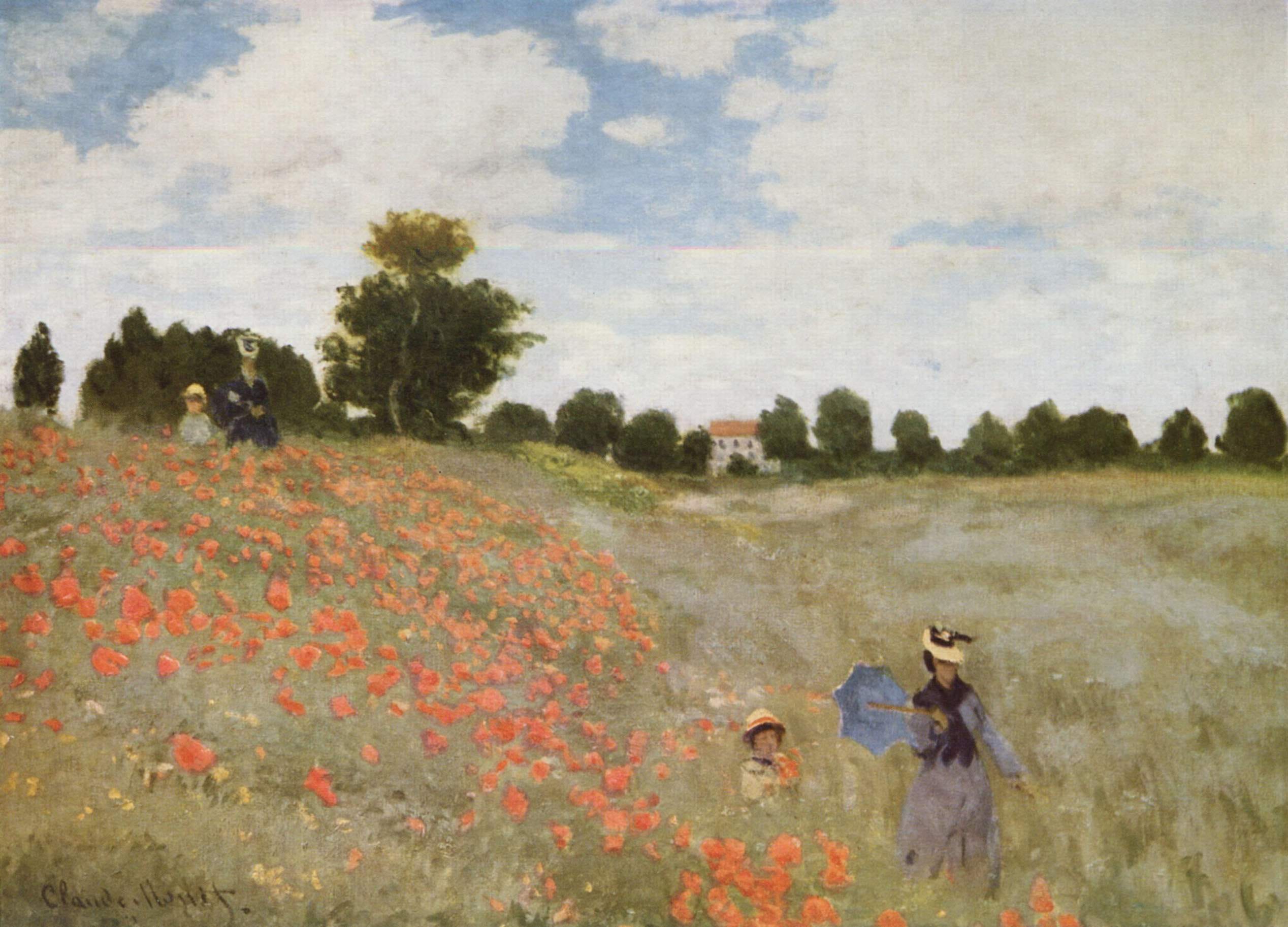
Claude Monet Poppy Field near Argenteuil red poppies meadow
Claude Monet, Poppy Field near Argenteuil, 1873, Musee d'Orsay, Paris

Monet paints a hillside scattered with red poppies under a wide summer sky, his wife and son walking through the grass in the middle distance. He lets small dabs of pure red stand for the flowers rather than painting any single bloom in detail.

Monet painted at least two nearly identical versions of this scene in the same summer of 1873. It has been in French national collections since the early 20th century and now hangs in the Musee d'Orsay in Paris.

12. Katsushika Hokusai, Red Fuji, or South Wind, Clear Sky (about 1830 to 1832)

Hokusai Red Fuji South Wind Clear Sky woodblock print
Katsushika Hokusai, South Wind, Clear Sky, about 1830 to 1832, Metropolitan Museum of Art, New York

Hokusai turns Mount Fuji entirely red under a clear morning sky, a rare condition when early light hits the mountain's iron rich soil after a late summer snow has mostly melted. He builds the print from a handful of flat color blocks, with almost no outline around the mountain itself.

It is one of the original 36 prints Hokusai planned for his Thirty Six Views of Mount Fuji series, which proved so popular that he added ten more afterward. The Prussian blue outline used across the series had only recently become cheap enough for mass printing, which is part of why Hokusai used it so often.


Join 170,000 readers who get the secrets behind the paintings. Free.

Where the reds hang today

  • Titian, Assumption of the Virgin: the Basilica dei Frari, Venice.

  • David, The Death of Marat: the Royal Museums of Fine Arts of Belgium, Brussels.

  • Van Gogh, The Red Vineyard: the Pushkin Museum, Moscow.

  • Velazquez, Portrait of Pope Innocent X: the Galleria Doria Pamphilj, Rome.

  • Delacroix, Liberty Leading the People: the Musee du Louvre, Paris.


Join 170,000 readers who get the secrets behind the paintings. Free.

Red without the confusion

  • What is Titian red? A warm reddish gold hair color named after Titian, who painted it on so many of his sitters that the shade became linked to him.

  • Why is red linked to blood in painting? Red pigment reads instantly as blood, so painters use it to mark violence or martyrdom without needing to explain the scene.

  • What was the only painting Van Gogh sold? The Red Vineyard, bought by the painter Anna Boch in 1890 for 400 francs, months before Van Gogh's death.

  • Why does Hokusai's Fuji look red? A rare mix of clear autumn light and the mountain's iron rich soil turns Fuji red at dawn for a few weeks each year, which Hokusai captured in this print.

  • What pigment made red paint? Painters used vermillion, ground from the mineral cinnabar, along with cheaper red lakes made from insects or plants for glazes.

The color that sold once, and the color a pope called too honest

Line these twelve up and red keeps doing the same handful of jobs: marking blood, marking power, marking a flag worth dying for. Titian spent a whole career refining his reds, David used exactly one pool of it to turn a bathtub into propaganda, and a pope complained that his own portrait had painted him too honestly in it.

Van Gogh sold exactly one painting during his lifetime, for 400 francs in 1890, months before his death. It was a field of grapevines under a red sky, and it now hangs in the Pushkin Museum in Moscow.