Religious painting is not one genre but a system: altarpieces that taught scripture, church walls that staged devotion, angels who carried the sacred between worlds, and visions of hell and death that made the stakes of faith impossible to ignore.
For most of Western art history, the church was the client. It paid for the panels, chose the subjects and decided what a believer needed to see on the way in and on the way out of a building.
That system had four moving parts, and painters returned to all of them for centuries. Scripture itself, told scene by scene. The building that held the scene. The angel who delivered the message or the soul. And the judgment waiting at the end, heaven on one side, hell on the other.
This page is the map between those four parts, and the five deep dives that cover them in full.
The Scenes That Taught a Faith

Before most people could read, a painting was often the only version of the Bible they would ever see. An altarpiece or a church wall had to convince, instruct and move a viewer in a single glance.
The oldest image on this site's list is a bearded Christ raising one hand in blessing, painted in hot wax around the year 550 and still hanging in a monastery on Mount Sinai. The panel survives largely because that monastery, remote and defensible, escaped the waves of icon destruction that wiped out almost every Christian image of its age.
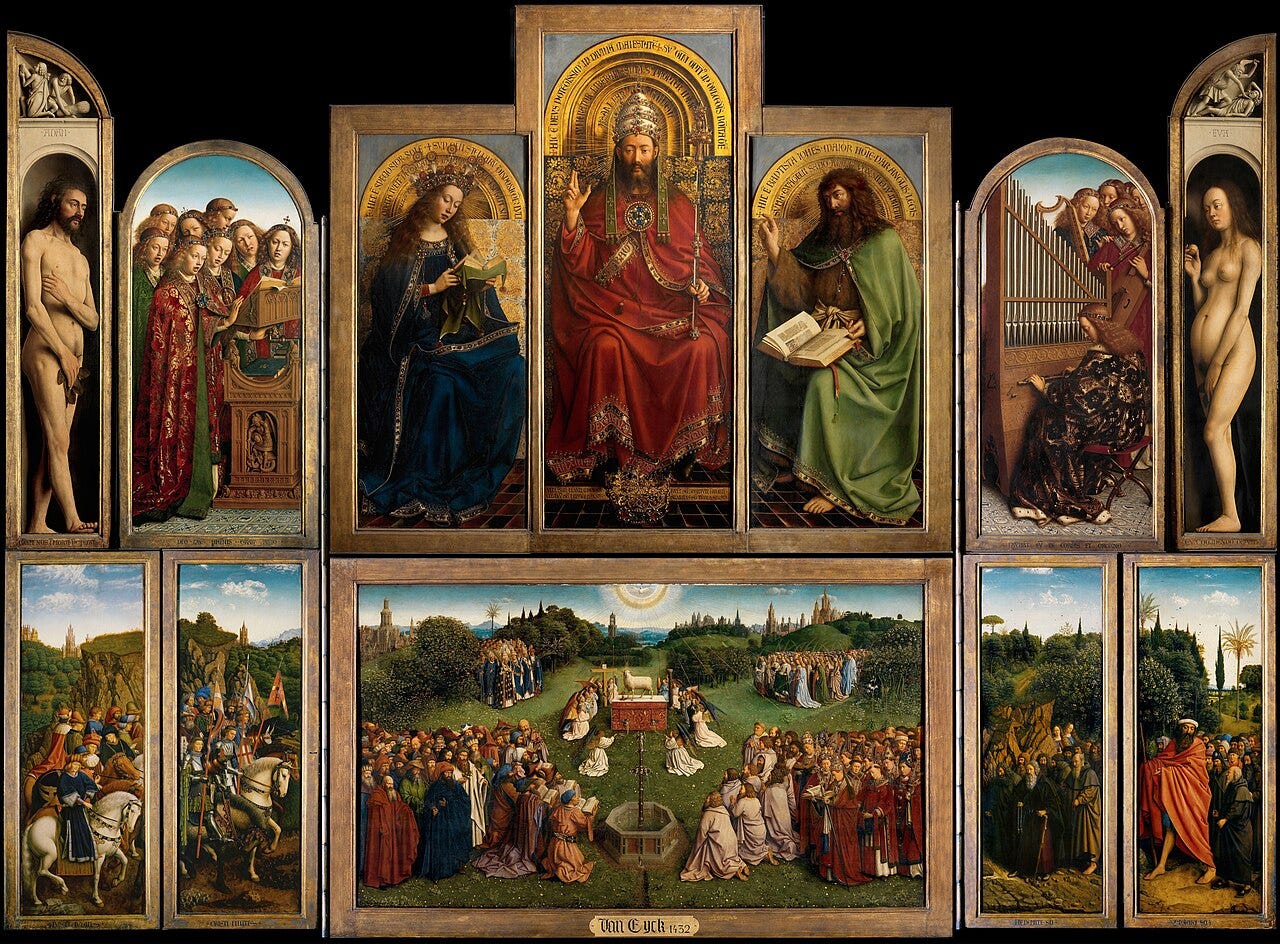
Six centuries later, Giotto put weight and grief into sacred bodies for the first time, in a chapel paid for by a banker atoning for lending money at interest. Two centuries after that, the Ghent Altarpiece became the most stolen artwork in history, and one of its panels, taken in 1934, has never been found.
The Buildings Painters Kept Returning To
A church gives a painter something rare: a long space with parallel lines, a controlled light source, and a room full of people willing to sit still. It is a perspective exercise you are allowed to sell.
Some of the most interesting church paintings are Dutch, and Protestant, and painted after the images inside were taken down. A painter would spend months rendering a whitewashed wall where an altarpiece used to hang, and sell the picture to the same congregation that removed it.
Monet took the opposite approach and painted one Gothic front more than thirty times, tracking how the stone itself seemed to change color with the hour. And the Sistine Chapel's most famous surface, the ceiling, was not the first to be painted. Botticelli, Perugino, Ghirlandaio and Rosselli finished the side walls in 1481 and 1482, a full twenty five years before Michelangelo arrived.
All twelve buildings, empty and full, real and invented, are in Churches and Cathedrals in Painting: 12 Works and the Light.
Messengers With Wings
Angels solve a problem no other figure in religious art can. They let a painter show something crossing between heaven and earth, in a single body, without a word of narration.
That range is wide. Two half bored cherubs leaning on a ledge at the bottom of Raphael's Sistine Madonna became, by the nineteenth century, the most reproduced angels on earth. At the other end, Rubens painted an entire army of rebel angels hurled screaming out of heaven, their beauty warping into something monstrous as they fall.
Leonardo, still in his twenties, studied real birds so his angel's wings in his Annunciation would look capable of actual flight. Four centuries later, Hugo Simberg painted a wounded, bandaged angel carried on a stretcher by two ordinary boys. Finnish voters later named it their national painting.
All twelve, messengers and warriors alike, are in Angel Paintings: 12 Famous Works to Know.
What the Judgment Threatened
Religious painting did not only promise heaven. For a thousand years, the same churches that taught scripture also commissioned fear, and hell was where that fear got a face.
Giotto put his hell on the exit wall of the Scrovegni Chapel, so that visitors walked out beneath a giant blue Satan swallowing sinners whole, the last image they saw before leaving the building. Luca Signorelli's demons at Orvieto Cathedral were studied closely by Michelangelo before he painted his own Last Judgment in the Sistine Chapel three decades later.
This page treats hell as theology rather than horror: the second half of a promise a church made to its congregation, heaven on one wall, hell on the other. For the fuller account of damnation as a genre in its own right, including the sinner whose backside Bosch turned into sheet music, see Hell in Painting: 12 Famous Visions of Damnation.
The Angel Who Comes For You
Death in European painting almost never arrives as a skeleton by accident. That figure was invented late, spreading across Europe only after the Black Death of 1347 to 1351. Before it, and alongside it for centuries afterward, death arrived as an angel.
That angel is usually calm rather than monstrous, a tradition that reaches Christian art through older Jewish and Islamic images of a named angel who takes the soul without cruelty. It is why so many deathbed paintings show a serene winged figure at the bedside instead of a scythe.
Painters kept both versions of death running side by side for four hundred years, sometimes in the same building, sometimes in the same altarpiece. The full account, including the print series that gave Death to every rank of society in turn, is in The Angel of Death in Painting: 12 Works and Where the Skeleton Came From.
One Altarpiece, Every Theme on This Page at Once
There is a single painting where the church, the angel, the judgment and the fate of the soul all appear in the same nine panels.
Rogier van der Weyden finished the Beaune Altarpiece around 1451 for a hospital chapel in Burgundy, founded by the chancellor Nicolas Rolin after a plague outbreak had emptied the town of a hospital it needed. Archangel Michael stands at the center, holding a scale that weighs one naked soul against another. On his right, the gate of heaven. On his left, the mouth of hell.
Rolin had the altarpiece placed where dying patients could see it from their beds. In Michael's scale, unusually for the period, the damned soul outweighs the saved one. The painting was not made to comfort a wealthy patron in a private chapel. It was made to be the last image a dying stranger saw.
Frequently Asked Questions
Why was so much art in history religious? For roughly a thousand years the church was the main patron of painting in the West, so most artists worked to its brief: teach a Bible scene, decorate a building, or prepare a viewer for judgment.
What is an altarpiece? A painting, often built from hinged panels, placed above or behind a church altar. The Ghent Altarpiece and the Beaune Altarpiece are both examples on this page, made two decades apart by artists who knew each other's work.
Why do angels appear in scenes of both heaven and hell? Angels carry messages and souls between worlds, which makes them equally useful for an Annunciation and for a Last Judgment. The same figure who tells Mary she will bear Christ can also weigh a dying stranger's soul.
Did painters really design hell to be seen on the way out of church? In at least one documented case, yes. Giotto placed his Last Judgment, hell included, on the exit wall of the Scrovegni Chapel around 1305, so it was the final image a worshipper passed under before leaving the building.
When did death start being painted as a skeleton instead of an angel? Only after the Black Death of 1347 to 1351. Before that outbreak, European painters showed death chiefly as an angel, and the two traditions ran side by side for centuries afterward.
Nicolas Rolin's hospital chapel in Beaune received almost 300,000 visitors a year by the early twenty first century, most of them coming to see the same altarpiece a dying stranger once saw from a hospital bed in 1451.