
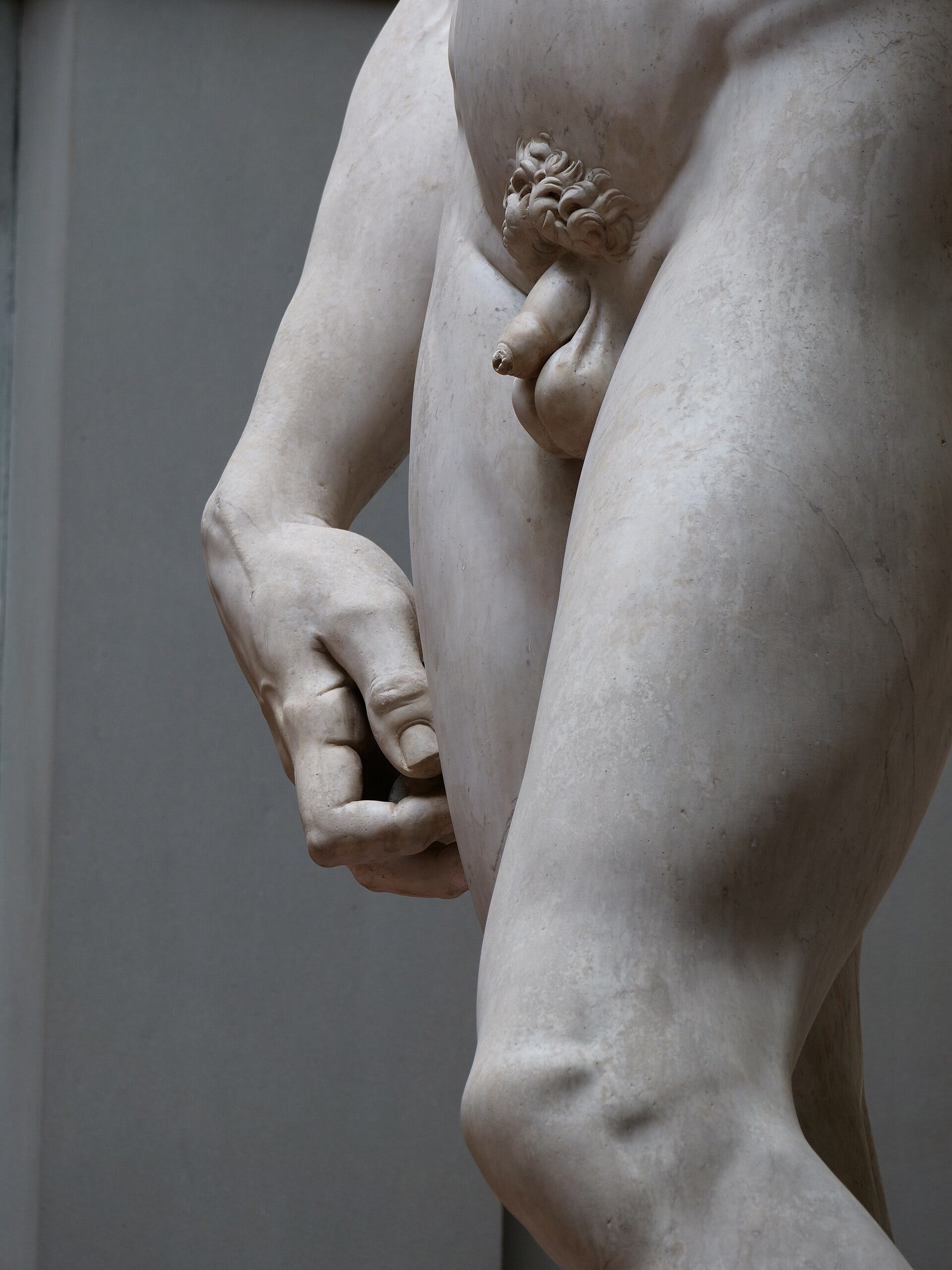
Renaissance art, made in Italy from about 1400, shows a calm and balanced moment, with the main figure settled at the center and the light even. Baroque art, from about 1600, shows the action while it is happening, off balance and lit from one side. The pair to look at is Michelangelo's David and Bernini's David, the same young hero carved a little more than a century apart.
Michelangelo's David was unveiled in Florence in 1504. It stands upright and still, a marble giant 517 centimeters high that scans the horizon for an enemy who has not yet appeared. Bernini carved his David in Rome in 1623 and 1624, and his young man is already twisting, with the arms drawn tight around the sling, a moment before the stone flies.
That difference is the quickest test for the two periods. A Renaissance picture holds the figure still, with the weight settled and the composition balanced around the center. A Baroque picture catches the figure in motion, with the light coming from one side. The test is simple enough to apply from across a gallery, and it has an awkward exception.
Cool Stories About Art is a newsletter to learn art the fun way.
Join 200,000+ readers and get:
10 new art stories / month
The entire archive of content (1,000+ articles)
Comment, ask questions, and chat with other readers
Raphael's School of Athens, painted between 1509 and 1511, is the standard picture of the calm half of the rule, with Plato and Aristotle at the center of the crowd and the whole fresco settling around them.
His last altarpiece, The Transfiguration, was made between 1516 and 1520, and its lower half breaks the rule. Figures gesticulate frantically around a possessed boy caught in an awkward twisting pose.
By that test, the lower half of a Renaissance masterpiece is already Baroque. And the test itself is much younger than the pictures it is used to sort. It comes from one man, writing in the nineteenth century.
Who first set the Renaissance and Baroque side by side?
The Swiss art historian Heinrich Wölfflin, in his book Renaissance und Barock of 1888. According to Britannica, the book showed that the term Baroque could be used as a stylistic designation rather than as a term of thinly veiled abuse. Until then the word had often been an insult.
His method was to compare the forms of pictures: composition, line, color and light. Britannica calls this formal stylistic analysis, and it is why a Renaissance picture and a Baroque one can be set next to each other and judged by what the eye sees. In 1915 he gathered his ideas into Principles of Art History, his chief work, which Britannica describes as a complete aesthetic system.
The same source adds that his approach is no longer widely endorsed, though it had great influence on later art historians. The test at the top of this page deserves the same verdict, useful for sorting and unreliable as a law. Two sculptures of one hero show where it works best, and Raphael's altarpiece shows where it fails.
What You'll Discover
Where Bernini put Goliath.
What stood beside Raphael's body.
What came between Raphael and Bernini.
Where these works hang today.