René Magritte: The Complete Story
Rene Magritte was the Belgian who painted impossible things in the most reasonable style on earth. Born in 1898, he gave the century its bowler hats, its pipe that is not a pipe, and skies that never quite belong to the street below.
He looked like a bank clerk, worked in his dining room, and quietly dismantled the idea that pictures tell the truth. Here is the whole trick explained, as far as he allowed.
René Magritte at a glance:
1898: born in Lessines, Belgium, eldest son of a tailor and a milliner.
1926: paints The Lost Jockey, his first picture he considered truly his, and moves to Paris the next year.
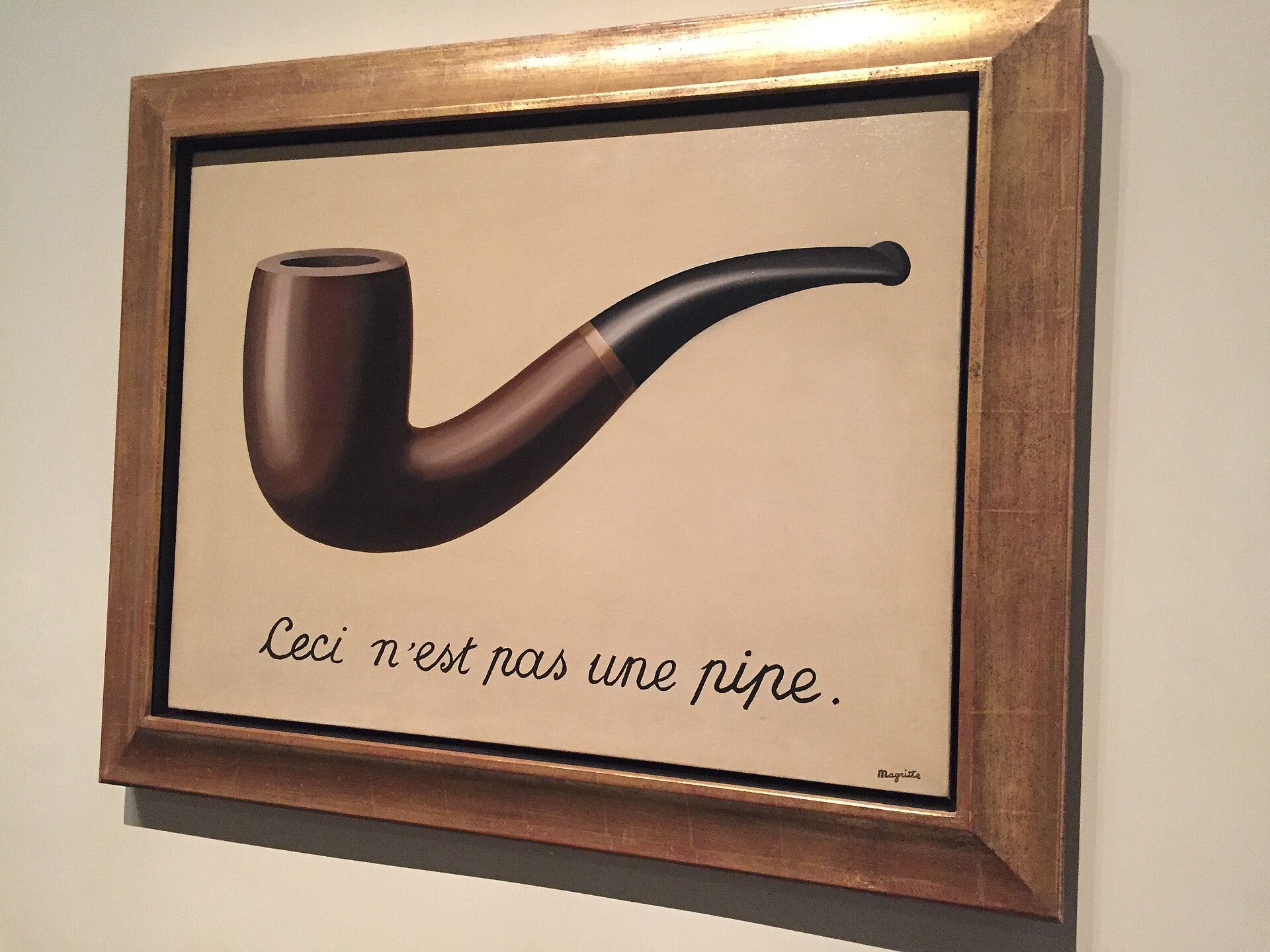
1929: The Treachery of Images, the pipe that is not a pipe, painted at 30.
1948: floods his first Paris solo show with deliberately crude vache paintings; nothing sells, and he never apologizes.
1967: dies in Brussels at 68, leaving a last Empire of Light unfinished on the dining-room easel.
Lessines, and the river
Magritte was born in 1898 in Lessines, in French speaking Belgium. The defining wound came at thirteen, in 1912, when his mother drowned herself in the Sambre; what the boy saw, and what he later claimed, is a story with its own dark folds, and we tell it in full in The Magritte River Tragedy. He rarely spoke of it. The veiled faces in his paintings have been read against it ever since.
1926, and the picture that is not a pipe
After art school in Brussels and years designing wallpaper and posters, he found his method in 1926 with The Lost Jockey and never changed course.
In 1929 he painted a pipe above the words Ceci n'est pas une pipe, The Treachery of Images: the politest bomb in art history.
Paris Surrealism claimed him from 1927 to 1930, until he quarrelled with Breton and went home to Brussels, to Georgette, and to a life of aggressive ordinariness.
More incredible painter stories
If René Magritte pulled you in, you will love these too:
The myth: the gentle dreamer
Poster shops sell Magritte as whimsy, which would have made him wince. He insisted his pictures were not dreams but demonstrations: visible thought, staged to show that the word is not the thing and the image is not either.
He painted in a suit, in the dining room, no studio, production line steady; and in 1948, for his first Paris solo show, he unleashed the vache period, deliberately loud, crude paintings made to insult the taste of the city that had patronised him.
The mild man had teeth.
Empire of Light
From 1949 he painted the Empire of Light series again and again: a nocturnal street, lamp lit, under a bright daytime sky. No trick in any single element, and no way to make them agree.
2 million dollars, the record for any Surrealist work, seven decades after critics called the idea a one liner.
The bowler hats and the last decade
The Son of Man, the apple faced man in the bowler hat, arrived in 1964, three years before his death in 1967; the image has since escaped into films, album covers and advertising more completely than any painting of its century. Magritte, who had spent the 1930s designing ads to pay rent, would have noted the irony without smiling.
Where to see Magritte
The Magritte Museum in Brussels, opened in 2009 on the Place Royale, holds more than 200 works, the world's largest collection. MoMA keeps The Lovers and The Empire of Light; the Treachery of Images hangs in Los Angeles at LACMA.
The vache period, revenge in gouache
In 1948, for his first solo show in Paris, Magritte produced thirty-nine deliberately coarse pictures in a few weeks: leering cartoon faces, sloppy paint, jokes in bad taste. The période vache, cow painting.
Paris had condescended to him for twenty years and this was the reply. Nothing sold, and Georgette hated them.
He went straight back to the smooth manner, but the show has aged into a cult: proof the calm surface was a choice, not a ceiling.
The counterfeiter's years
During the occupation he answered scarcity two ways. One was the Renoir period, feathery sunlit pastiches meant, he said, to set pleasure against catastrophe.
The other was plainer: to keep money coming in he painted fakes, Picassos, Braques, de Chiricos, and by several accounts his brother helped pass forged banknotes after the war.
Both episodes embarrass admirers, which is why they matter. The painter of impossible certainties was flexible about the real ones.
Words against pictures
Between 1927 and 1930 he made dozens of word paintings: neatly painted objects labeled with the wrong nouns, a horse called the door, a clock called the wind.
The point was the gap, not the joke: names stick to things by habit alone, and a picture can pry them apart.
When Conceptual artists of the 1960s began exhibiting printed language as art, the road led back to those Brussels canvases. Magritte had gotten there first, in oil, politely.
The René Magritte questions that keep coming up
What is he known for? The pipe that is not a pipe, bowler hatted men, and day night skies: philosophy as image.
Was he a Surrealist? Yes, Brussels branch: with the movement from the 1920s, allergic to its Paris pope.
What is the Empire of Light? His series of lamp lit streets under daytime skies, painted from 1949 onward.
When did he die? In Brussels in August 1967, at 68.
How much does a Magritte cost? A 1954 Empire of Light sold for 121.2 million dollars in New York in 2024, a record for any Surrealist work.
Did Magritte explain his paintings? He refused. Titles came afterwards, often proposed by friends at Saturday gatherings, and were chosen to deepen the mystery, never to solve it.
More secrets to unlock
Banker's hours in the kitchen
He had no studio and wanted none: he painted at an easel in the dining room, in jacket and tie, and stopped for lunch with Georgette and the Pomeranian. The most destabilising painter of his century kept banker's hours in his own kitchen, which may be the most Magritte image of all.