

170 000+ readers. Learn art the fun way.
This is a preview. Paid subscribers get the full story.
You’ll also get:
10 new stories every month
The full archive (130+ Art stories)
Your personal art guide. Comment, ask questions, DM me anytime
iPhone user? Subscribe at coolstoriesabout.art, not via the app. Apple adds 30% to the price.
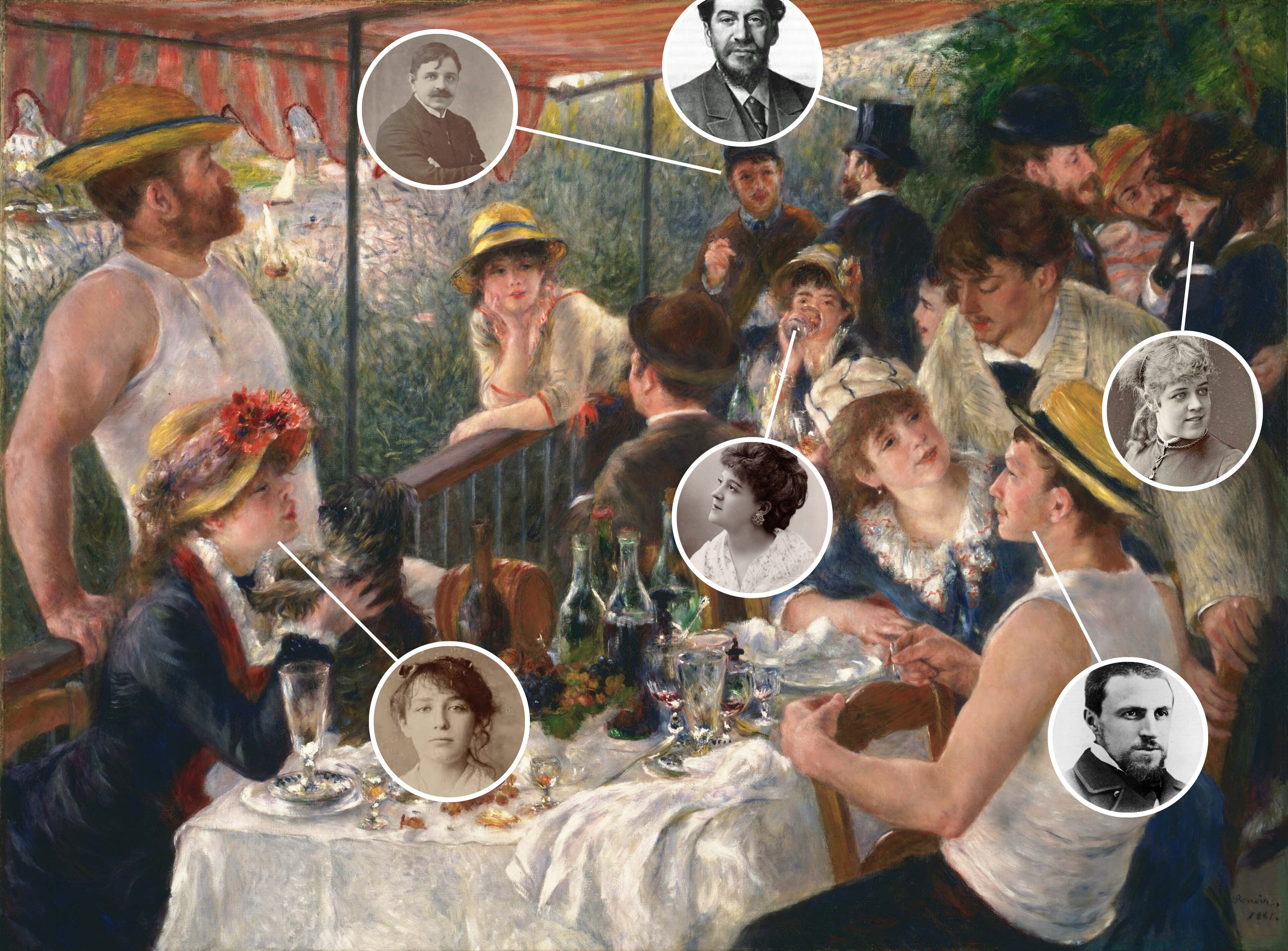
At the center of the painting, a young woman lifts a glass to her lips.
Her gaze meets no one else’s.
It’s on her face that, in the film Amélie, an old confined painter struggles year after year, obsessively copying the same painting without ever managing to figure out what she’s thinking.
The painting is called Luncheon of the Boating Party.
It’s the crown jewel of the Phillips Collection in Washington.
Pierre-Auguste Renoir painted it between the summer of 1880 and March 1881, on the terrace of an inn at Chatou, fifteen kilometers west of Paris.
Renoir is 39 years old. He’s broke. He’s just walked out of the Impressionist group after ten years of battles.
In January 1880, six months before starting the painting, he fell off his bicycle and broke his right arm. He painted for a few weeks with his left hand, and he wrote to a friend: “I think I did well to break my arm.”
At this table, they are fourteen.
Several of them will become, in the next thirty years, names around whom part of European 20th-century culture will be built.
We’ll look at them one by one.
The Inn
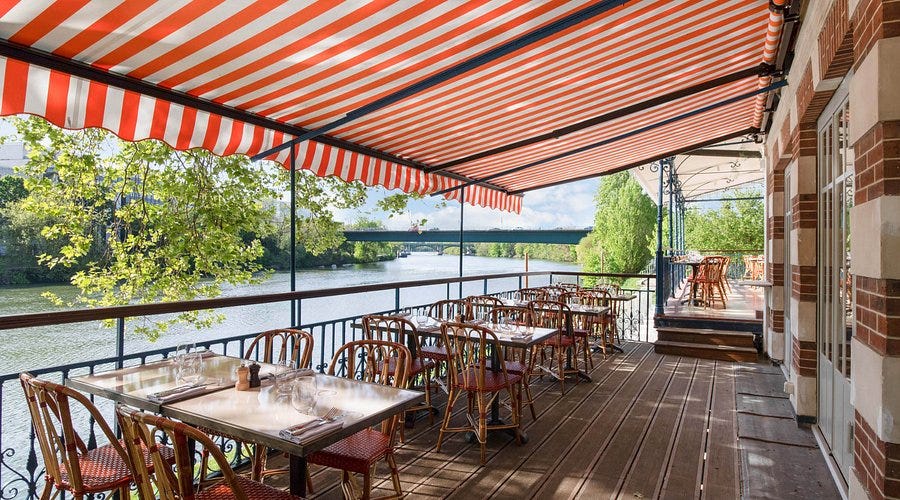
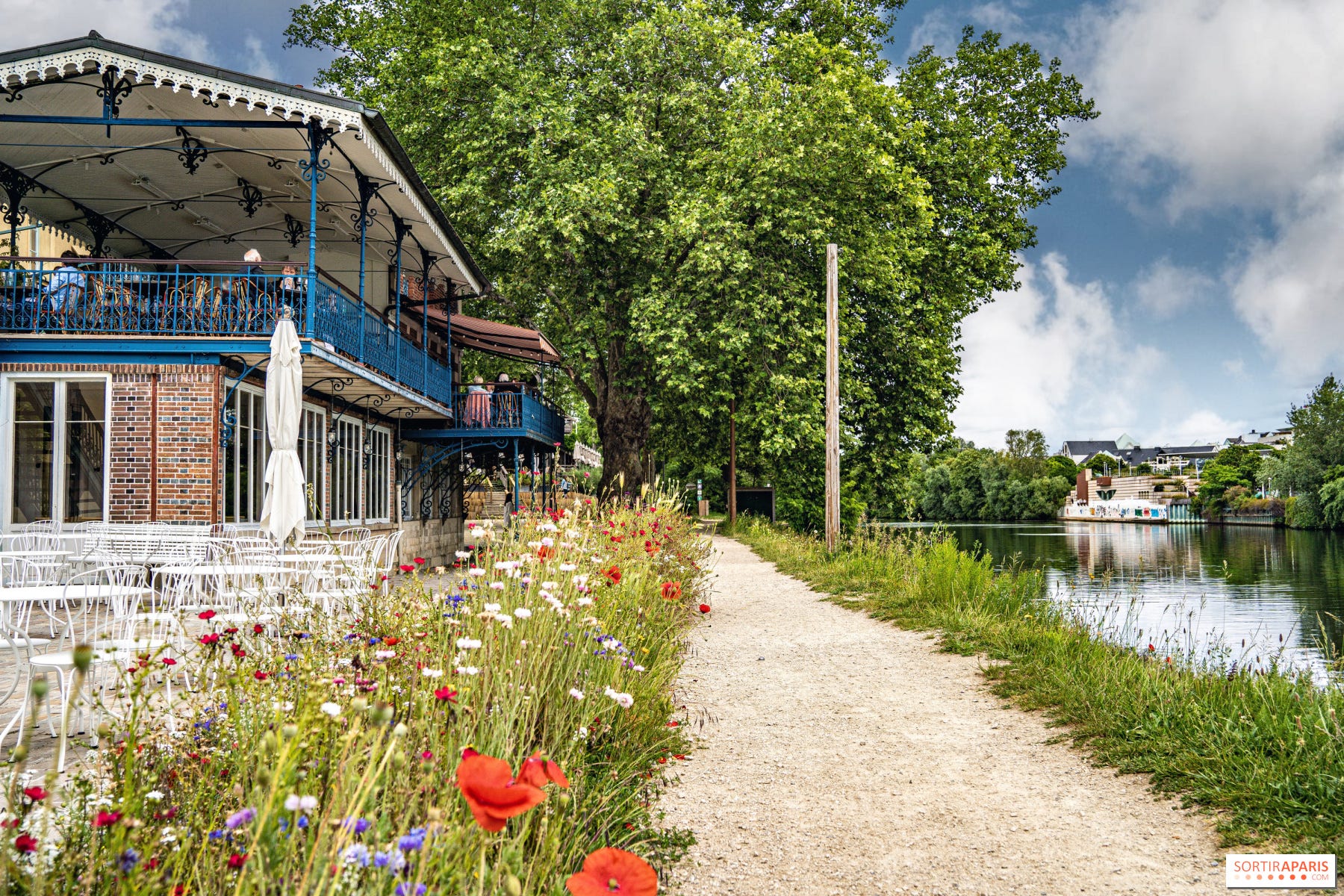
A small island in the middle of the Seine, facing the village of Chatou.
At its far end, a white two-story building: the Maison Fournaise.
In 1857, a former marine carpenter named Alphonse Fournaise senior bought the building and turned it into a restaurant doubled with a boat rental service. The success was rapid.
Twenty years later, it had become the favorite spot of Parisians wanting to escape the city on a Sunday.
It all came from a train. Since 1837, France’s very first passenger railway line had connected Paris to Saint-Germain-en-Laye, passing through Chatou.
Twenty-five minutes’ journey. One franc sixty for a one-way ticket. A clerk, a civil servant, a small shopkeeper could leave Paris at ten in the morning and have lunch here at noon.
In the dining room, at this table, in the 1880s: Parisian bourgeois, artists, actresses, civil servants, journalists, single women, barons, seamstresses.
A social mix the city allowed nowhere else.
Maupassant, a regular at the place for years, called it “le phalanstère des canotiers”, a sort of small republic of boating enthusiasts.
This is where Renoir set up his easel in the summer of 1880.
Discover my new newsletter !

Keep learning art the fun way


Aline and the Little Dog
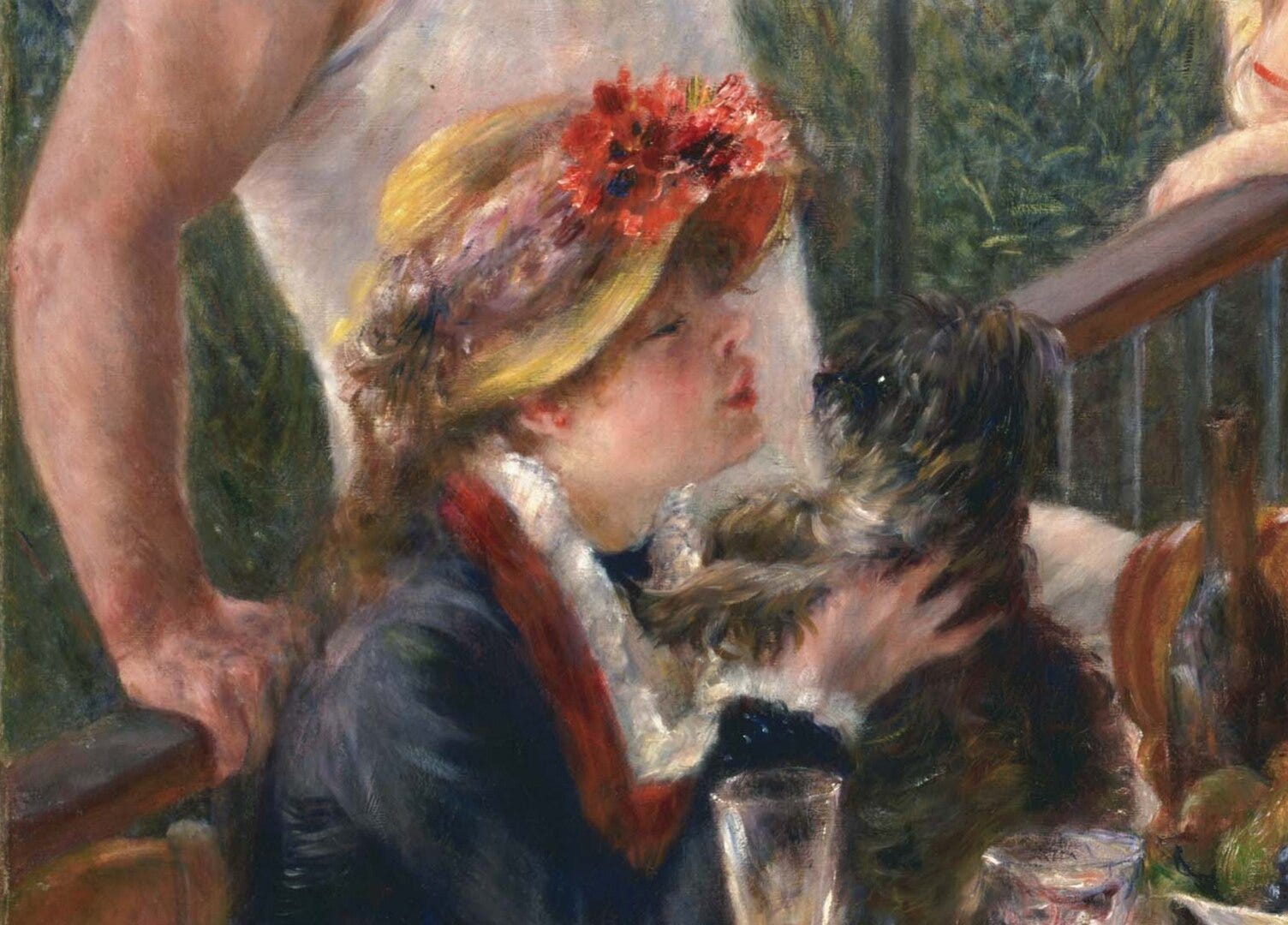
In the foreground, at the bottom left, a young woman playfully looks into the eyes of a small black dog she is holding in front of her.
She looks at nothing else.
She is 21 years old. Her name is Aline Charigot. She’s a seamstress. She comes from Essoyes, a winegrowing village in the Aube, on the edge of Champagne.
For a few months now, she’s been having lunch every day at a creamery on rue Saint-Georges, in the 9th district of Paris. She pays a few sous for her daily plate.
Pierre-Auguste Renoir, eighteen years older than her, broke, single, sleeps on the fifth floor right across the street. He comes to lunch there every day at the same time she does.
One noon, he arranged to sit at the table next to hers.
By the end of 1879, she had fallen in love with him.
In the summer of 1880, he takes her to pose at Chatou. He places her in the bottom left, in the softest light of the table.
The dog isn’t hers. Renoir placed it there later, during the execution, because at that spot there had first been someone else.
We’ll come back to this.
The Big Red-Bearded Fellow
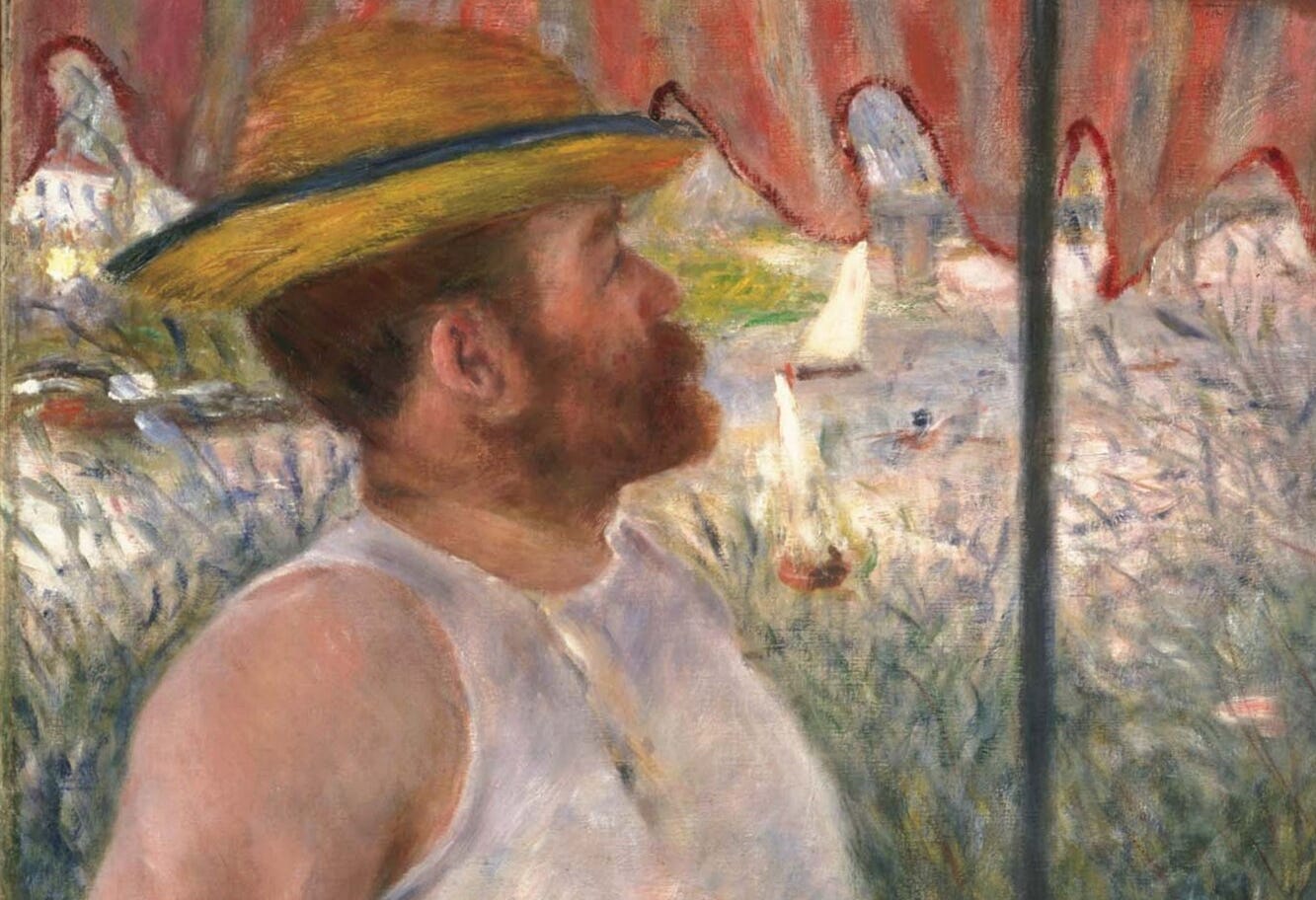
Behind Aline, standing, leaning on the wrought-iron railing, a tall guy in a white cotton singlet.
Bare arms, thick moustache, red beard, flat-topped straw hat tilted back on his head.
This is Alphonse Fournaise junior. 34 years old. The restaurateur’s son. He grew up on this island, in this inn.
He’s the one in charge of renting out the boats. He has about thirty of them. Thin rowing boats, flat-bottomed barges, even a Canadian canoe brought back from a World’s Fair.
That white singlet he’s wearing is the visual marker of a boater. Bare arms in the presence of ladies, in 1880, is a measured transgression.
At Chatou, you allow yourself what the city forbids.
Exactly one month from now, this face will be found in a book.
The Baron and the Young Widow
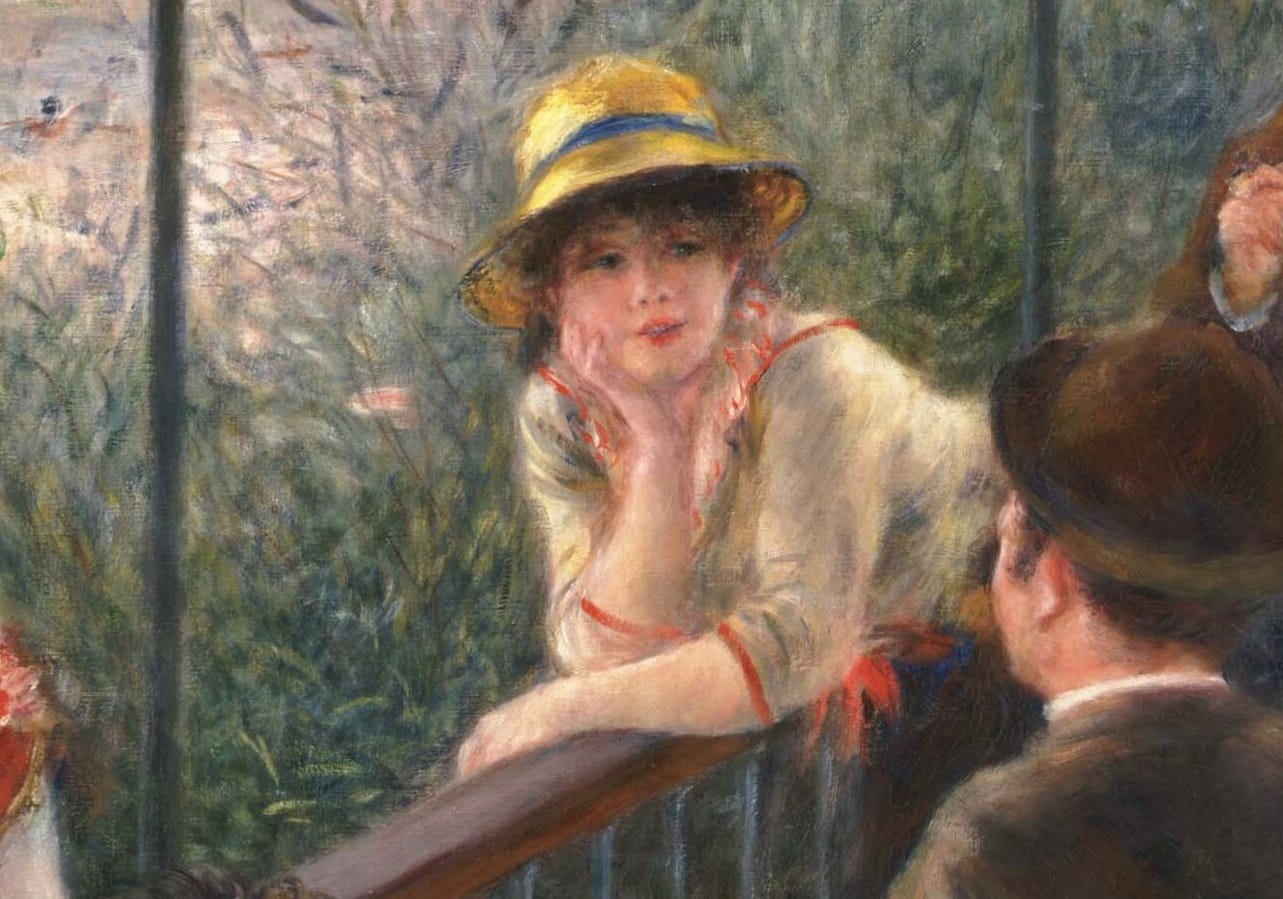
Shift your gaze to the center of the painting. Two figures are in deep conversation.
A man seated with his back to us, a brown bowler hat, a wide neck. A woman leaning on the railing, white dress with red trim, yellow straw hat, half-smile.
The man is Baron Raoul Barbier. 40 years old. Former cavalry officer. Mayor of Saigon between 1871 and 1872, at the time when France was setting up its colonial administration in Indochina (today’s Vietnam). Légion d’honneur. Bon vivant.
The woman he’s talking to is Alphonsine Fournaise. 35 years old. The restaurateur’s daughter. A young widow.
She’s the one who welcomes the guests at the inn, who handles the reservations, who knows which boat to rent at what time. Renoir had already painted her on five other canvases.
In the autumn of 1880, while Renoir is working on this painting, another young painter is setting up at Chatou to decorate the ground floor of the inn with frescoes. His name is Maurice Réalier-Dumas. He is 20 years old.
And Alphonsine is in the process of falling in love with him.
Barbier, meanwhile, talks. She listens. But her mind is on the floor below.
The Drinking Woman at the Center
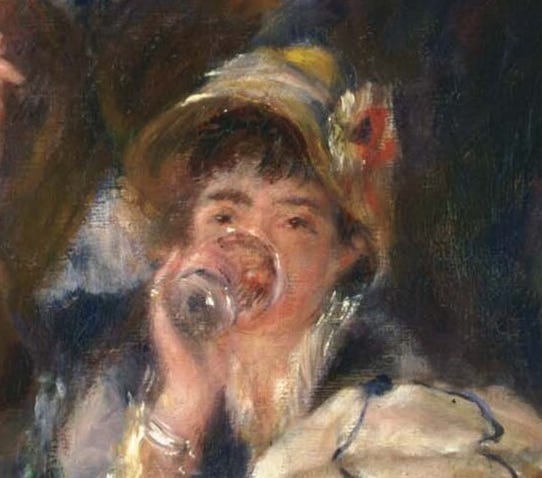
Come back to the center. To the young woman lifting a glass to her lips, the one who opens this article.
Her name is Ellen Andrée. 23 years old. Actress, model, former dancer at the Folies Bergère.
At 18, Édouard Manet paints her in La Parisienne. At 22, in La Prune. At 23, in Chez le père Lathuile.
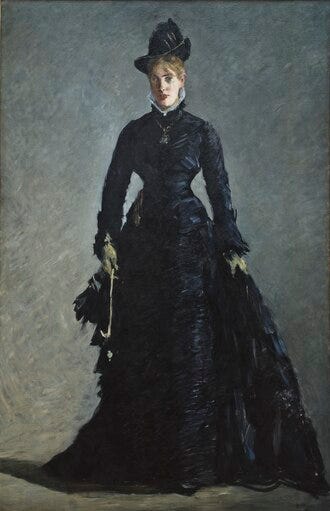
When she poses for Renoir, she’s on the rise at the Comédie-Française and the Variétés. She has posed for half the Impressionist painters in less than ten years.
She stares into space. The glass serves her as a screen.
More than a century later, a filmmaker will spend years trying to figure her out.
Remember her glass.
The Journalist and the Florist
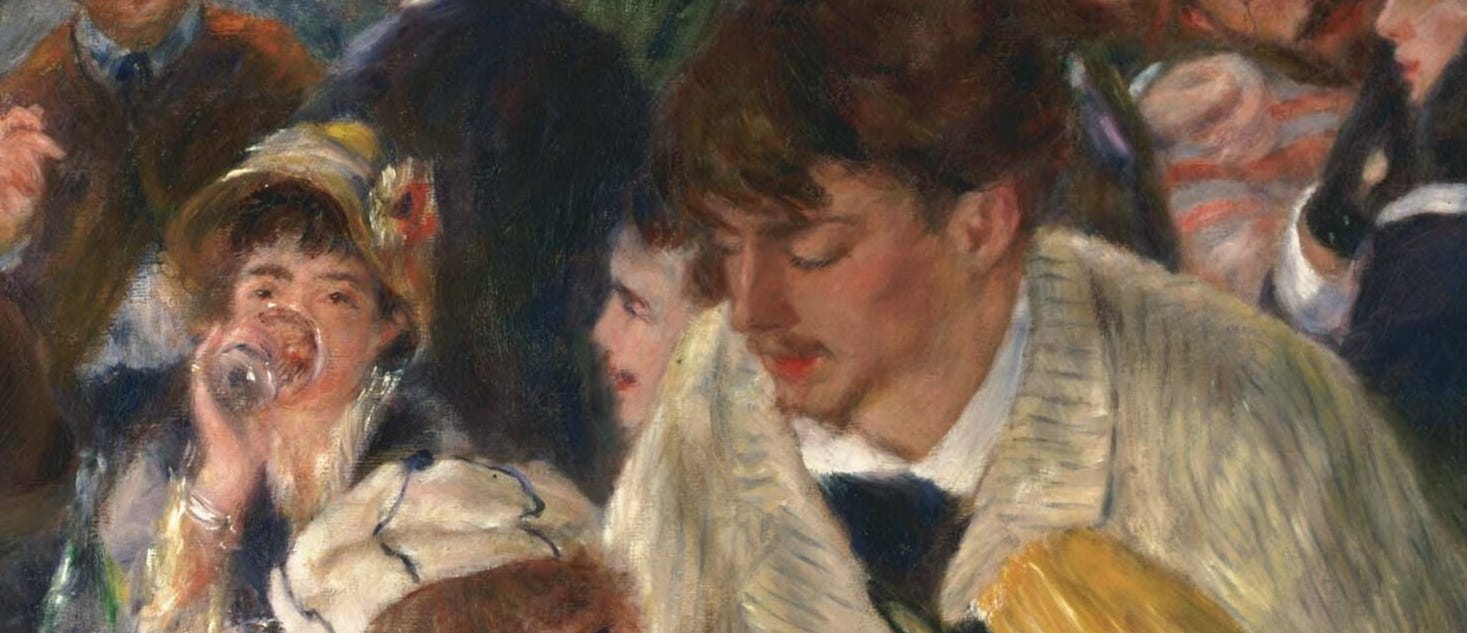
Still at the center, two figures are openly flirting.
A standing man leans toward a seated young woman who’s drinking gracefully from her glass.
The man is Adrien Maggiolo. 37 years old. A monarchist journalist, editor at L’Union then director of La France nouvelle. Six years earlier, in 1875, he had fought a sword duel for seven rounds against a fellow journalist after accusing him of cheating at cards.
The duel ended with a shared glass of Malaga wine between the two men.
The young woman he’s talking to is Angèle Legault. A florist from Montmartre, model for the painters of the hill.
Renoir said he appreciated her for her Parisian street slang.
She listens while drinking. She might well be the only person in the painting who’s actually listening to someone else.
The Boater Sitting Backwards
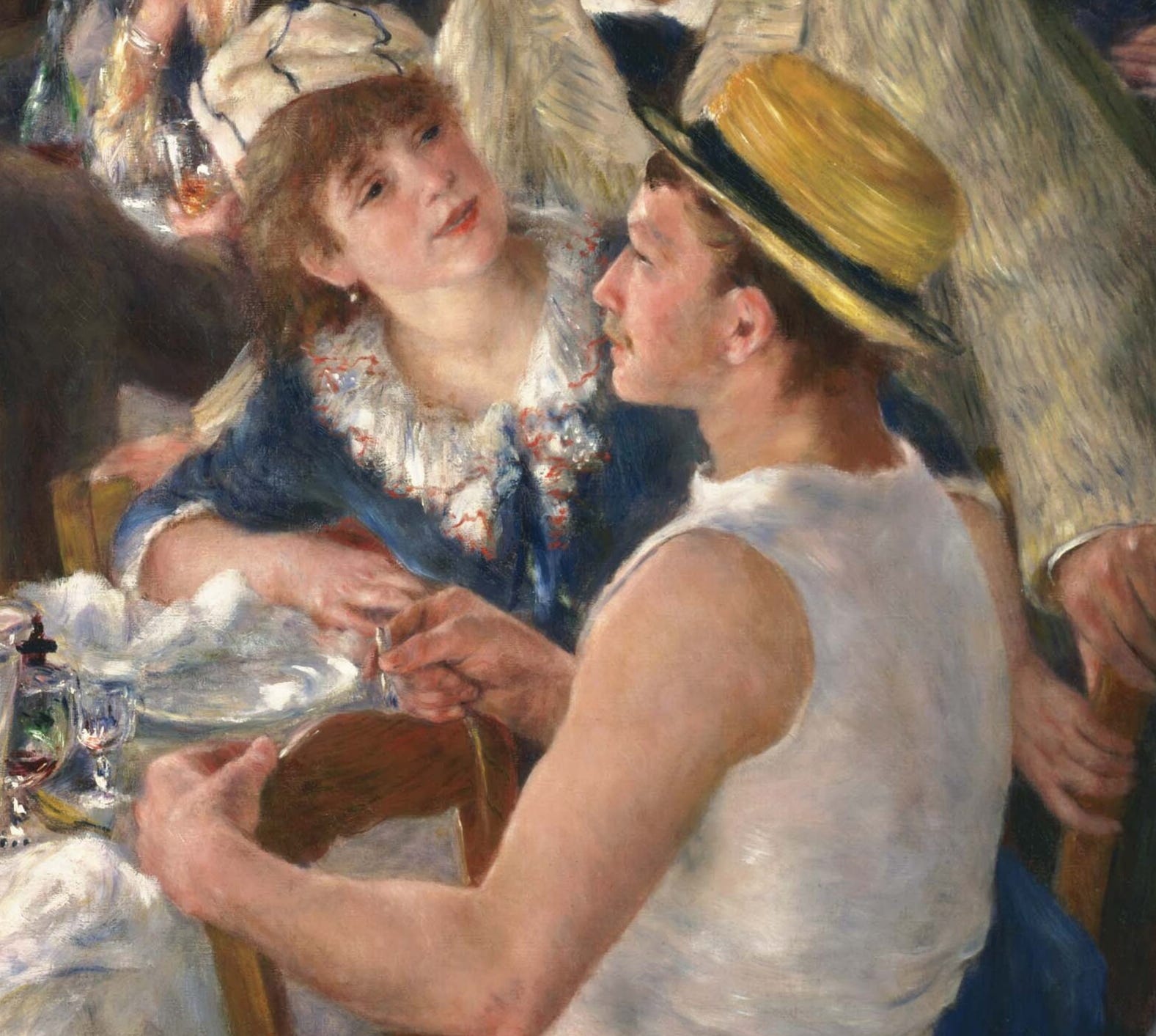
Front right. A man has sat down backwards on his chair. Arms folded over the backrest, chin almost resting on it.
He wears a white singlet identical to Fournaise’s and a straw boater hat.
This is Gustave Caillebotte. 32 years old. Painter. Amateur naval architect. Well-known regatta sailor on the lower Seine.
He comes from a family of wealthy magistrates. His father is dead, his brother is dead, his mother died in 1878. At 30, he inherited a massive fortune. He lives alone, without children.
He has just bought, in 1881, a house at Petit-Gennevilliers, on the other side of the Seine facing Chatou.
At 28, he had already drawn up his will. One of its clauses, thirteen years from now, will trigger one of the most violent cultural battles of the Third Republic.
The Banker in the Top Hat
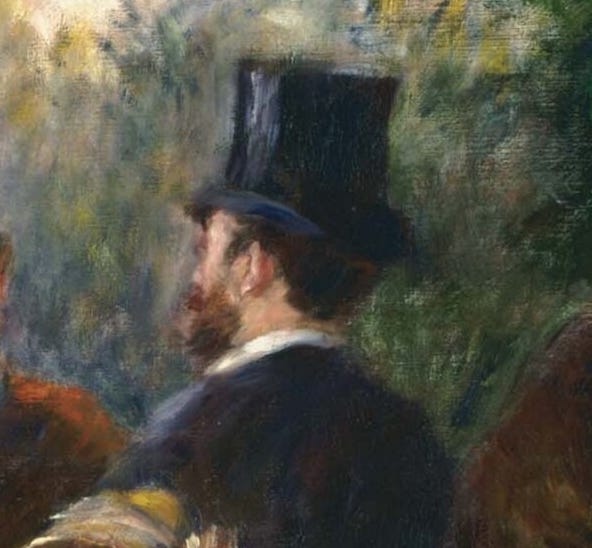
In the background to the right, among the bare heads and straw hats, one silhouette stands out.
Black suit, strict frock coat, rigid top hat firmly on his head. White shirt, collar buttoned.
Not a single concession to the heat, not a single concession to Chatou.
This is Charles Ephrussi. 31 years old. A Jewish banker from Odessa, settled in Paris for ten years in a private townhouse on rue de Monceau.
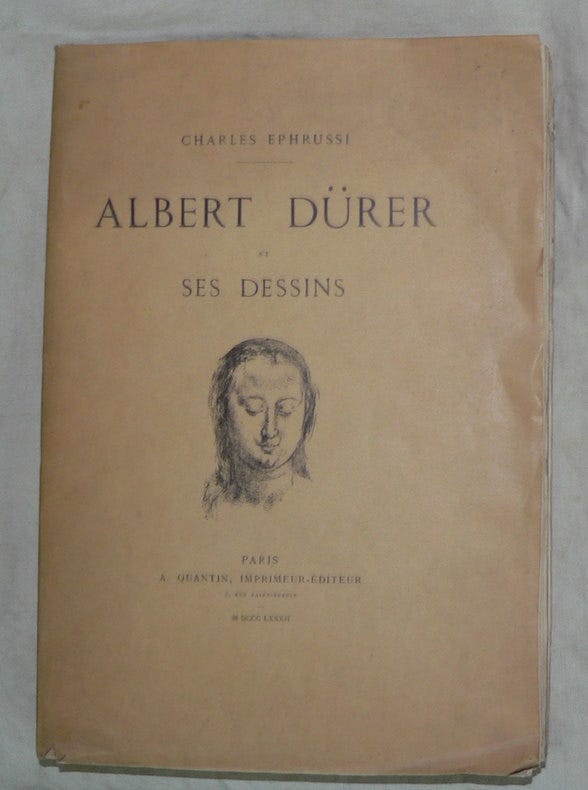
He doesn’t really do banking. His family made its fortune in the wheat trade on the Black Sea, and his grandfather was nicknamed “the wheat king”.
Charles, for his part, writes. He publishes art history essays in the Gazette des Beaux-Arts. He’s currently preparing a major monograph on Albrecht Dürer.
What he does for Renoir and his friends isn’t visible in the painting.
Right next to him, almost in his shadow, a young man in a brown jacket and soft cap. 20 years old. Not Parisian.
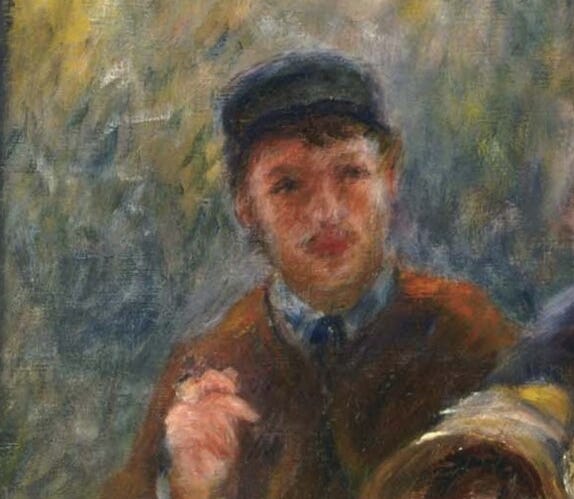
His name is Jules Laforgue, born in Montevideo, Uruguay. Destitute, he sleeps in maids’ rooms and reads all day at the Bibliothèque nationale. Ephrussi hired him in 1881 for 150 francs a month.
He’s the one who actually writes the Dürer monograph his boss is about to publish next year.
In a few months, he’ll be the official guest of an empress.
Remember his cap.
The Trio on the Right
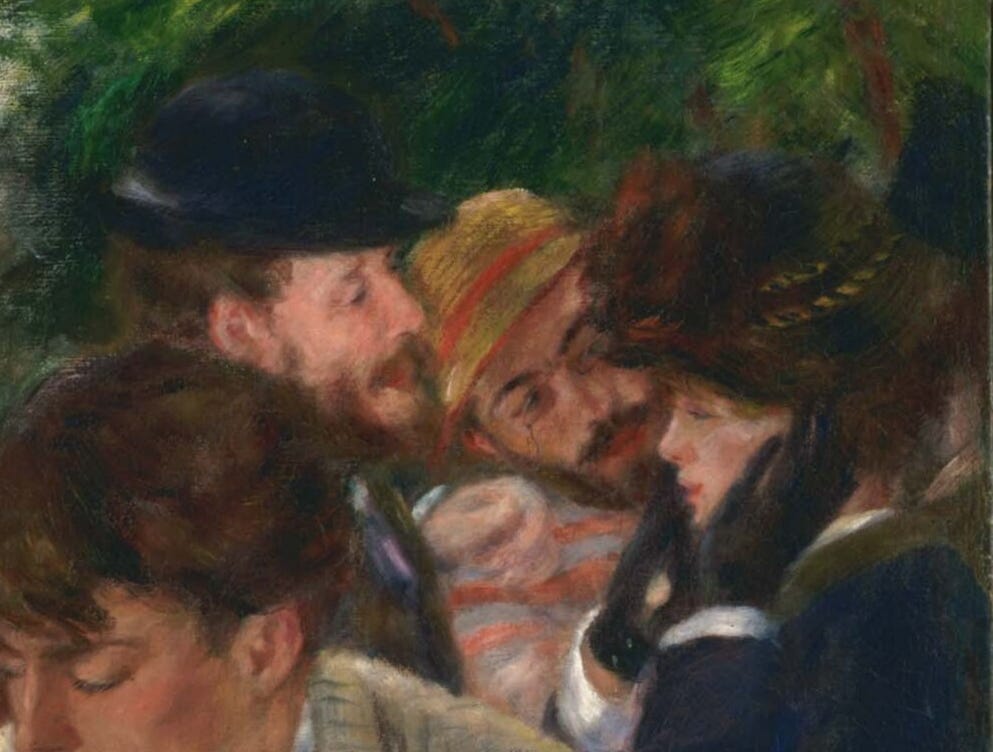
At the far right of the painting, a trio crammed into the corner. A young woman standing, two men cornering her. One by the shoulder, the other almost at her neck.
The young woman is laughing while raising her hands to cover her ears.
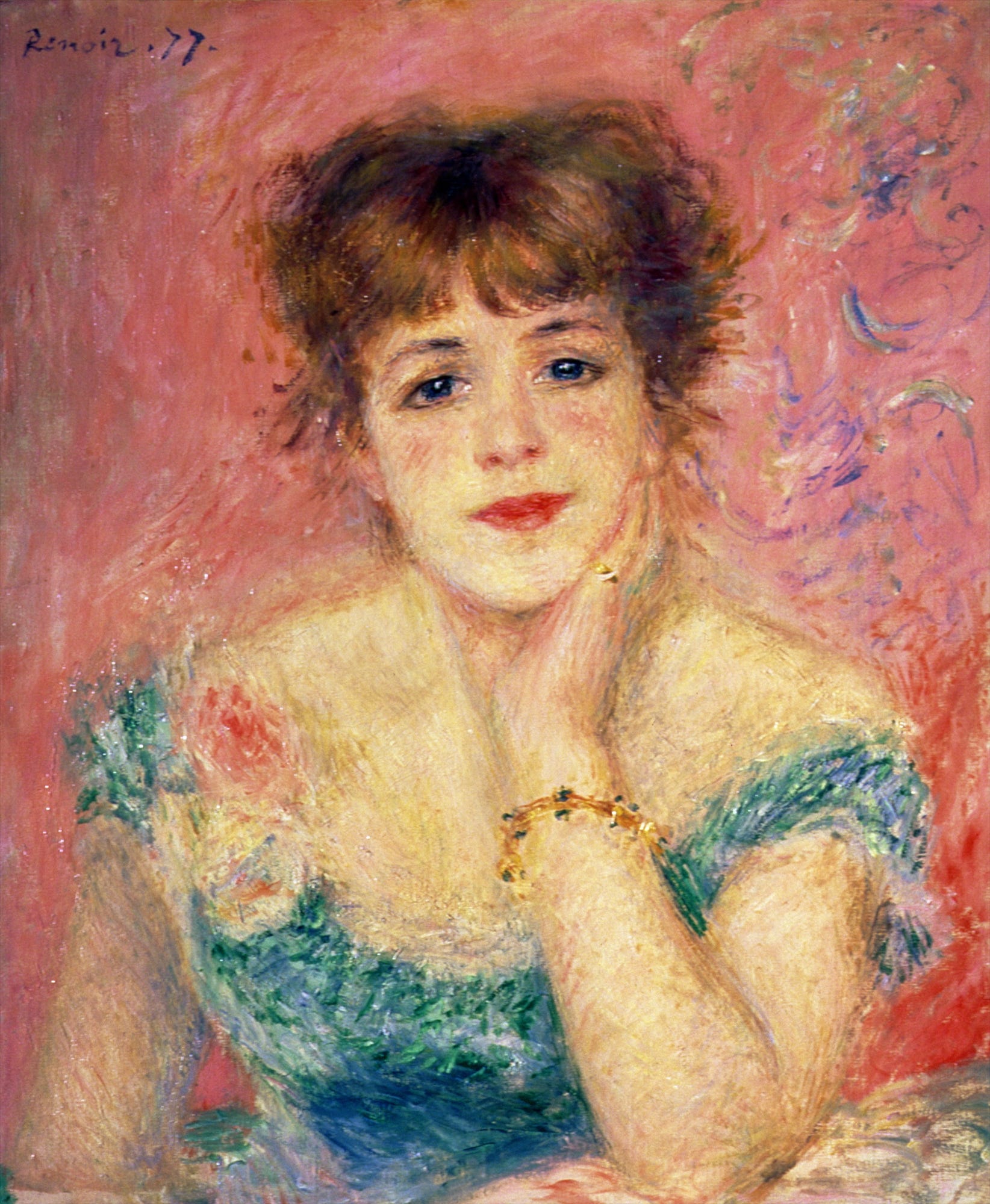
Her name is Jeanne Samary. 23 years old. A permanent member of the Comédie-Française since 5 December 1878. Specialist in comedy roles. Her father is a cellist at the Opéra. Renoir had already painted her a dozen times.
She had also been his mistress, briefly, in 1877.
The one holding her by the waist on her right wears a pince-nez and a boater hat. This is Paul Lhote. 30 years old. Sailor, weekend painter, journalist, traveler. He’s one of Renoir’s closest friends.
The other one, behind her in a dark felt hat, is Eugène-Pierre Lestringuez. A senior civil servant at the Ministry of the Interior. Impeccable dark gray suit.
Beneath the suit, a passion: the occult. He reads Éliphas Lévi, frequents spiritualist circles, believes in animal magnetism and palmistry.
He’s telling Jeanne a story. Something you don’t tell a lady in the city.
The Gazes
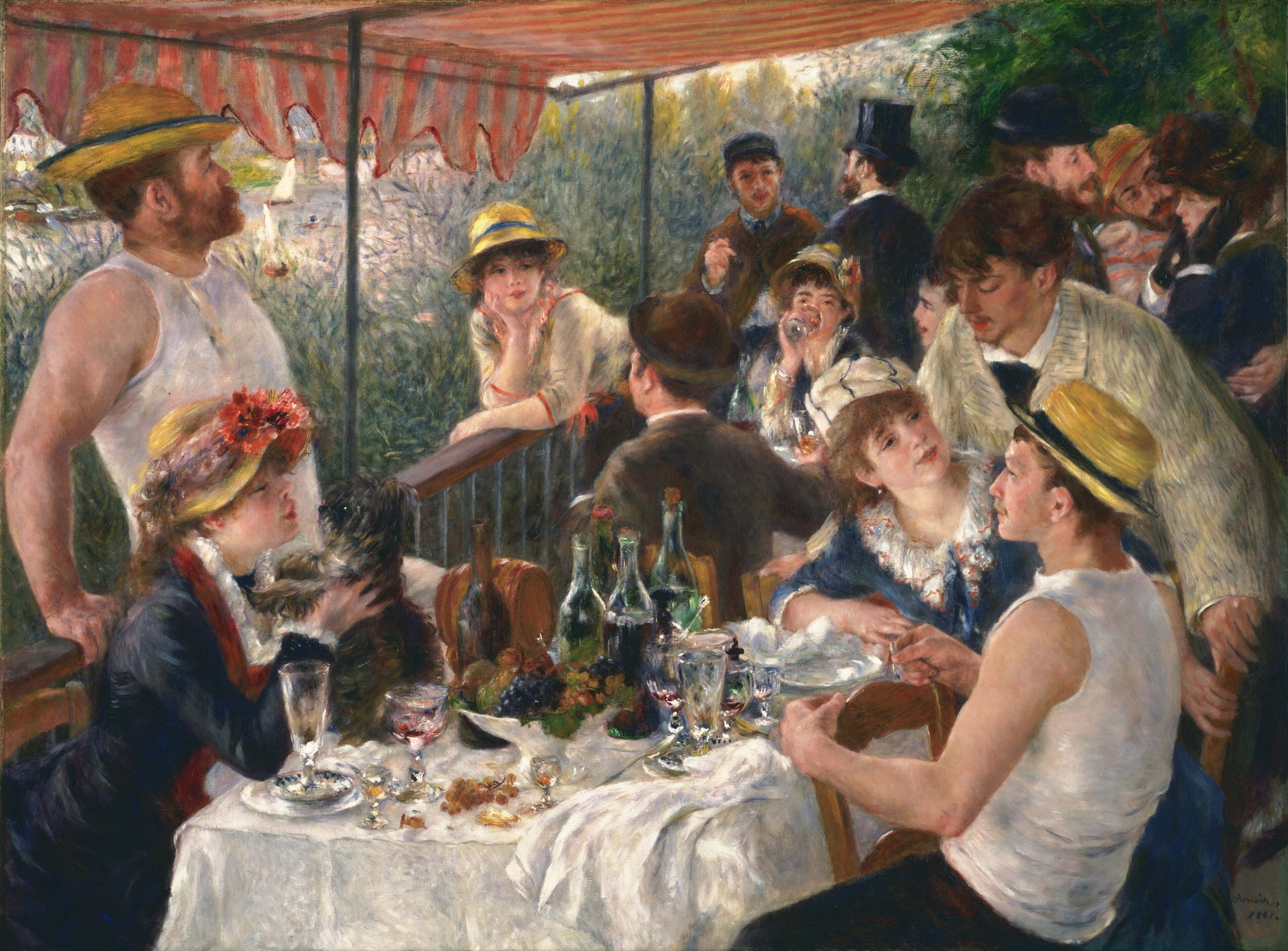
Step back and look at the whole.
Caillebotte stares at Aline. Aline looks at the dog. Barbier talks to Alphonsine, but Alphonsine is thinking of the young painter working on the floor below.
Ellen Andrée stares into space. Jeanne Samary looks away from the civil servant with the passion for the occult who is whispering in her ear. Ephrussi speaks to his secretary, but their bodies are turned in two different directions.
Not a single guest in the painting meets the gaze of another.
Fourteen people around the same table for an entire Sunday, and no one really meets anyone.
There’s a technical reason for this. Renoir never brought these fourteen people together at the same time on the terrace.
He painted the still life and the decor first, then had his friends come one by one, or in small groups, over sixteen months.
None of them could meet the gaze of another who wasn’t there.
Then you start counting.
Thirteen, or Fourteen?
Aline, Alphonse junior, Caillebotte, Barbier, Alphonsine, Ellen Andrée, Maggiolo, Angèle, Ephrussi, his secretary in the cap, Samary, Lhote, Lestringuez.
Thirteen.
And then this partial face behind Ellen Andrée, this half-profile beneath a backwards-tilted cap, who speaks to no one and to whom no one is listening.
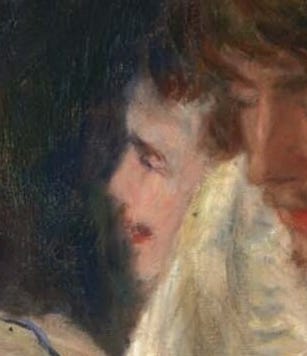
The fourteenth.
Thirteen would have been a problem for Renoir. Thirteen guests around a table in a large 19th-century painting, any French viewer of the time would have recognized as The Last Supper.
Christ’s last meal with his twelve apostles, painted a thousand times since Leonardo da Vinci. The moment when Jesus announces that one of the twelve is going to betray him, six hours before his arrest.
Renoir is painting the exact opposite. He’s painting a Sunday of friendship, warmth, light wine.
He couldn’t afford thirteen.
So who is this fourteenth face he added at the very last moment?
That’s the first secret of the painting. Others follow. And several of these unknown people, from this terrace at Chatou, will weigh on the century that is about to open…