
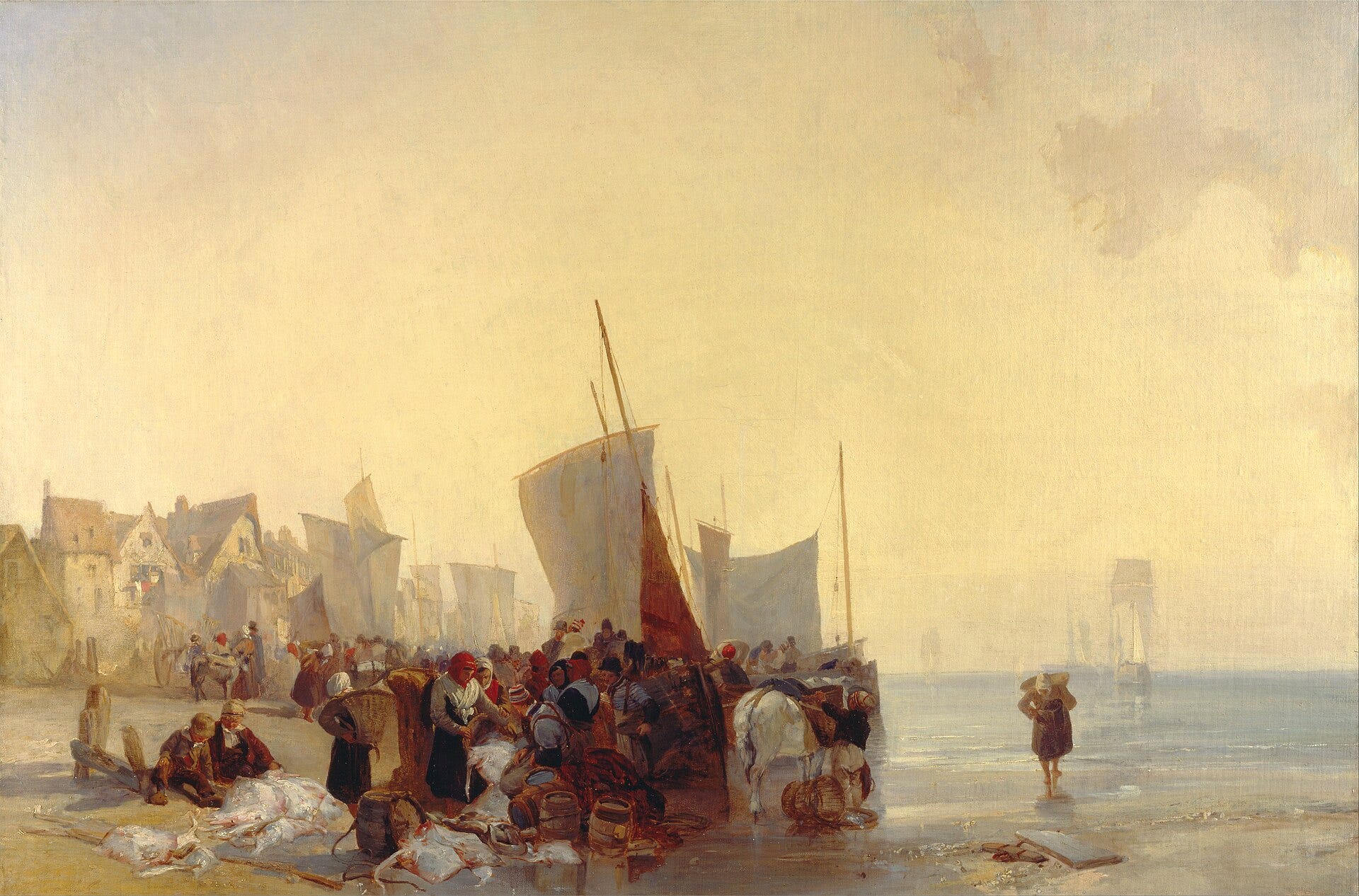
Richard Parkes Bonington (1802 to 1828) was an English painter who worked mostly in France. He became famous in Paris for harbors and beaches like A Fish-Market near Boulogne, and for his views of Venice, in watercolor and in oil.
Cool Stories About Art is a newsletter to learn art the fun way.
Join 200,000+ readers and get:
10 new art stories / month
The entire archive of content (140+ articles)
Comment, ask questions, and chat with other readers
Bonington painted small, quick pictures of beaches under wide skies. Paris gave him a gold medal, and French painters imitated him. In London, the capital of his own country, hardly anyone knew his name until 1826. Two years later, he was dead, at twenty-five.
In 1817, an English family landed at Calais, the French port that faces England across the Channel, the narrow sea between the two countries. The father, Richard Bonington, a drawing teacher from Nottingham, had come to France to open a lace factory.
Lace, a fine cloth with patterns of tiny holes, was the great trade of Nottingham, a city in central England. New machines were putting the city's lacemakers out of work, and the Boningtons were short of money.
The father had brought his wife, a teacher, and their son, also named Richard, a boy of about fourteen.
The boy had been born on October 25, 1802, in Arnold, a village near Nottingham. His father had taught him watercolor, a paint thinned with water that dries fast and lets the white of the paper shine through. At about eleven, young Richard had shown his work at an exhibition in Liverpool, a port in the north of England.
In Calais, the boy found a second teacher. Louis Francia, a painter born in the town, had spent years in England, where artists had turned watercolor into a serious art. Francia knew the English methods, and he gave lessons to the newcomer.
In 1818, the family moved on to Paris, where the father opened a lace shop. While his father sold lace, Richard spent his days in the Louvre, the old royal palace turned museum, copying Dutch and Flemish landscapes.
By 1821, before he was twenty, Richard Parkes Bonington was traveling the coast of northern France with his paints, and paying for each trip by selling his watercolors to art dealers. Three years later, Paris gave him a gold medal.
What did Paris see in the small beach scenes of a young Englishman?
In the rest of the story
Why Paris called its great art exhibition of 1824 the English one.
What a great French painter, his friend, called Bonington's watercolors long after his death.
Which famous English painter wanted his own pictures hung beside Bonington's Venice.
How Bonington went on painting Paris after his strength was gone.