
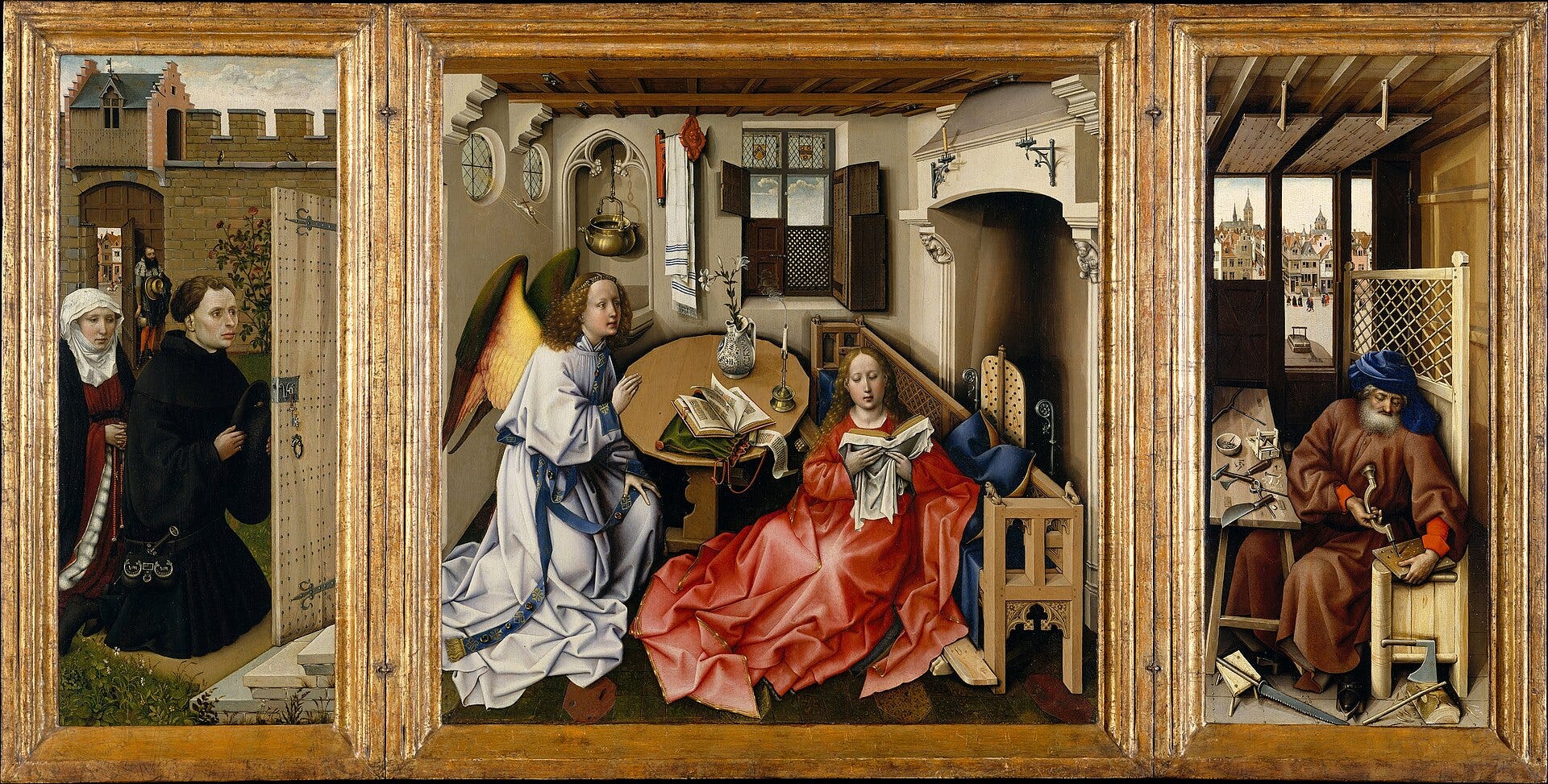
Robert Campin (around 1375 to 1444) painted in today's Belgium. With Jan van Eyck, the great painter of Bruges, he founded the realistic style of oil painting there. His workshop is credited with the Merode Altarpiece, a religious painting in three panels, in New York.
Cool Stories About Art is a newsletter to learn art the fun way.
Join 200,000+ readers and get:
10 new art stories / month
The entire archive of content (140+ articles)
Comment, ask questions, and chat with other readers
The archives of Tournai, Robert Campin's city, mention him again and again, down to the day each of his pupils arrived. Yet not one of the paintings on wooden panels that museums show today is tied to his name by a record. Each was recognized as his by its style, and for years the finest of them carried an invented name, the Master of Flémalle.
Around 1406, Saint-Brice, a parish church of Tournai, paid Robert Campin to paint an Annunciation on the wall of its choir, the part of the church around the altar. An Annunciation shows the angel Gabriel telling the Virgin Mary that she will bear Jesus.
A record of 1422 gives Campin's age as forty-seven, so the painter was about thirty at Saint-Brice.
Tournai, today a city of Belgium, had answered directly to the king of France since 1187, after a struggle by its citizens, while the neighboring county of Flanders belonged to the dukes of Burgundy.
For the city, Campin painted coats of arms, the badges of noble families and towns, on its banners. On December 29, 1410, he paid to become a citizen of Tournai. By then, he was in practice the painter of the city.
On June 3, 1423, the craftsmen of Tournai took over the government of the city. Their guilds, the trade bodies that decided who could open a shop in each trade, now ran Tournai.
A week later, Robert Campin became deputy dean of the guild of goldsmiths and painters, the second in command of his trade.
Within ten years, the same city put the painter on trial twice. In 1432, its judges sentenced him, a married man of about fifty-seven, to a year of banishment for his private life.
How could a painter whom Tournai recorded so closely lose his name on every panel that survived?
In the rest of the story
Why a court sent Campin on a pilgrimage hundreds of miles from home.
Which everyday object in the Merode Altarpiece may carry a message about the devil.
Who stepped in to keep Campin in Tournai after his sentence of 1432.
How a cloth merchant's tale gave Campin's paintings a new name.