
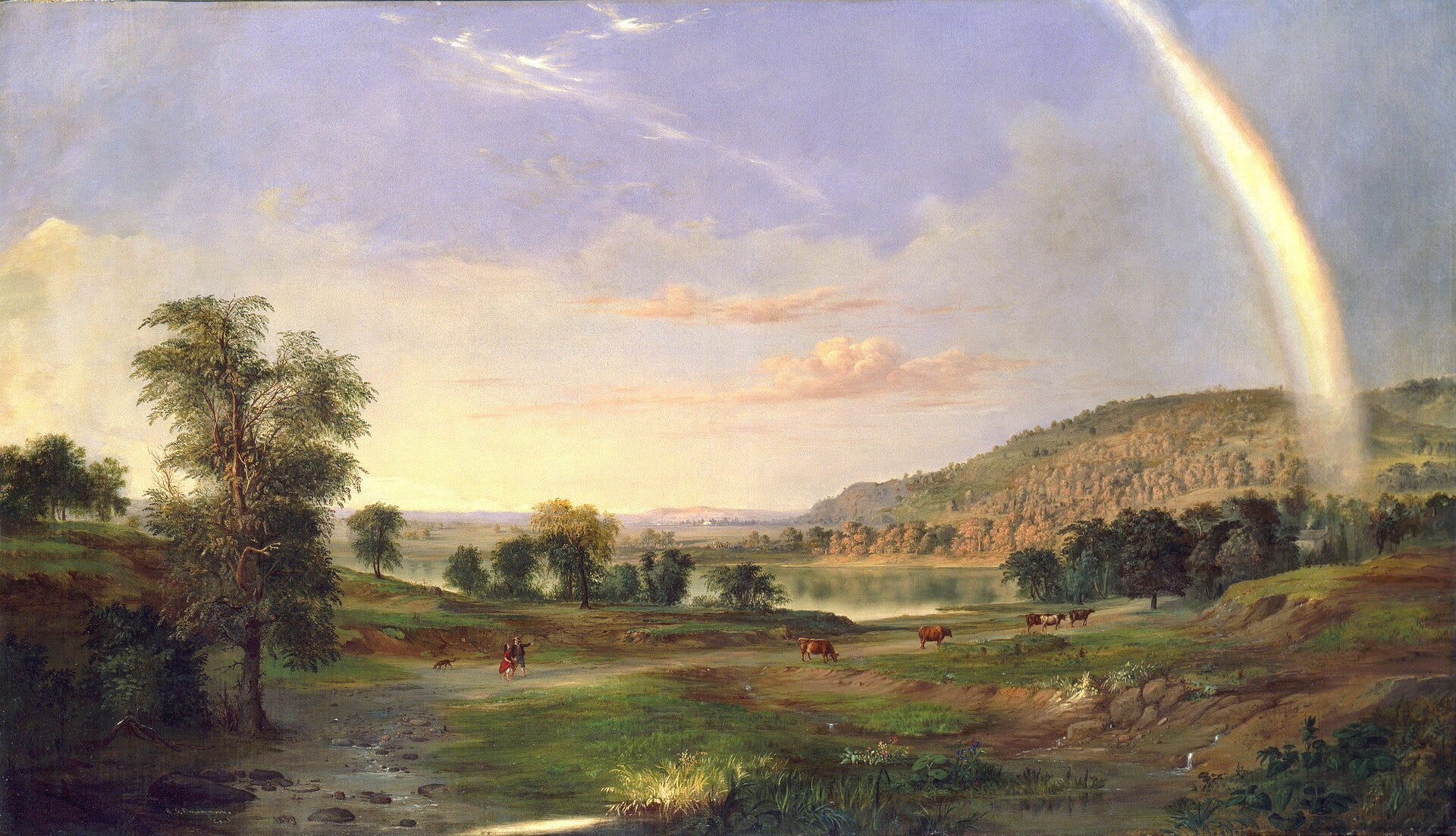
Robert S. Duncanson (about 1821 to 1872) was an African American painter of landscapes, pictures of land, water and sky. He worked in Cincinnati, Ohio, and painted calm valleys like Landscape with Rainbow, now at the Smithsonian American Art Museum in Washington, D.C.
Cool Stories About Art is a newsletter to learn art the fun way.
Join 200,000+ readers and get:
10 new art stories / month
The entire archive of content (140+ articles)
Comment, ask questions, and chat with other readers
In his lifetime, a Cincinnati newspaper called Robert S. Duncanson "the best landscape painter in the West," at a time when the West meant young states like Ohio, beyond the Appalachian Mountains. His best known canvas, Land of the Lotus Eaters, was bought for the royal collection of Sweden.
Yet when Duncanson died, in 1872, he was buried in a grave that carried no name for almost a hundred and fifty years.
His story starts in Monroe, a small town in Michigan on the shore of Lake Erie. In the spring of 1838, the Monroe Gazette, the town's newspaper, printed an ad for a new business. Two young men offered to paint houses and fit glass into windows.
One was John Gamblin, who fitted the glass. The other was Robert Duncanson, seventeen. Robert had been born around 1821 in Fayette, in the state of New York, and his family had settled in Monroe in 1828.
The Duncansons were Black and free. Their roots were in Virginia, where members of the family had been enslaved, then freed. The men of the family worked as carpenters and house painters.
Robert soon turned from houses to portraits, and around 1840 he settled near Cincinnati, a growing city on the Ohio River, nicknamed the Athens of the West after the ancient Greek city of art and learning.
Across the river from Cincinnati lay Kentucky, where slavery was legal. Ohio was a free state, where slavery was banned, and Cincinnati had one of the largest Black communities in the United States.
Duncanson had no teacher. He learned by copying engravings, pictures printed from carved metal plates, and by painting portraits and still lifes, pictures of fruit or flowers. In 1842, the Cincinnati Academy of Fine Arts, a society of local artists, accepted three of his portraits for its exhibition.
In 1850, Duncanson was at work in the house of Nicholas Longworth, one of the richest men in Cincinnati, a lawyer grown rich on land. Longworth was a patron, a buyer who supports artists with regular orders.
The young man who had offered to paint houses in Monroe now covered the walls of Longworth's front hall with eight large landscapes, each one bigger than a front door.
How did a painter so praised in his lifetime end up forgotten, in a grave without a name?
In the rest of the story
Where Longworth's eight painted landscapes ended up, and who found them again.
What changed in the newspapers after he gave away one painting.
What Duncanson wrote back when his own son accused him in 1871.
Who finally put a name on Duncanson's grave, and what they carved beside it.