
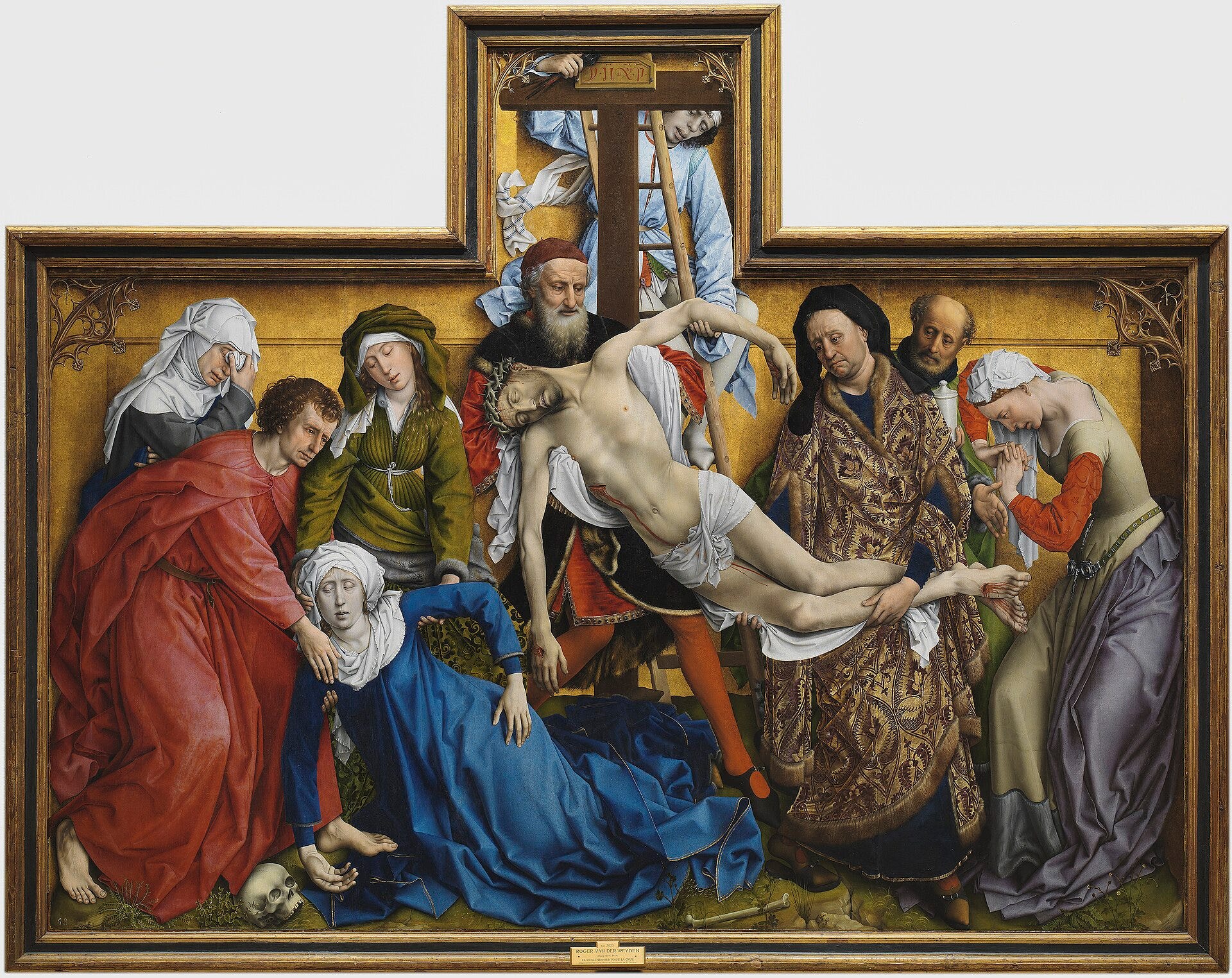
Rogier van der Weyden was a Flemish painter, born Rogier de le Pasture in Tournai around 1399, who died in Brussels on 18 June 1464. He was the official painter of the city of Brussels, and his most famous surviving painting, The Descent from the Cross, hangs in the Prado. The only paintings he is known to have signed burned in 1695.
Almost everything he made for his own city is gone. For the Golden Chamber of the Brussels town hall he painted four huge panels on justice, each about twelve feet high, and two of them carried his signature and the date 1439. Albrecht Dürer made a point of going to the town hall in 1520 to see them. In August 1695 a French bombardment set Brussels on fire, and all four panels burned.
The picture that does survive is the Descent, which he painted around 1435 for the crossbowmen of Leuven. Its figures are almost life-size, which was rare in Flemish painting at the time, and they are packed into a shallow box, like painted sculptures. The Virgin has fainted in the same pose as her dead son, and a tear is about to fall from her chin.
Cool Stories About Art is a newsletter to learn art the fun way.
Join 200,000+ readers and get:
10 new art stories / month
The entire archive of content (1,000+ articles)
Comment, ask questions, and chat with other readers
That panel is not complete either. It was the center of a triptych, and the wings that went with it are lost. Philip II of Spain ordered new wings for it in 1566, and those are lost too. What hangs in Madrid is a middle with nothing around it.
The man who made it is just as hard to pin down. The Flemish Primitives database, the research site of the Flemish museums, states that not a single painting can be attributed to him with absolute certainty. Scholars still argue over the order in which he painted them.
What You'll Discover
Why his name changed with his city.
How the Descent reached Spain.
What the town hall panels showed.
What he admired in Rome.
Whose face hides in a saint.
Where his paintings hang today.