
Rome has been painted for longer than anywhere else, and mostly by visitors. Piranesi sold etchings of the ruins to tourists who wanted proof they had been there, Poussin ran his career from Rome without being Roman, and Turner arrived at forty four and painted the light rather than the buildings.
Rome in twelve pictures
The Grand Tour turned painted Rome into a souvenir industry.
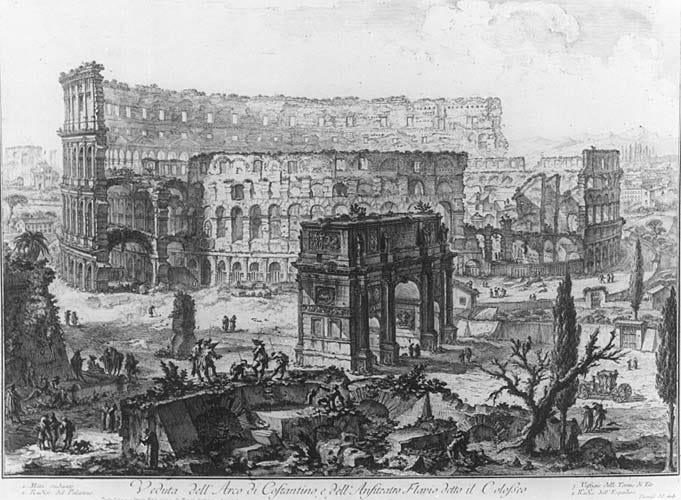
One artist made around a hundred and thirty five plates of Roman ruins, exaggerating their scale on purpose.
Painters came to Rome to draw the antique, and the Academy sent its prizewinners there for centuries.
Half the great Roman views were painted by people from France, Britain and the Netherlands.
The most painted building in Rome is not Saint Peter’s.
Learn art the fun way
1 | Piranesi and the Vedute di Roma (from 1748)
Around a hundred and thirty five large etched views, sold to Grand Tourists. He raised the buildings, shrank the people and darkened the shadows to make ruins look overwhelming.
The technique is in what is etching.
He worked in Rome from 1740 until his death in 1778 and the plates were sold singly to travellers, who had them bound at home. The copper plates survived him and were still being printed in the nineteenth century, which is why the same views hang in so many houses.
2 | Poussin and the Roman classical landscape
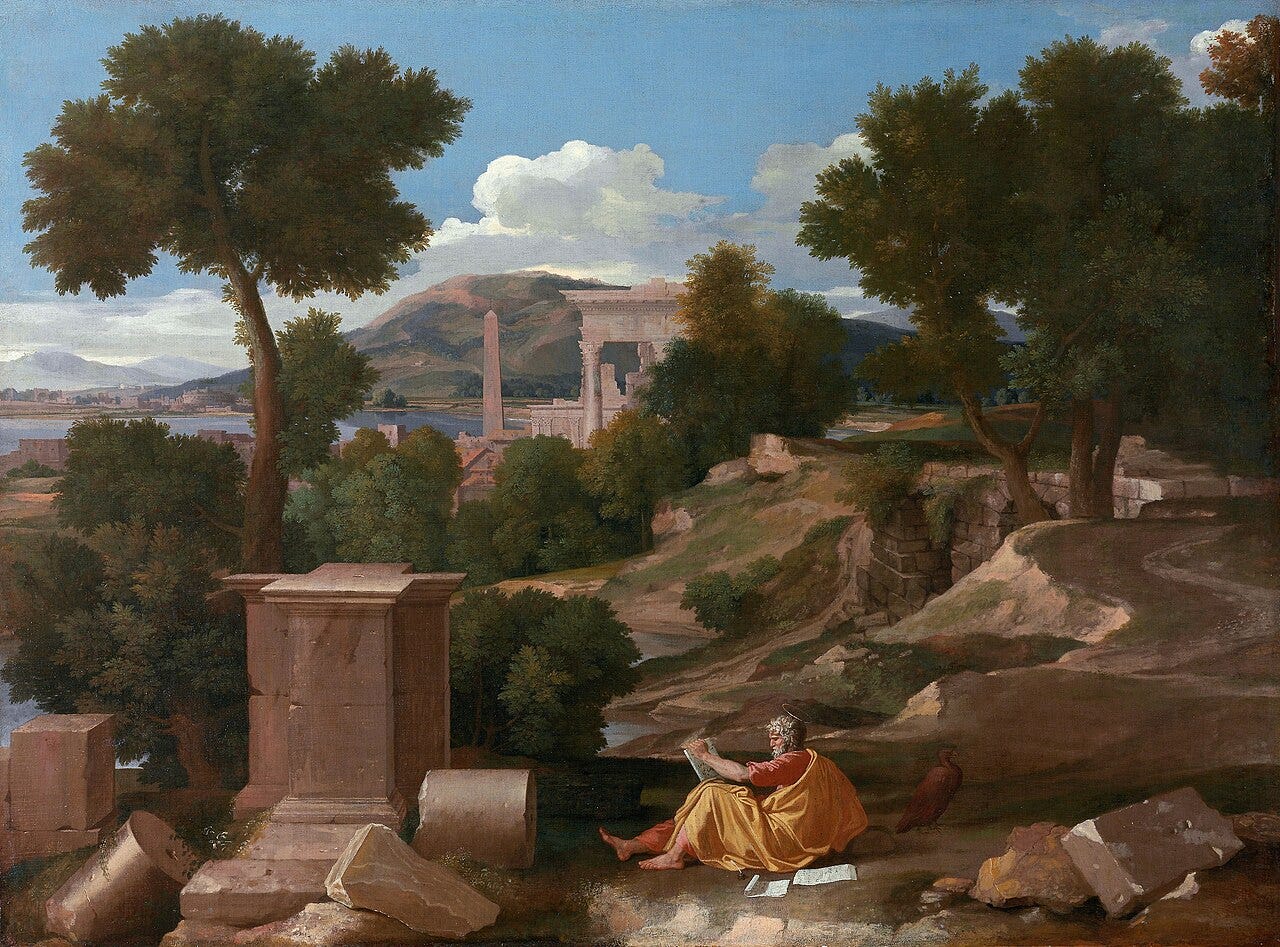
Poussin spent almost his entire career in Rome, building ideal landscapes out of Roman light and antique architecture, and refusing to return permanently to France.
More on him in Nicolas Poussin.
He arrived in 1624 and stayed, apart from an unhappy stint in Paris between 1640 and 1642 that ended with him going straight back. He built his compositions from wax figures arranged in a box, moving them until the light fell where he wanted it.
3 | Claude Lorrain and the harbour at sunset
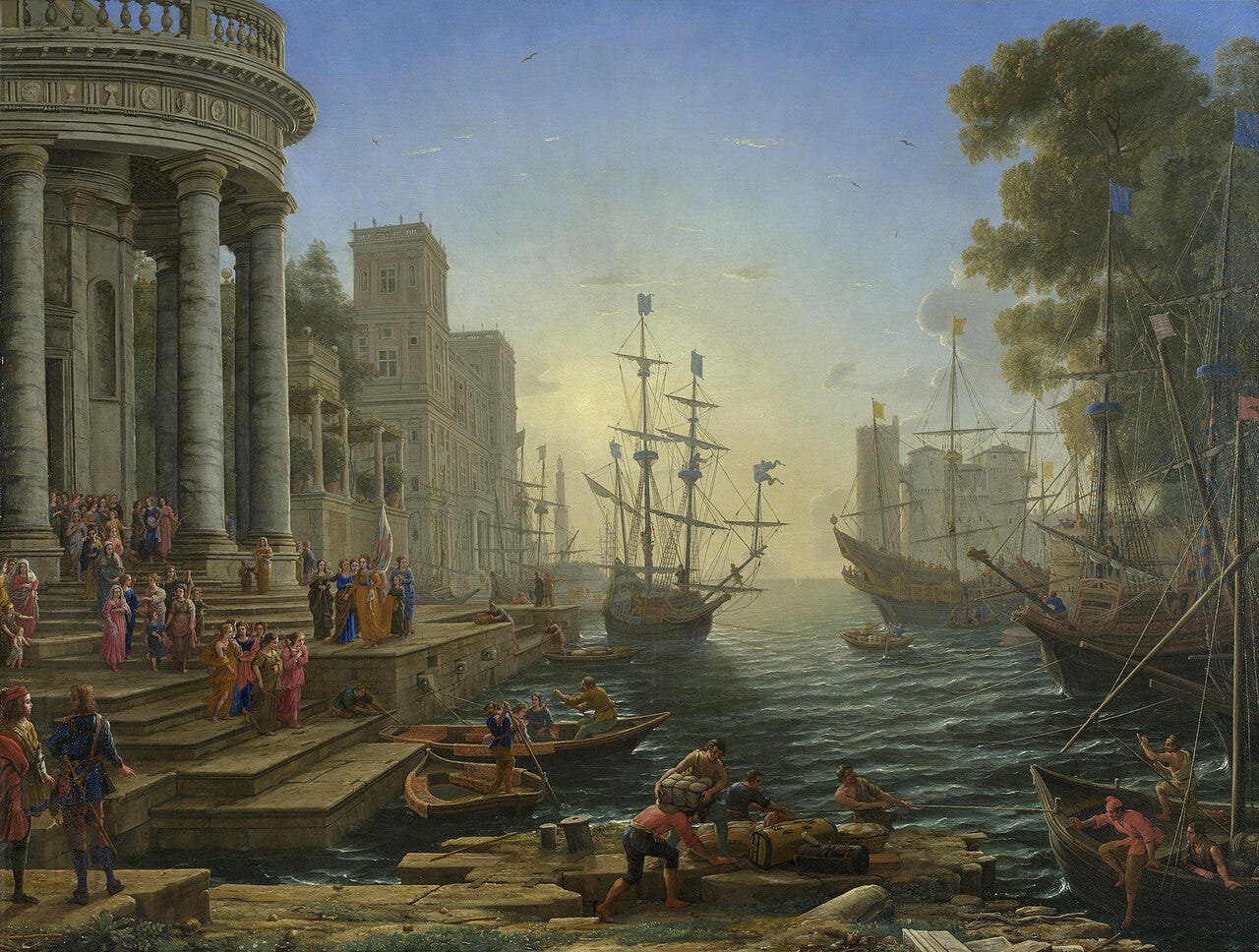
Claude worked in Rome and invented a formula that painters copied for two centuries: a harbour, columns on one side, and the sun sitting low in the middle of the picture.
Turner asked to be hung next to him, and got his wish.
Born in Lorraine around 1604, he reached Rome as a teenager and worked as a pastry cook before he painted. To stop forgers, he kept a drawing of every finished picture in a book he called the Liber Veritatis, which now sits in the British Museum.
4 | The Colosseum, the most painted ruin
It was a quarry, a fortress, a chapel and a botanical curiosity before it was a monument. Over four hundred plant species were catalogued growing in it in the nineteenth century.
More in ruins in painting.
A papal decree of 1749 declared it a sacred site because of the martyrs believed to have died there, which is what saved it from being quarried further. Painters had been drawing it as a ruin for two centuries by then.
5 | Caravaggio’s Rome
Caravaggio painted Roman street people into altarpieces for Roman churches, and several of those pictures are still in the churches they were made for.
More on him in Caravaggio.
He arrived around 1592 with nothing and was dead by 1610. In between he produced the Contarelli Chapel cycle in San Luigi dei Francesi and the two Cerasi Chapel panels in Santa Maria del Popolo, both still in place, lit by coin operated lights.
6 | Raphael and the Vatican rooms
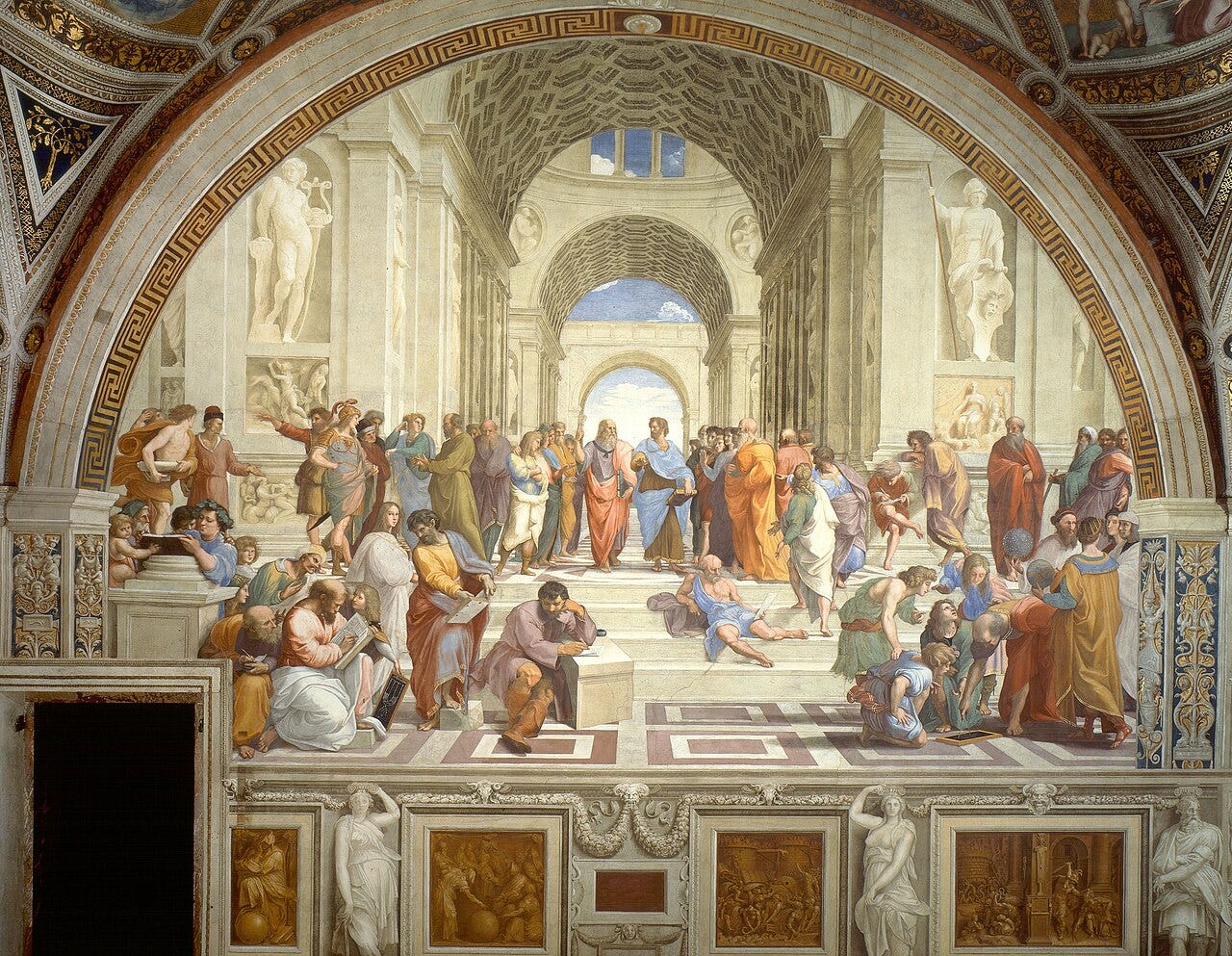
The School of Athens is a Roman picture in every sense: painted in the Vatican, built on Roman architecture, and full of portraits of men working in Rome at the time.
More on him in Raphael.
He was twenty five when Julius II gave him the Stanze in 1508, working a corridor away from Michelangelo on the Sistine ceiling. He died in Rome in 1520 at thirty seven and was buried in the Pantheon at his own request.
7 | Panini and the painted gallery
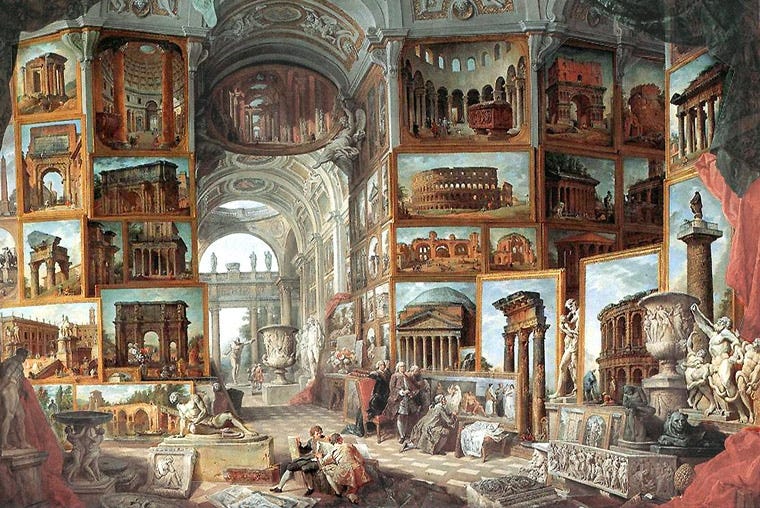
Giovanni Paolo Panini painted imaginary galleries hung with every view of Rome at once, sold to visitors as a portable summary of the whole trip.
It is a souvenir shop inside a picture. More on the type in what is a capriccio.
He painted two enormous gallery pictures around 1757, one of ancient Rome and one of modern Rome, each crammed with dozens of miniature views inside a single imaginary hall. They were made for the French ambassador, the duc de Choiseul.
8 | Corot in the Roman campagna
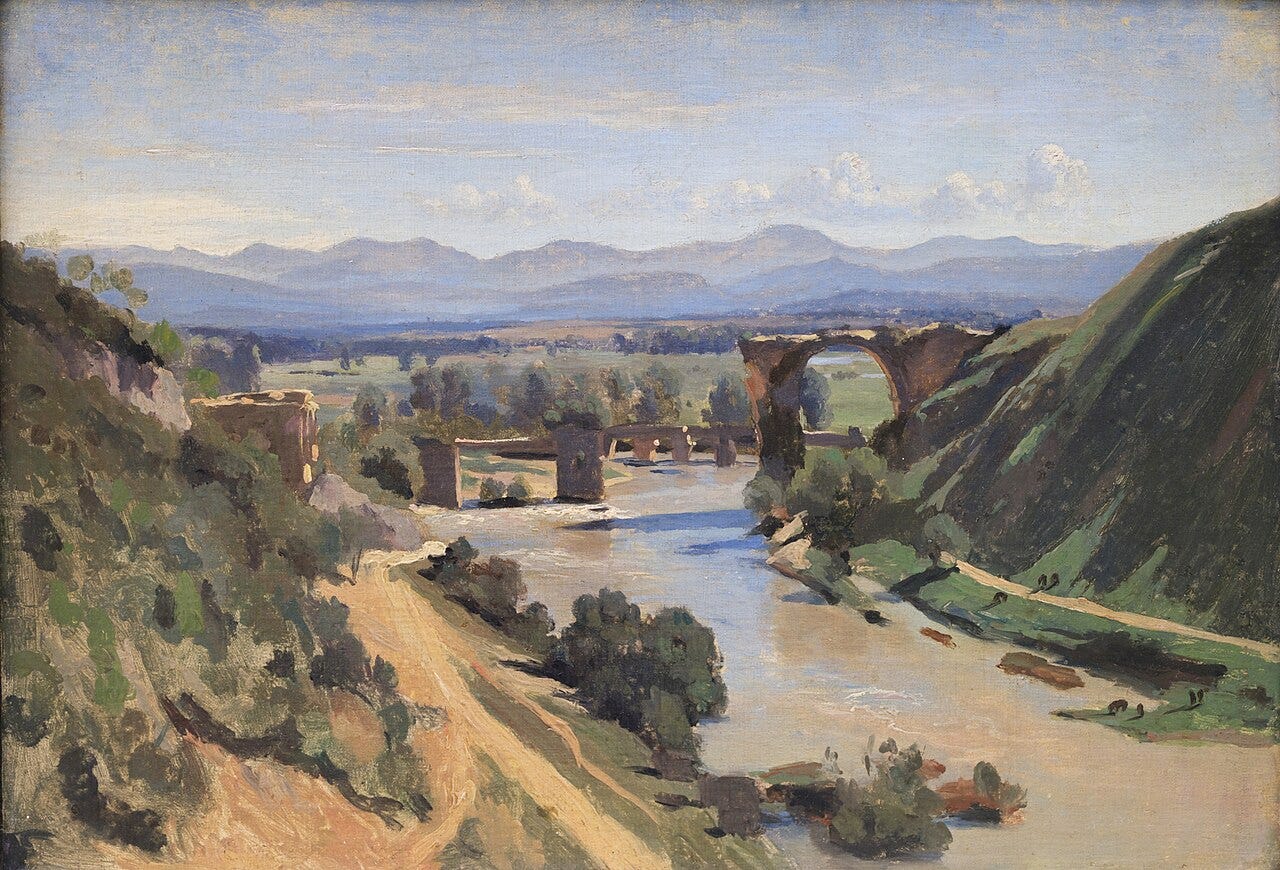
Corot arrived in 1825 and painted small oil studies outdoors around Rome, quick and unfinished, which turned out to matter more than the salon pictures he made from them.
More on him in Camille Corot.
He made three Italian trips, the first in 1825, and the small panels he painted outdoors were never meant for sale. They stayed in his studio and were only recognised as his best work long after his death in 1875.
9 | Turner in Rome, 1819 and 1828
He filled sketchbooks with thousands of pages and painted Rome as weather. Roman critics were unimpressed when he exhibited there.
More on him in JMW Turner.
He filled around twenty three sketchbooks on the 1819 trip alone. When he exhibited in Rome in 1828 the local reaction was cold, and he never showed there again.
10 | The Prix de Rome
From 1663 the French state sent its best young artists to Rome for years at state expense. The prize shaped French painting until it was abolished in 1968.
Ingres, David and Fragonard all went. More on the system in what is academic art.
Winners lived at the Villa Medici, which the French state bought in 1803 for exactly this purpose. The stay ran to five years, and the required work sent home each year was called an envoi.
11 | Rome burning and Rome falling
The other Rome in painting is the disaster: the fire, the sack, the collapse. It is a different genre with a different customer.
More in the fall of Rome in painting.
The two big set pieces are the fire of 64 under Nero and the sack of 1527 by imperial troops, when the pope hid in the Castel Sant’Angelo. Both were painted long after the fact, by artists selling a lesson rather than a report.
12 | Why painters kept coming
Rome offered three things at once: antique sculpture to copy, church commissions to live on, and a light that painters from the north had never seen. That combination existed nowhere else.
Most of them intended to stay two years.
Goethe wrote that he only began to live once he reached Rome in 1786, and painters said the same thing in less elegant words. The Accademia di San Luca gave them a professional structure, and the antique gave them a syllabus.
Painted Rome, in five answers
Who painted Rome the most? Piranesi in print, with around a hundred and thirty five large etched views from 1748, and Panini in paint with his gallery pictures.
Did Piranesi exaggerate the ruins? Yes. He enlarged the architecture and reduced the figures to make the ruins look more overwhelming than they are.
What was the Prix de Rome? A French state prize, from 1663, sending young artists to study in Rome at public expense. It was abolished in 1968.
Which Caravaggios are still in Roman churches? Several, including the Contarelli Chapel cycle in San Luigi dei Francesi and the Cerasi Chapel in Santa Maria del Popolo.
Which museum has Piranesi’s views of Rome? The Vatican Museums, the Capitoline, the National Gallery in London, and the churches themselves.
In the nineteenth century a botanist catalogued over four hundred plant species growing inside the Colosseum. Painters had been putting weeds into their Roman ruins for a century, and they were not exaggerating.
More painted Rome sits at the Met and the Rijksmuseum.
This subject is one thread in a wider theme. See how it fits into Cities and Places in Painting.