
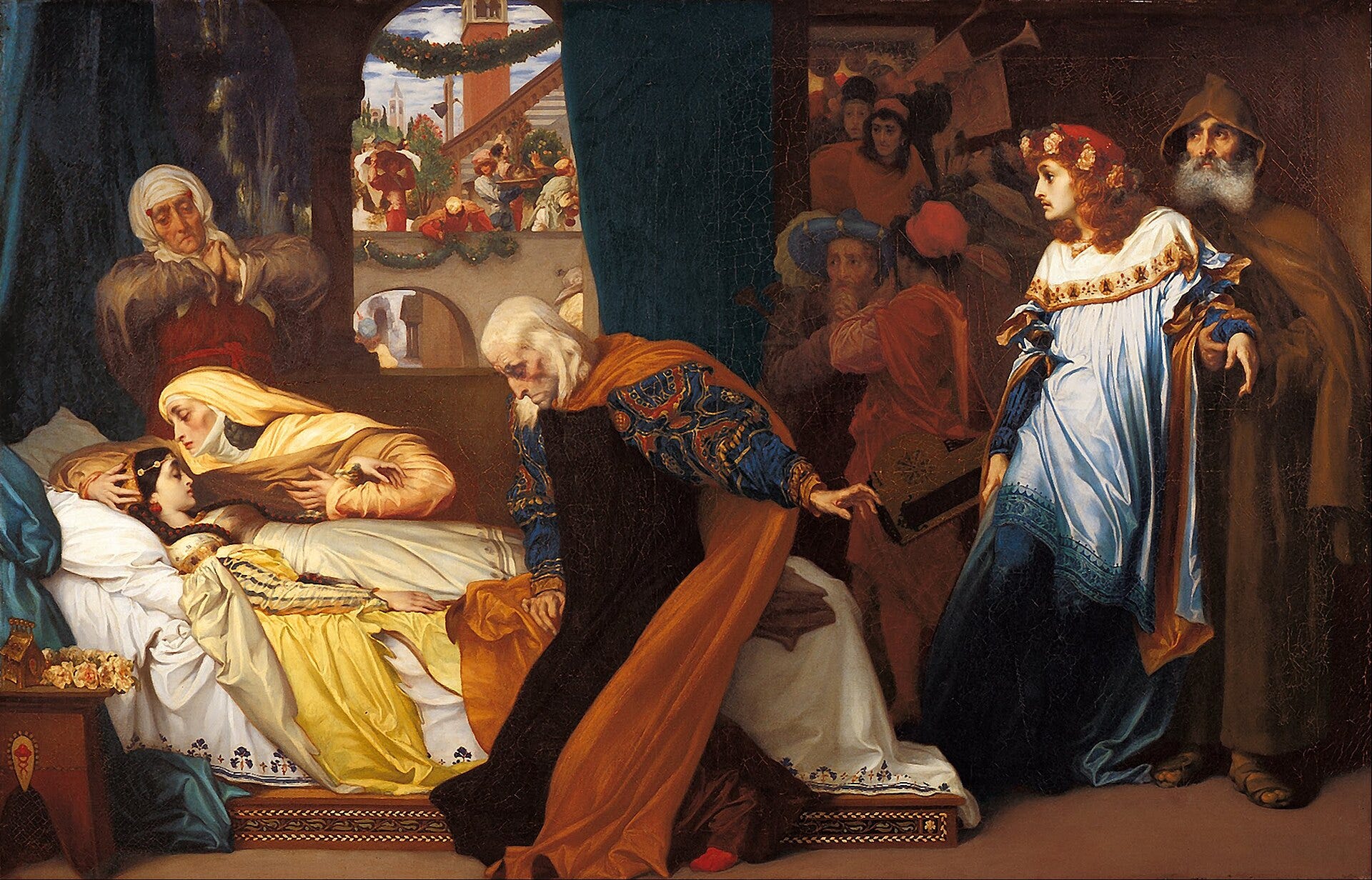
Juliet is not yet fourteen when the play opens, and before the week is out she and Romeo are both dead. Painters have returned to those few days for more than two hundred years. For about a century of that time, though, the death scene most theatergoers watched on stage was not the one Shakespeare had written.
Cool Stories About Art is a newsletter to learn art the fun way.
Join 200,000+ readers and get:
10 new art stories / month
The entire archive of content (1,000+ articles)
Comment, ask questions, and chat with other readers
What Painters Wanted From Shakespeare's Lovers
The play takes place in Verona over less than a week in July. The lovers meet at a party given by Juliet's family, marry in secret the next day, spend one night together and die in the Capulet family vault. Shakespeare gives them very few scenes alone, and painters keep going back to that handful.
What those scenes share is the hour. Romeo first speaks to Juliet at night, from below her window. They part at dawn, arguing over whether the bird outside is the nightingale or the lark. The last scene takes place in a vault lit by torches. For a painter, each of these moments is a problem of light as much as a love story.
The play became a favorite subject in the nineteenth century, when painters often borrowed their stories from books and the stage.
Every work chosen here starts from the play itself, from a scene, a character or a line. Two of them record real performances, because for a long time the play lived on the stage more than on the page.
12. Benjamin Wilson, David Garrick and George Anne Bellamy in "Romeo and Juliet" (1753)
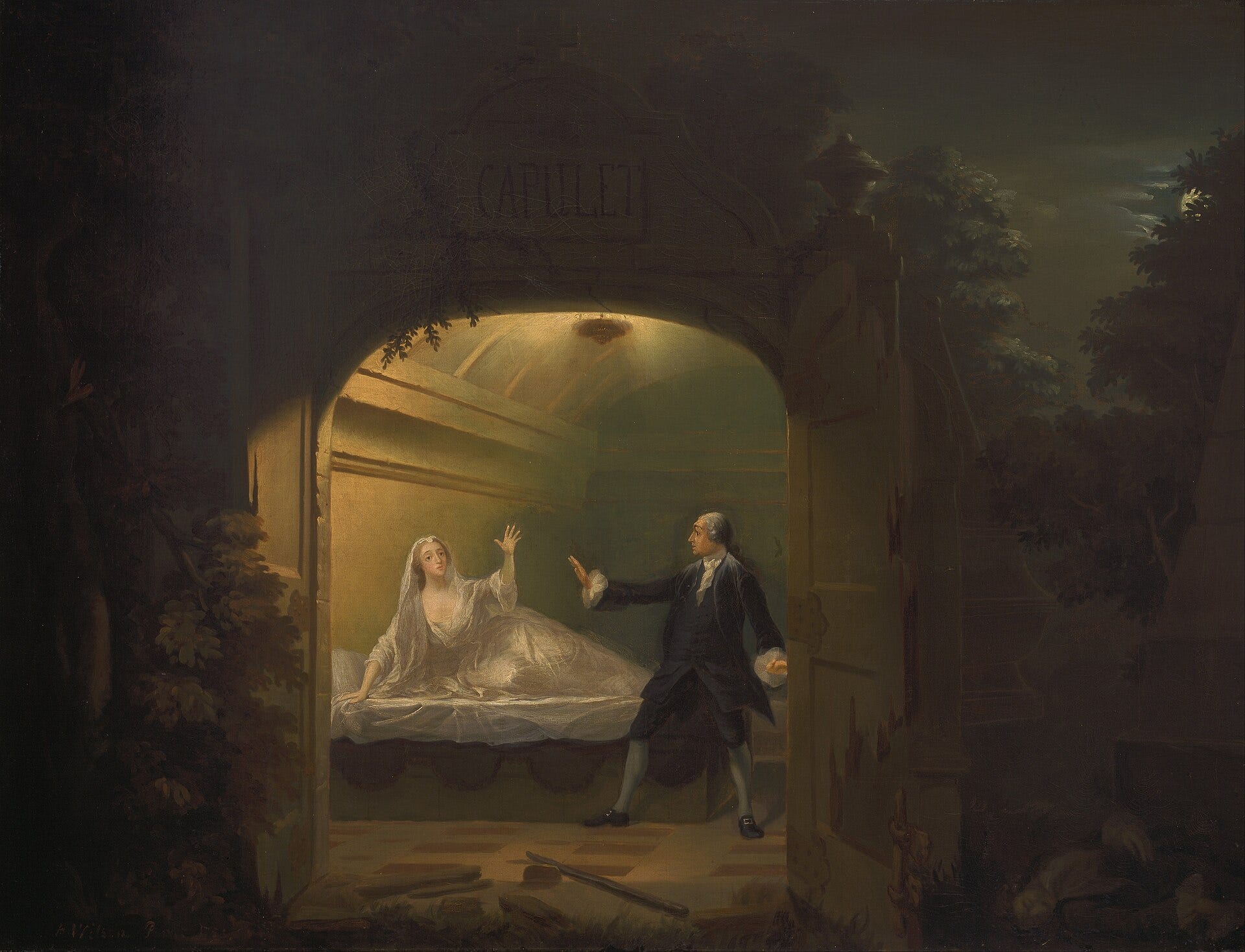
A man in eighteenth-century clothes throws his arms back in horror. In front of him, a young woman in white sits up in her tomb, alive. He has just swallowed poison, believing her dead, and now he understands it is too late.
What makes the moment strange is that Shakespeare never wrote it. In the play, Romeo drinks the poison in the Capulet vault and dies at once, on the words "Thus with a kiss I die." Juliet wakes only afterward, finds him dead and stabs herself. The two lovers never exchange a word in the tomb.
The scene in the picture belongs to David Garrick, the leading English actor of his day and the manager of the Drury Lane theater in London. In 1748, he staged his own version of the play and changed the ending. Juliet now wakes after Romeo has taken the poison but before it kills him, which gives the lovers a last conversation of sixty-seven lines, all written by Garrick.
Two years later, that version set off a theater war. When the rival Covent Garden announced Romeo and Juliet for September 28, 1750, Garrick played Romeo himself the same evening, opposite George Anne Bellamy as Juliet. Both houses ran the tragedy twelve nights in a row, Garrick added a thirteenth, and the commentators gave him the victory, above all for the tomb scene.
That is the scene Benjamin Wilson chose to paint in 1753, with Garrick and Bellamy in their roles and the vault set at the back of the stage, where the audience saw it.
Garrick's ending lasted. Almost a hundred years passed before an American actress brought Shakespeare's own ending back to London (number 10). Until then, the death of Romeo and Juliet that people knew was a farewell Shakespeare never wrote.
At a Glance
Artist: Benjamin Wilson (1721 to 1788)
Painted: 1753
Medium: Oil on canvas
Size: 138.7 x 184.2 cm (54.6 x 72.5 in)
Where to see it: Yale Center for British Art, New Haven
11. Richard Dadd, Sketch for the Passions: Love (1853)
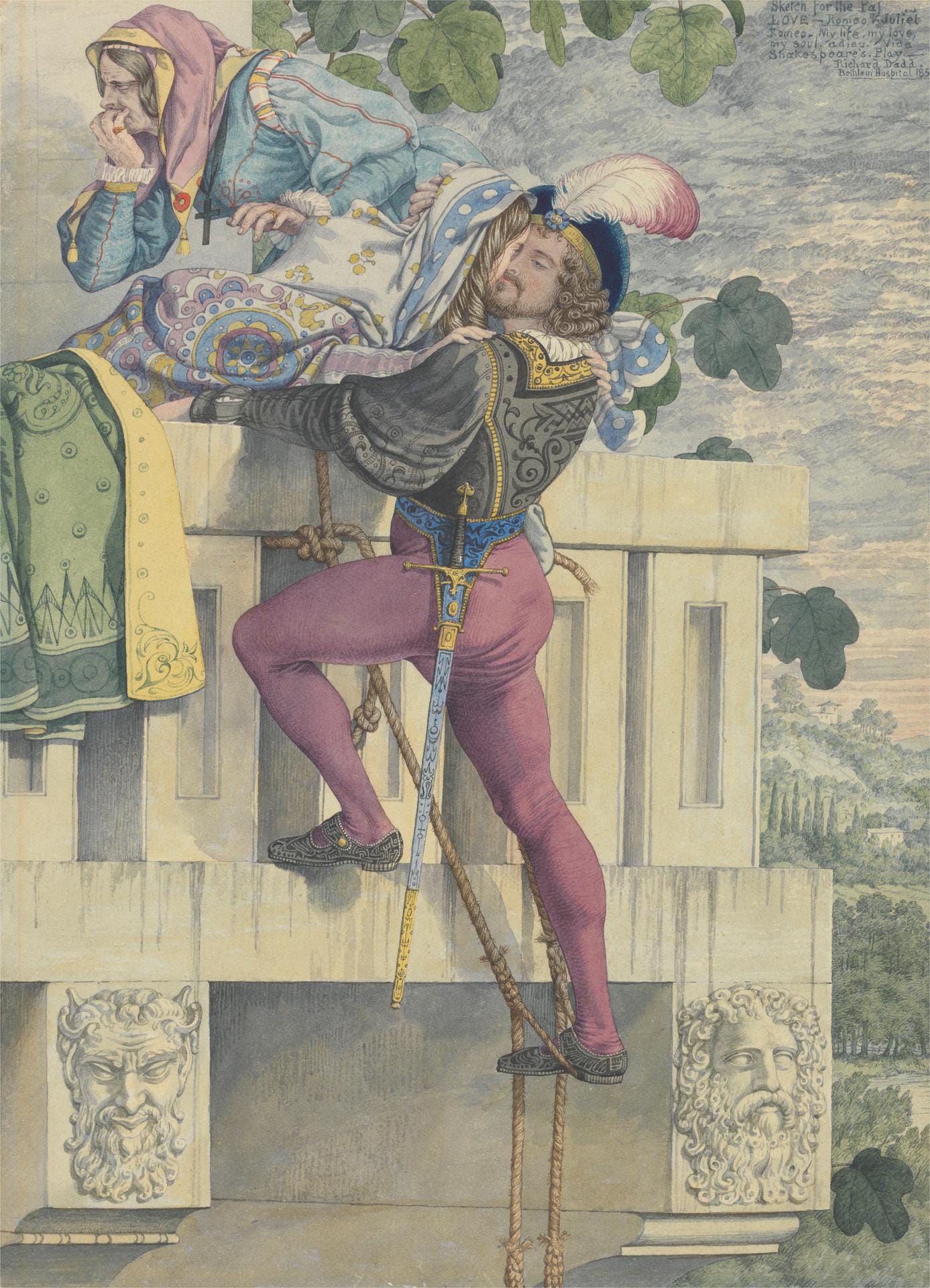
In 1853, the man who drew this kiss had been locked for nine years in Bethlem's wing for criminal patients, the London hospital for the insane. Richard Dadd had killed his father in 1843 and would never again live outside an asylum. Inside, he began a series of watercolors on the human passions, and for the sheet he called Love, he turned to the most famous lovers of the English stage.