Rosa Bonheur: The Complete Story

Rosa Bonheur, who lived from 1822 to 1899, was the most famous woman painter in the world during her lifetime. She painted animals with stunning realism, carried a police permit so she could wear trousers to work, lived openly with women, and became the first woman artist made an officer of the Legion of Honor.

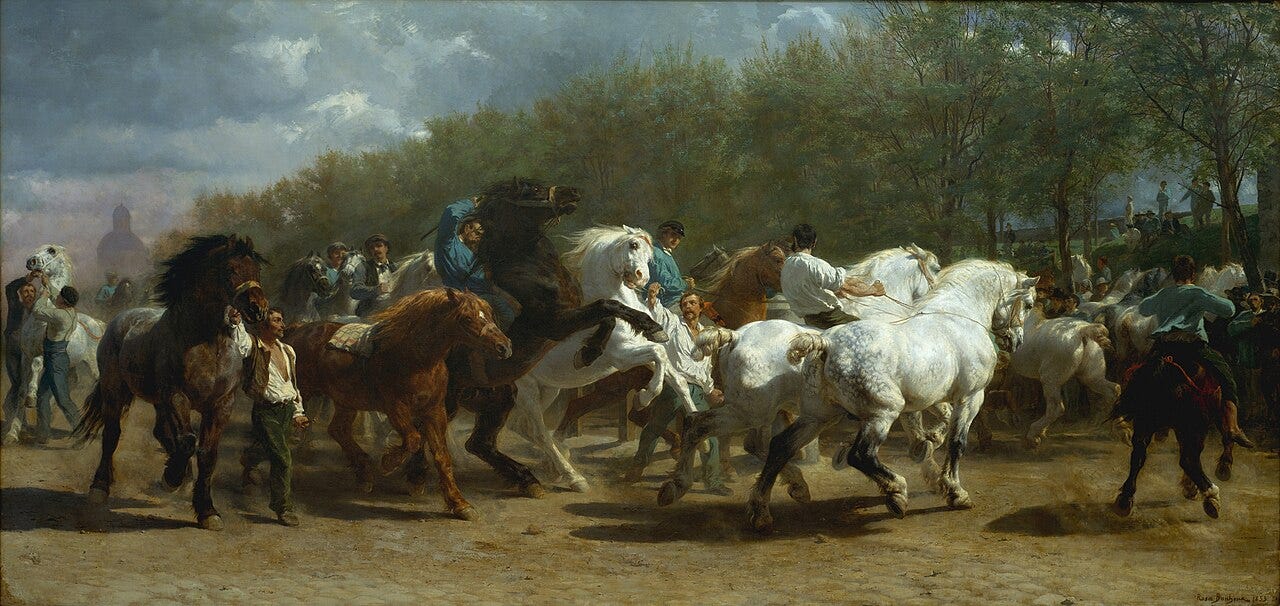
Rosa Bonheur The Horse Fair
Rosa Bonheur, The Horse Fair, 1852 to 1855

Bonheur in five facts

  • Born in Bordeaux in 1822 and raised to believe women were equal.

  • Made her name with huge, lifelike paintings of animals.

  • Held an official permit to wear men's clothing in public.

  • Shared her life with two women, one after the other.

  • Was decorated by the French state when most women painters were ignored.


Hooked on Rosa Bonheur? Get more art secrets and stories in your inbox, free.


The archive, where it gets specific

The ones I would send you to next:


Raised to believe women were equal

Portrait of Rosa Bonheur by Dubufe
Edouard Dubufe, Portrait of Rosa Bonheur, 1857

Rosa Bonheur was born in 1822 in Bordeaux. Her father belonged to a utopian movement that preached the equality of men and women, and he raised her to expect a full career of her own, the way he would have raised a son.

That upbringing was rare, and it gave her the nerve to live a life almost no other woman of her time could imagine.

She learned animals at the slaughterhouse

Rosa Bonheur painting of a stag
Rosa Bonheur, A Stag, study of a wild animal

To paint animals as no one had before, she studied them inside out. She sketched at horse markets, visited stockyards, and even attended dissections to understand muscle and bone.

Her work belongs to Realism, painting the world exactly as it looked, and she often worked outdoors among the very animals she drew.

The painting that made her a star

Rosa Bonheur Ploughing in the Nivernais
Rosa Bonheur, Ploughing in the Nivernais, 1849

Her giant canvas The Horse Fair, finished in 1853, showed a thundering line of workhorses at a Paris market. It was a sensation, toured Britain and America, and made her internationally famous.

An American collector eventually gave it to the Metropolitan Museum in New York, where it still draws crowds. Few painters of her century, male or female, sold so well.

She needed a police permit to wear trousers

Photograph of Rosa Bonheur
Rosa Bonheur photographed in her working smock

To work at markets and slaughterhouses, Bonheur dressed in men's clothing, which was illegal for a woman in France. So she obtained an official police permit allowing her to wear trousers, renewed every few months.

She also cut her hair short, smoked, and hunted. She did not dress as a man to provoke. She did it to get to work.


Join 150,000 readers who learn art the fun way.


The women she loved

Anna Klumpke portrait of Rosa Bonheur
Anna Klumpke, Portrait of Rosa Bonheur, 1898

Bonheur lived for some forty years with Nathalie Micas, a relationship widely read as the central love of her life. After Nathalie died, she shared her last years with the American painter Anna Klumpke.

Klumpke became her companion, her heir and her biographer. Bonheur lived these partnerships openly, at a time when that took real courage.

First woman officer of the Legion of Honor

In 1865 she was made a knight of the Legion of Honor, and in 1894 she was promoted to officer, the first woman artist ever raised to that rank. The Empress Eugenie, who pinned on an earlier honor, is said to have remarked that genius has no sex.

With her fortune she bought a chateau near Fontainebleau and kept a private menagerie, including lions, so she always had models close at hand.

What people want to know about Rosa Bonheur

Who was Rosa Bonheur?

A French painter, the most celebrated woman artist of the 1800s, known above all for animals.

When and where was she born?

In Bordeaux, France, in 1822.

What is she known for?

Large, realistic animal paintings, especially The Horse Fair.

Why did she wear trousers?

To work safely at markets and stockyards. She held a police permit because trousers on a woman were against the law.

Who were her partners?

Nathalie Micas for about forty years, and later the painter Anna Klumpke.

How and when did she die?

She died in 1899, near Fontainebleau, at the age of 77.

The permit and the medal

Rosa Bonheur had to carry a slip of paper from the police just to wear trousers to her own job. The same society that made that necessary also made her the first woman artist to be honored as an officer of the Legion of Honor.

She features among the greats in 10 Women Artists You Need to Know and The Old Masters Were Women Too.


One great art story at a time. No spam, no lectures, free.