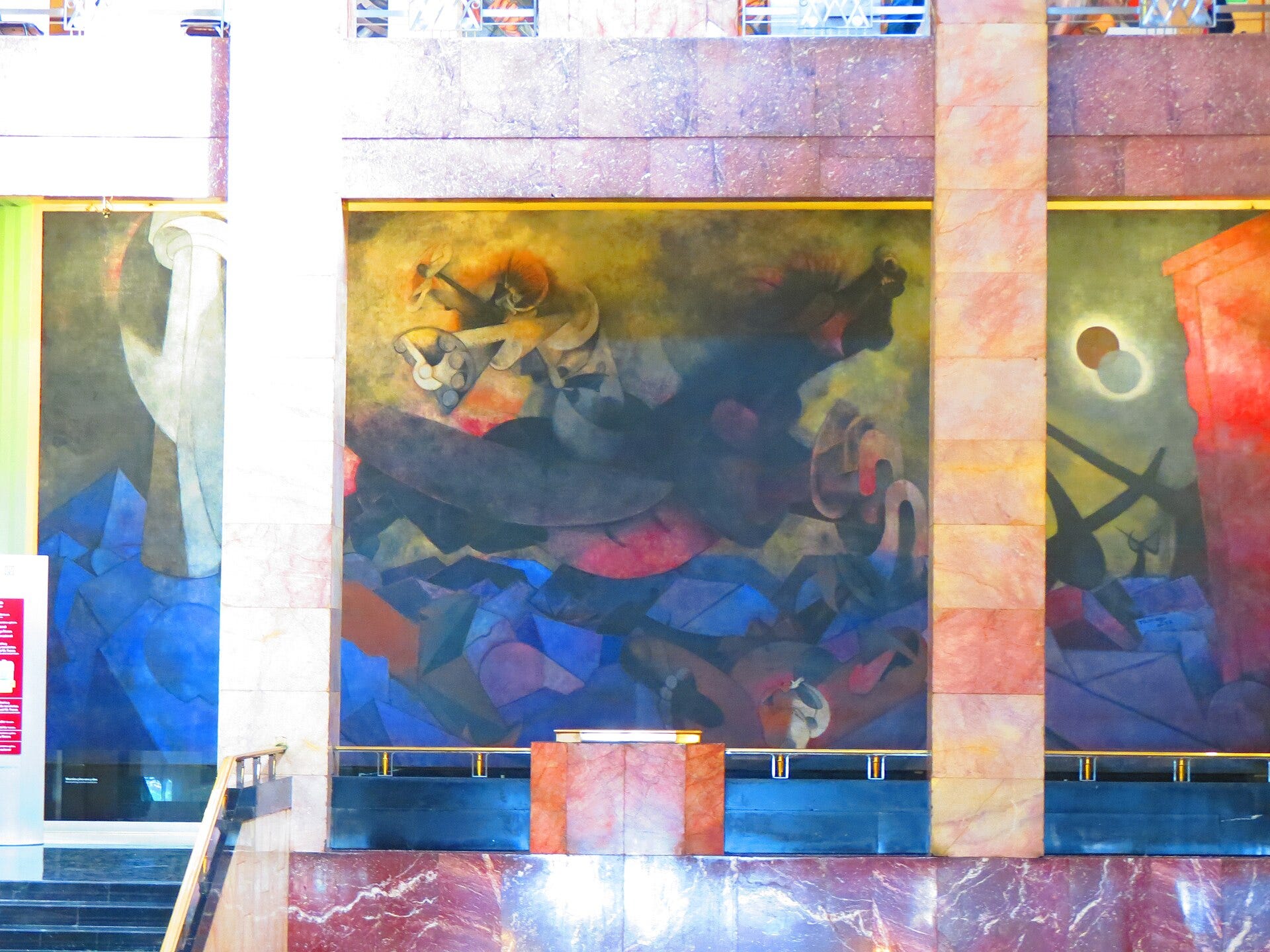
Rufino Tamayo: The Complete Story
Glowing figures the colour of earth and fire, watermelons stacked like jewels, a man reaching for the moon. Rufino Tamayo painted Mexico in a language all his own, refusing both the politics of the muralists and the pull of pure abstraction.
He was a Mexican artist who fused ancient native art with European modernism, building a personal style of rich colour and simple, monumental forms.
Where this gets interesting
Three worth opening next:
Was Monet really the first Impressionist, the painting that may have got there first
The secret behind Monet Magpie, one bird in the snow, and why it matters
Lady with an Ermine, detail by detail, why she is holding that animal
Between two worlds
Tamayo drew on the art of ancient Mexico, its sculpture, pottery and colour, and combined it with the lessons of European modern art he learned in New York and Paris.
The result was a semi abstract style, close to abstract art but never fully leaving the human figure, and unmistakably rooted in his homeland.
The rebel among muralists
Mexican art in his day was dominated by the great political muralists like Rivera and Orozco, who used art to push revolution.
Tamayo refused. He insisted that painting should be about colour, form and feeling, not slogans, and was attacked as a traitor for it, even as he made murals of his own that count as history painting without the politics.
The colour of the earth
Tamayo was a master of colour, building deep, glowing surfaces in earthy reds, pinks and purples that seem lit from within.
He developed his own printmaking technique using many layers of colour, and his sense of pigment is the first thing most viewers remember.
The collector and giver
Tamayo and his wife built a great collection of pre Hispanic art, which he gave to his home state of Oaxaca, and a museum of modern international art that he gave to Mexico City.
He believed ordinary Mexicans deserved to see great art of all kinds, and put his fortune behind that belief.
Things people ask about Rufino Tamayo
What is he known for?
Colourful, semi abstract paintings fusing ancient Mexico with modern art.
Why did he clash with the muralists?
He rejected their political art in favour of colour and form.
Where was he from?
Oaxaca, Mexico, born in 1899.
When did he die?
In 1991.
Why his colour still glows
Tamayo took the lonelier road, refusing both pure politics and pure abstraction, and built an art that feels both ancient and modern at once.
He gave away two great museums to his country, so the painter once called a traitor became one of the most generous patrons Mexican art has ever had.
He spent decades living and working in New York and Paris, carrying Mexican colour into the heart of the international art world, before returning home in triumph.
His watermelons, painted again and again across his life, became a personal signature, a humble fruit turned into a symbol of his homeland sweetness and abundance.
His prints and paintings now hang in major museums across the Americas and Europe, and prices for his work have climbed steadily since his death.
The two museums he founded remain among the most visited in Mexico, so his belief that ordinary people deserved great art continues to draw crowds every single day.
His distinctive printmaking, layering many colours to achieve his glowing surfaces, influenced a generation of Latin American artists who studied his methods.
Decades after his death, his earthy reds and watermelons remain among the most recognisable images in all of Mexican modern art. He lived to ninety one and worked almost to the end, leaving behind a vast body of paintings, prints and murals that secured his place as one of the four great figures of twentieth century Mexican art.