
The Bible tells the story of Salome in a few lines and never says what she felt. She dances at a king's birthday feast, she is promised a reward, and the reward she asks for is a man's head. Painters have been filling that silence for more than four centuries, and a picture of her that everyone now knows had to be drawn twice.
Cool Stories About Art is a newsletter to learn art the fun way.
Join 200,000+ readers and get:
10 new art stories / month
The entire archive of content (140+ articles)
Comment, ask questions, and chat with other readers
What the Gospel Leaves Out
The story is told in Mark's Gospel. John the Baptist had condemned King Herod Antipas for marrying Herodias, the wife of his own brother. At Herod's birthday feast, her daughter danced for the guests. The king promised her anything she wanted, and, prompted by her mother, she asked for John's head.
The Gospel never gives the girl a name, which came from later writers. It says nothing either of what she felt, so painters had to decide it for her. For centuries, they showed a daughter who obeyed. In the 1800s, writers turned her into a woman acting on her own desire, and painters followed them.
Each of the works below gives her a different face, in fresco, on panel, in ink and on canvas, from the 1450s to 1909. Two of them have also been called Judith, after the biblical widow who beheaded an enemy general, and that confusion runs through their stories.
12. Filippo Lippi, The Feast of Herod (1452 to 1465)
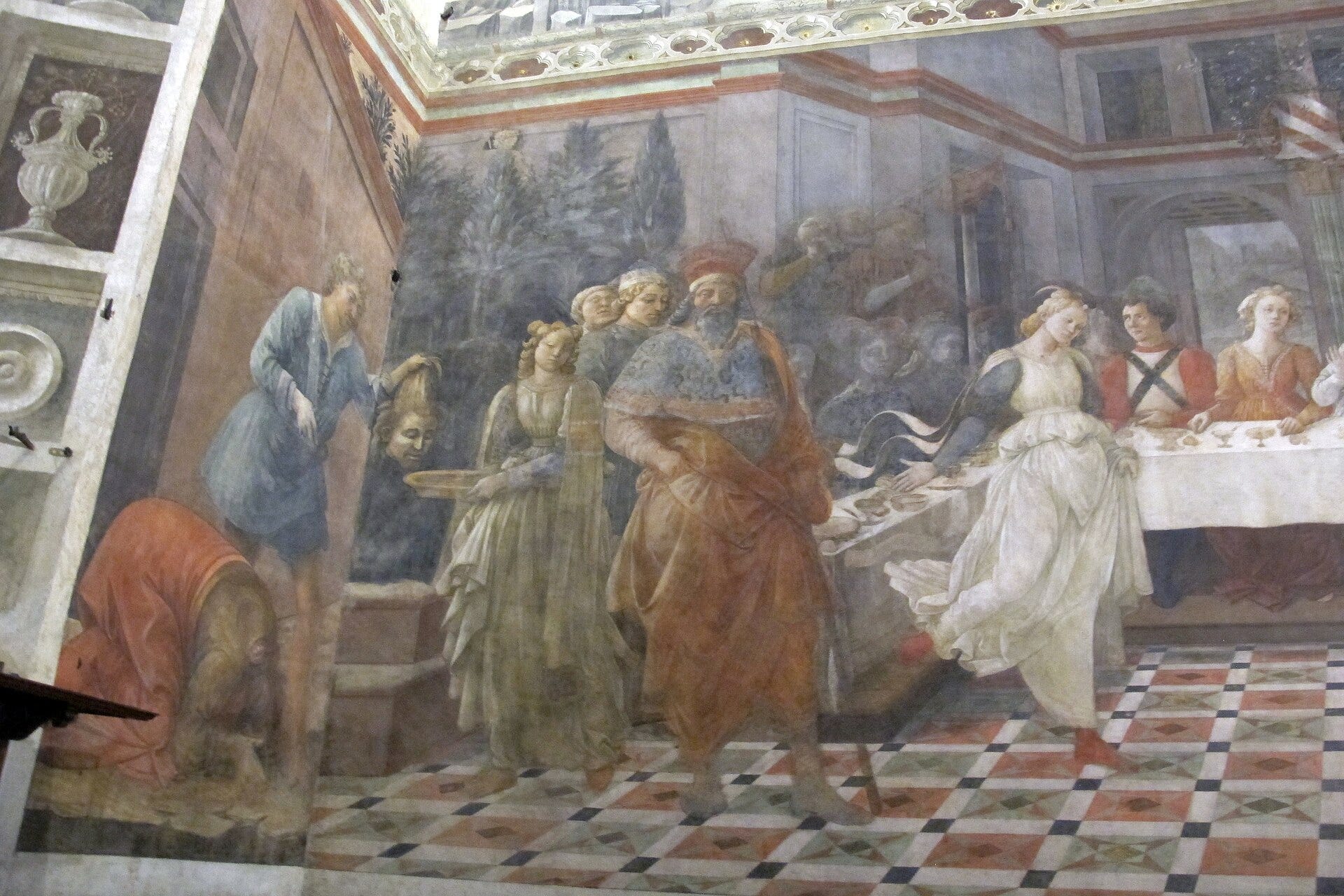
A young woman in a pale, flowing dress dances alone on a tiled floor, in the middle of a long banquet. On the right, the guests seated at the table have turned to watch her. At the far left, the same girl kneels and hands a dish to a seated woman, her mother Herodias.
This banquet covers a wall of the main chapel of the cathedral of Prato, a town near Florence. Filippo Lippi decorated the chapel from 1452 to 1465, with the life of Saint Stephen on one side and the life of John the Baptist on the other. On the Baptist's wall, he fits three moments into a single scene: the dance, the beheading and the gift of the head.
Lippi was a friar of the Carmelite order, and his years in Prato changed his life. According to Vasari, whose biographies of Italian artists appeared in the 1500s, he met Lucrezia Buti in 1456 while he was painting for a convent in the town, where she was a young nun or a boarder. He asked to use her as his model for the Virgin.
The rest happened on a feast day. The cathedral kept a relic venerated as the belt of the Virgin Mary, the Holy Girdle, and on the day it was shown, Lucrezia went out with the crowd to see it. Lippi took her to his house instead. She stayed with him in spite of the nuns, and their son, Filippino, grew up to be a painter.
The fresco may keep a trace of that love. A tradition in Prato holds that the dancing Salome has Lucrezia's face. Lippi gives her the center of the wall and more light than anyone at the feast, and he pushes the beheading and the gift of the head to the edges. In the middle, she is still dancing.
At a Glance
Artist: Filippo Lippi (about 1406 to 1469)
Painted: 1452 to 1465
Medium: Fresco
Size: Not published
Where to see it: Prato Cathedral (Cathedral of Santo Stefano), main chapel, Prato, Italy
11. Henry Ossawa Tanner, Salome (about 1900)
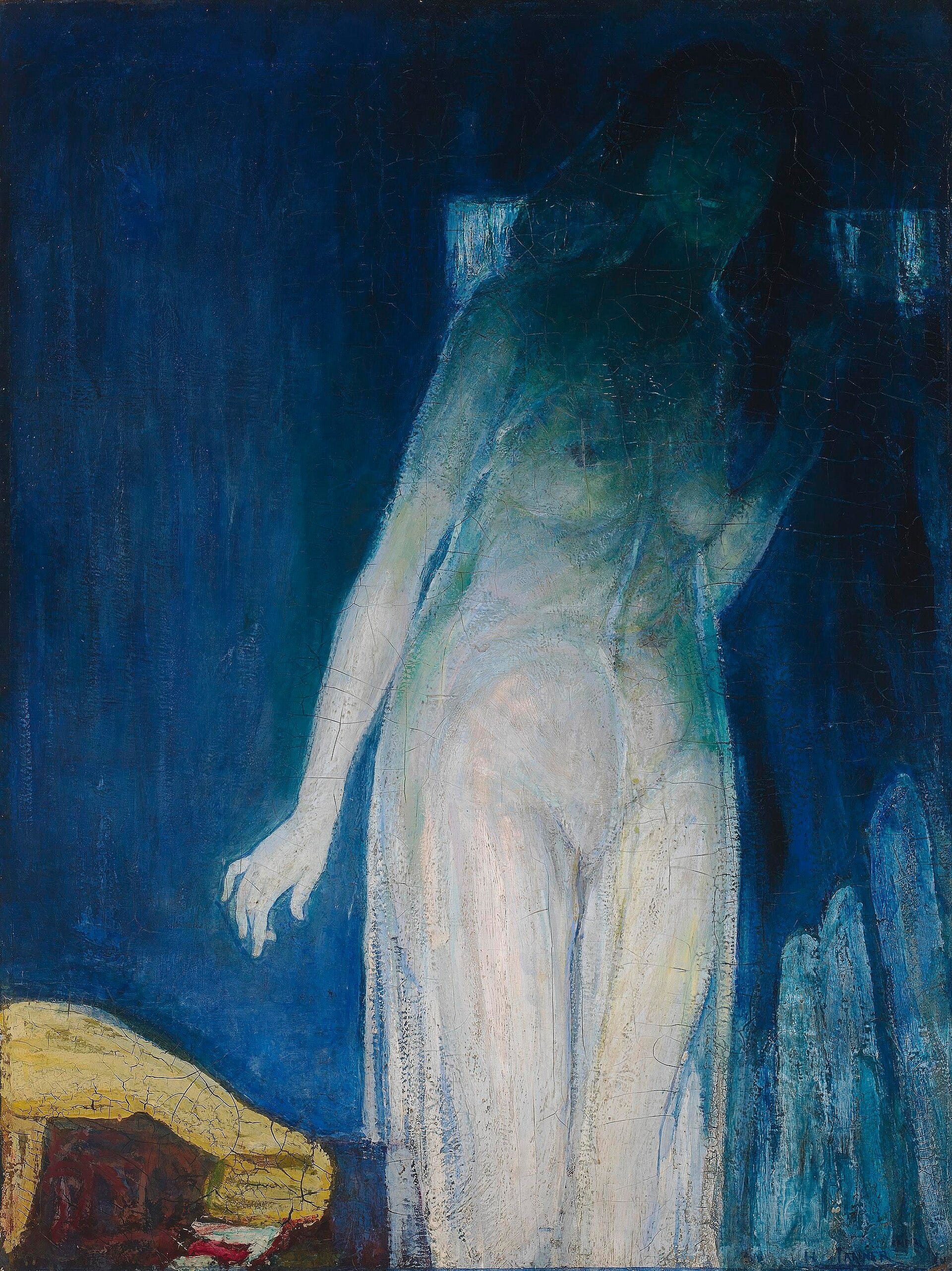
The shadow has swallowed her face. A tall woman in a sheer veil turns away into a blue-green darkness. Henry Ossawa Tanner painted this Salome in Paris around 1900. He was the son of a bishop, an American painter known for quiet, devout scenes from the Bible, and none of his other religious pictures goes this far.