
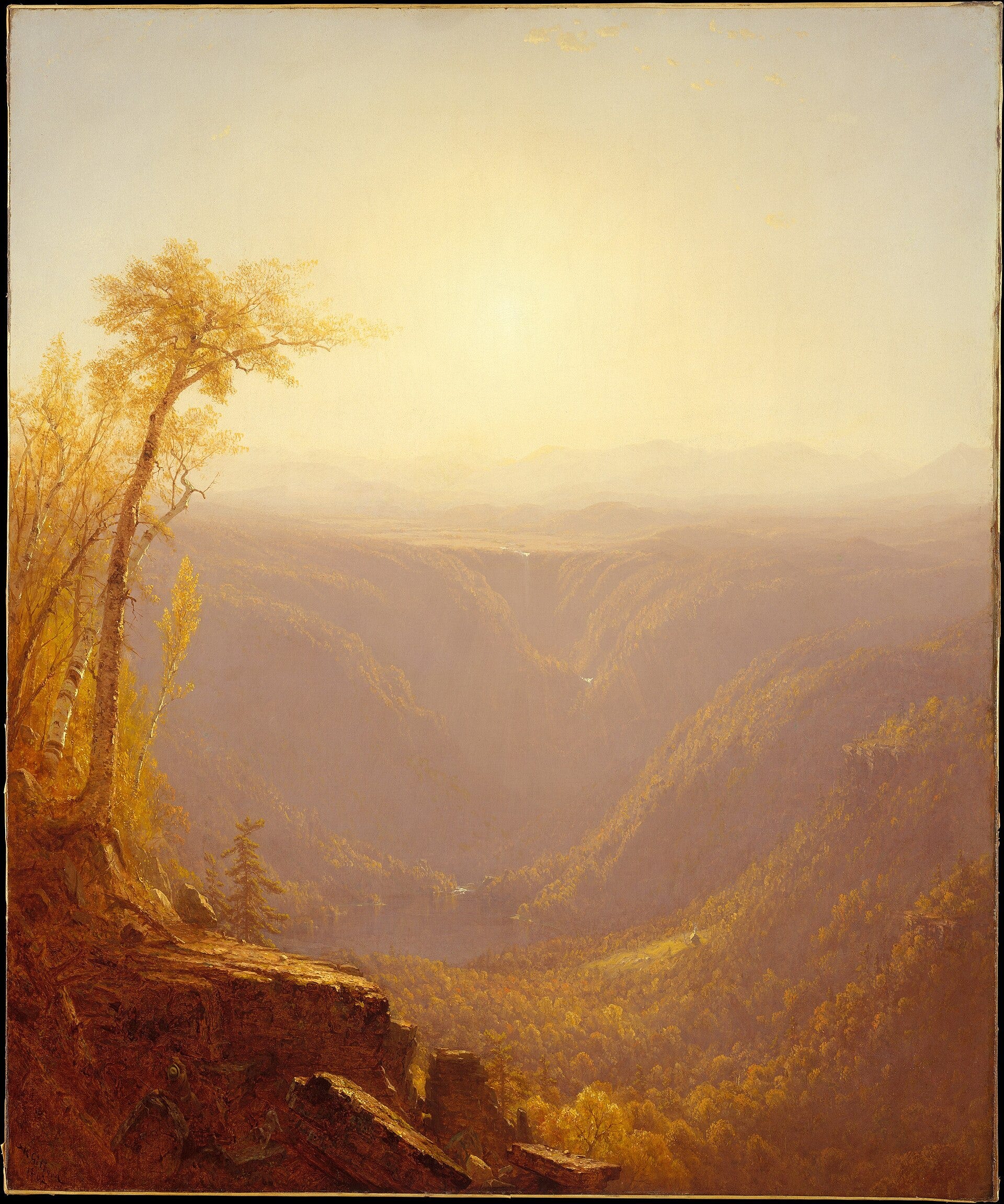
Sanford Robinson Gifford (1823 to 1880) was an American landscape painter of the Hudson River School, a group of painters of American mountains and rivers. He became famous for valleys and lakes filled with sunlight, like A Gorge in the Mountains (Kauterskill Clove).
Cool Stories About Art is a newsletter to learn art the fun way.
Join 200,000+ readers and get:
10 new art stories / month
The entire archive of content (140+ articles)
Comment, ask questions, and chat with other readers
Sanford Gifford spent his life painting the light of a single moment of the day, often the low sun of evening. Some of his sunniest pictures date from the Civil War, fought from 1861 to 1865 between the Union, the Northern states, and the Southern states that broke away to keep slavery.
In those years, Gifford put on a soldier's uniform three times, and his mother, Eliza Gifford, lost two of her sons.
In the summer of 1862, Corporal Sanford Gifford was on duty in Baltimore, a port city in Maryland. His unit, the Seventh Regiment of the New York National Guard, the state's part-time soldiers, guarded Fort Federal Hill, a Union fort on a hill above the harbor.
That year, Gifford painted the fort at twilight, in the dim light just after sunset. A single sentry, the soldier on watch, stands on the earth wall of the fort. Behind him glows the last light of the day.
Baltimore was Gifford's second time in uniform. The first time, in the spring of 1861, he had camped near Washington, and during those weeks his older brother Charles died. Charles was the brother who had first given Sanford a taste for art.
In his New York studio in 1862, after that summer in Baltimore, Gifford painted the picture at the top of the page, A Gorge in the Mountains. It shows the Kauterskill Clove, a narrow, steep valley in the Catskills, mountains north of the city.
In Gifford's time, tourists crowded the Kauterskill Clove. Thomas Cole, the founder of the Hudson River School, had painted the gorge as a wild and frightening place.
Gifford filled the same gorge with sunlight. Far away, the waterfall, which drops in two steps, almost vanishes in the glow. At the lower left, a hunter and his dog almost blend into the rock wall, and not a single tourist is in sight.
A Gorge in the Mountains hangs today at the Metropolitan Museum of Art in New York, known as the Met. Gifford himself helped found the museum in 1870.
The year of the gorge, the war reached the youngest of the Gifford brothers. In the summer of 1862, Edward Gifford became a captain in the Union army.
The sentry on the fort and the hunter in the gorge almost disappear in the light. So what was Sanford Gifford really painting, in the very years when his mother lost two sons?
In the rest of the story
What Edward Gifford did on the Fourth of July, 1863.
The six words Eliza Gifford said about her youngest son.
The sentence in which Gifford said what he was really painting.
The honor the Met gave Gifford before any other artist.