
Long before he wore a red suit, Santa Claus was a bishop in the fourth century, in a town in what is now Turkey. Sixteen centuries, a set of bones carried off by sailors, an ocean crossing and a great many magazine pages turned him into a round man with a white beard. These twelve images follow that change from start to finish.
Cool Stories About Art is a newsletter to learn art the fun way.
Join 200,000+ readers and get:
10 new art stories / month
The entire archive of content (140+ articles)
Comment, ask questions, and chat with other readers
How a Saint Became Santa
For centuries, painters who took on Saint Nicholas faced the same task: telling a whole story in a single picture. His legends are full of night visits, gold, ships and children brought back to life, and each scene had to read at a glance, first in a church and later in a family home.
No single artist painted Santa Claus. The figure was built in layers by altar painters, icon makers, engravers and illustrators, and each of them kept something from the image before: the gift left at night, the beard, the fur trim, the list of good children.
Each work here marks a stage of that change, or a place where it went another way, and each carries a story of its own. They are ordered from the picture almost nobody knows to the one everybody does.
12. Gentile da Fabriano, The Crippled and Sick Cured at the Tomb of Saint Nicholas (1425)
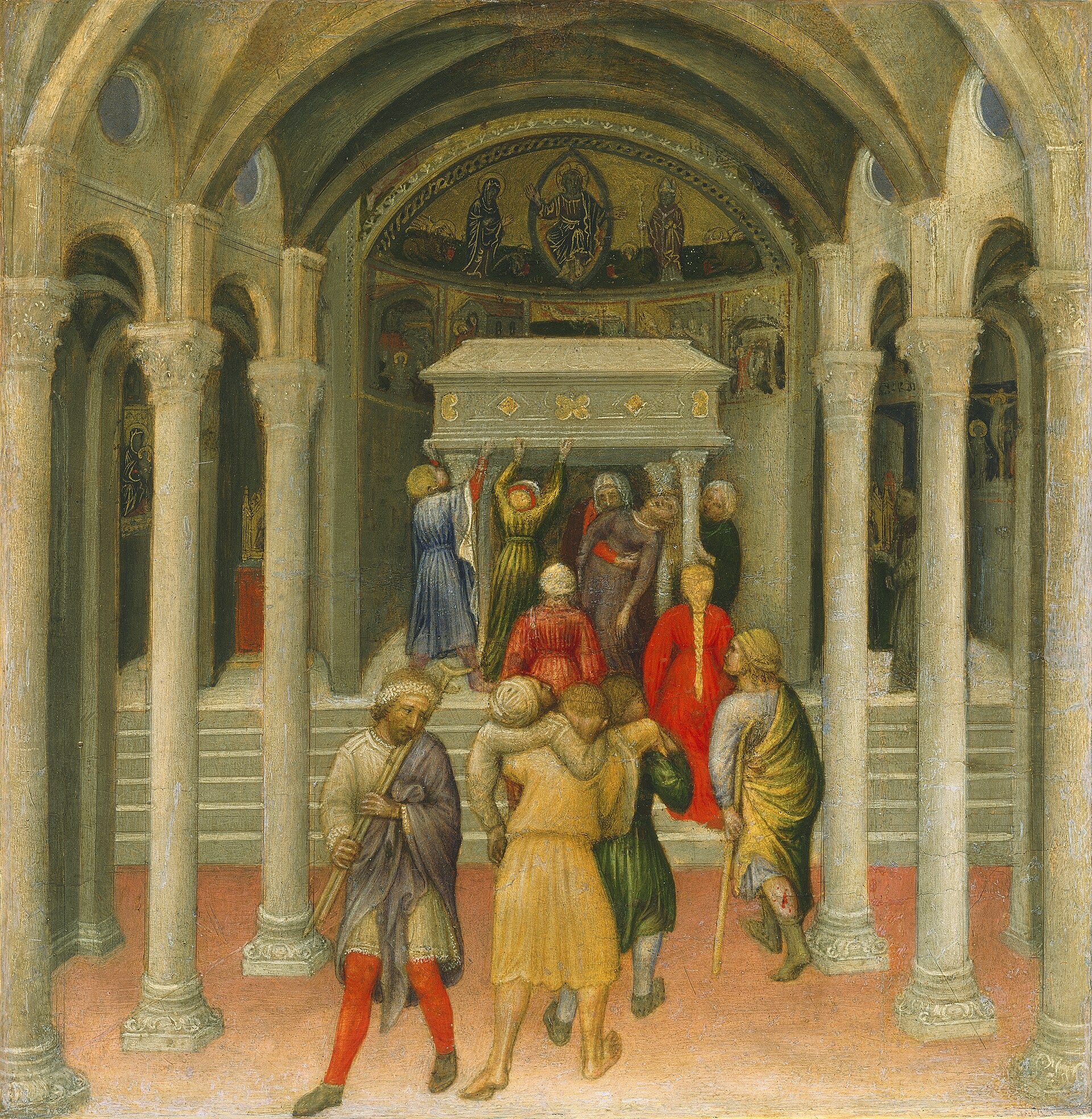
At the foot of a marble tomb, the sick and the crippled crowd together. Some kneel, others lean on crutches. The small panel shows a church cut open like a doll's house, with a gilded altar at the back and a deep blue vault overhead. The tomb belongs to Saint Nicholas, and the church around it stands in southern Italy, far from the town where he lived and died.
His body reached Italy through a theft. For more than seven centuries it lay in Myra, the town where he had been bishop, now called Demre, in Turkey. In 1087, sailors from Bari, a port on the Adriatic coast of southern Italy, landed there with three ships and carried the bones away. Whether they meant to save the relics from the Seljuk Turks or to bring pilgrims and their money to Bari is still argued over.
The pilgrims came, and the tomb gave them a reason to keep coming. It gives off a clear liquid that the faithful call manna, and for centuries they have credited it with the power to heal. That hope is what has brought the crowd in this panel so far.
More than three centuries after the theft, in Florence in 1425, Gentile da Fabriano gave the scene a place on a large altarpiece for the church of San Niccolò Oltrarno, as one of the small pictures along its base. He tells the miracle through the people who came for it, a church full of travelers holding on to the same hope.
Through that Italian port, a bishop from what is now Turkey became a saint of Western Europe. By the fourteenth century, painters across Italy were telling his life on their altars.
At a Glance
Artist: Gentile da Fabriano (about 1370 to 1427)
Painted: 1425
Medium: Tempera on panel
Size: 36.4 × 35.9 cm (14.3 × 14.1 in)
Where to see it: National Gallery of Art, Washington
About This Painting
What is the liquid leaking from St. Nicholas' bones?
It is known as the manna of Saint Nicholas. Every year on the evening of May 9, it is drawn from the tomb in Bari in front of the crowd, about half a liter. A chemistry laboratory at the University of Bari analyzed it in 1925 and found it remarkably pure. Some see a miracle in it, others simple condensation.
11. Fra Angelico, The Story of Saint Nicholas: Birth, Vocation and the Gift to Three Poor Girls (about 1437)
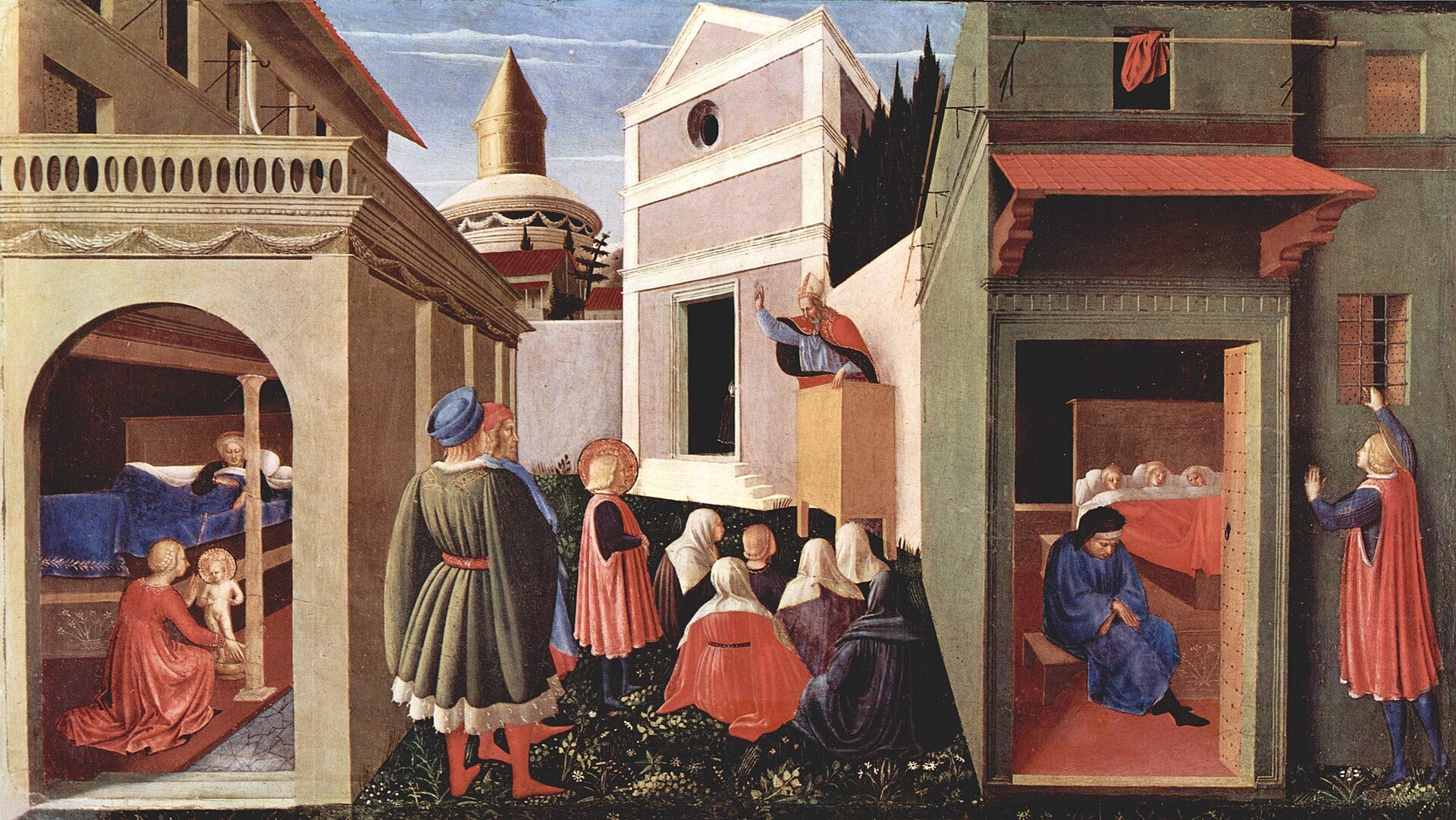
Through an open window, a young man stretches out his arm toward a dark room. Inside, three girls sleep near their father. The family has lost its fortune, and without a dowry no man of the time would marry the daughters. Their father has made the worst plan a father could make: he will let them be sold to men. Nobody in the room sees what the young man is about to throw.