
Homer never tells us what the sirens look like. He gives their song and the fate of the sailors who stopped to listen, nothing more. Every artist after him has had to answer the question he left open: what should a voice that kills look like? They never agreed, starting with the simplest point of all. Does she have wings, or a tail?
Cool Stories About Art is a newsletter to learn art the fun way.
Join 200,000+ readers and get:
10 new art stories / month
The entire archive of content (140+ articles)
Comment, ask questions, and chat with other readers
From Bird to Fish to Woman
The story starts in the Odyssey. The sirens sing from a meadow by the sea, and Ulysses, warned in advance, has his men plug their ears with wax and tie him to the mast, so that he can hear the song and live. Greek painters gave the singers the bodies of birds and the heads of women.
Centuries later, the medieval books of animals, which turned every creature into a moral lesson, gave the siren a fish's tail. English still keeps siren and mermaid as two different creatures, while French uses one word for both. In the 1800s, many painters dropped wings and tail alike and made her a woman.
Whatever body she wears, every siren chosen here is dangerous, and a ship or a sailor is always in the picture or close by. A fish-tailed siren earns her place only when a sailor is in danger, so the gentle mermaids combing their hair on a rock were left out.
12. Edward Burne-Jones, The Depths of the Sea (1887)
A mermaid swims down through green water with a young sailor in her arms, in a tall, narrow picture. She is smiling. His eyes are closed, and he is already dead, though she does not seem to have noticed.
The painter, Edward Burne-Jones, had little love for the Royal Academy, the official body of British artists in London. Even so, when it elected him an associate member in 1885, he accepted, and the next year he sent it a single work, The Depths of the Sea, painted in oil. It was the only time in his life that he exhibited with the Academy. A year later, he made a second version in watercolor and gouache.
To paint the water, he borrowed a glass aquarium from a fellow painter, Henry Holiday, who had set it up for a picture of the Rhine maidens. Then the Academy's president insisted that he add a school of sprats.
The showing went as badly as he had feared. He had predicted the picture would be "lost entirely in the Academy," and it was hung below a stag hunt. In 1893, Burne-Jones resigned.
At home, the mermaid meant something else. While he was painting her, Burne-Jones told his wife in a letter that the picture showed "a scene in Laura's previous existence." Laura Lyttelton, a young friend of the family, had died that year, and his wife, Georgiana, recognized Laura's expression in the mermaid's face.
For the catalog, Burne-Jones chose a line from Virgil's Aeneid: "Habes tota quod mente petisti, infelix." In English, it reads "Unhappy one, you have what you wanted with all your heart."
At a Glance
Artist: Edward Burne-Jones (1833 to 1898)
Painted: 1887 (a second version of the 1886 oil)
Medium: Watercolor and gouache on paper mounted on panel
Size: 197 × 76 cm (77.6 × 29.9 in)
Where to see it: Harvard Art Museums (Fogg Museum), Cambridge, Massachusetts
11. Gustav Wertheimer, The Kiss of the Siren (1882)
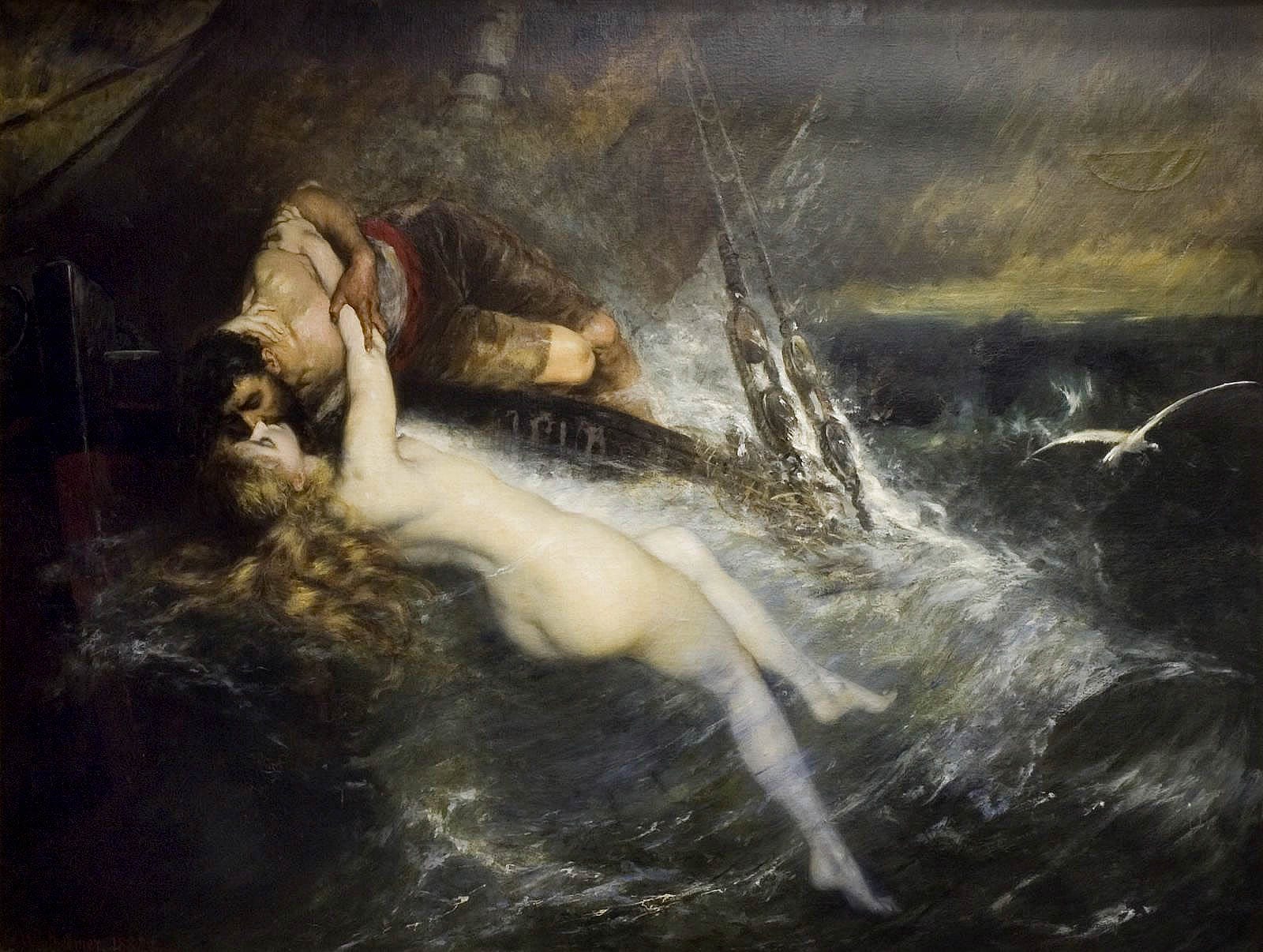
A storm has tipped a ship on its side, a sailor leans out over the rail, and a siren rises out of the wave to kiss him. She does not sing at all. The Viennese-born painter Gustav Wertheimer called this canvas, almost three meters wide, The Kiss of the Siren. In 1886, an art association in Indianapolis that did not yet even have a museum bought it, and about sixty years later the same institution decided it no longer wanted it.