
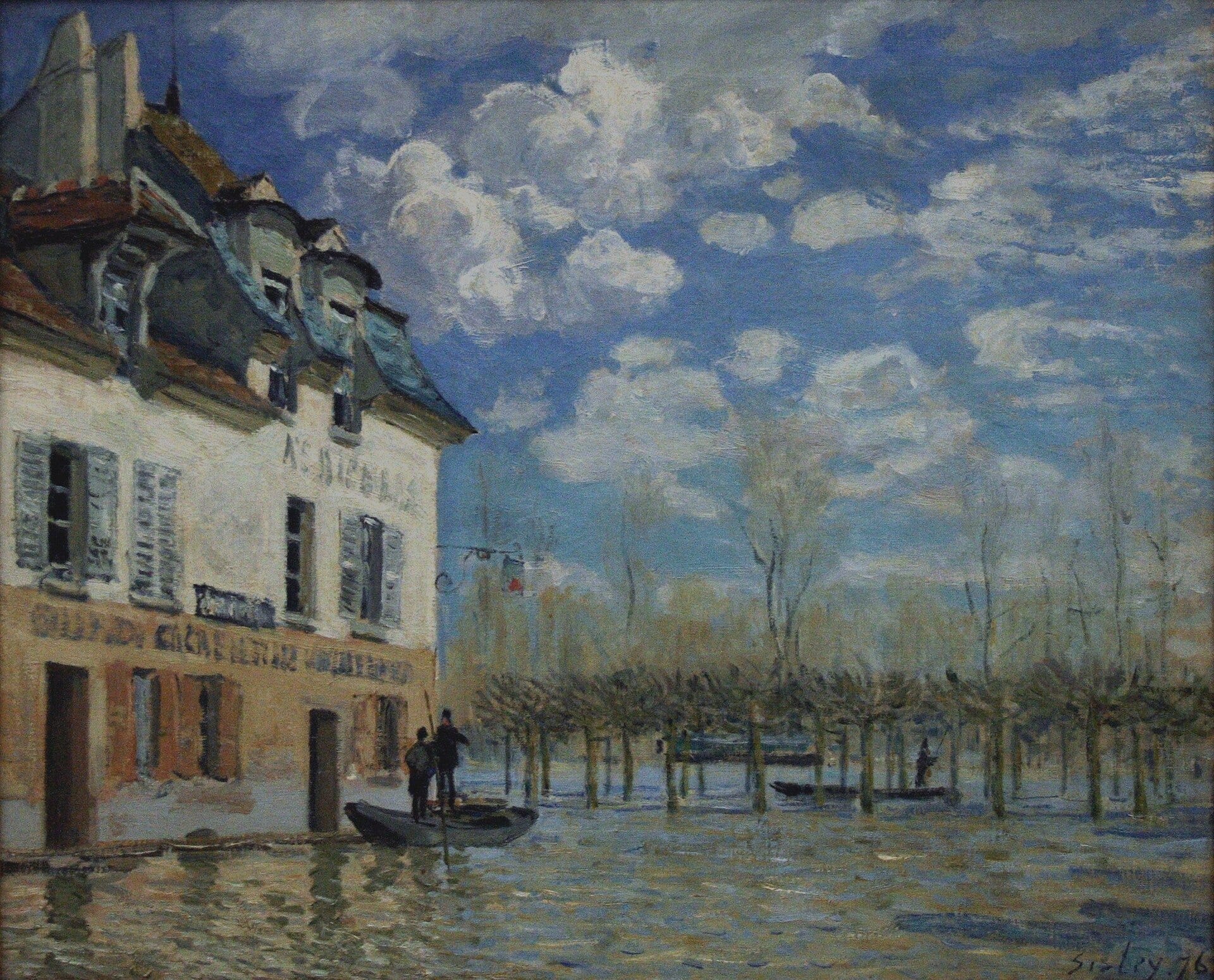
Sisley painted the flooded Seine at Port-Marly, a village in the western suburbs of Paris, during two different floods: in December 1872 and again in March 1876. One 1876 canvas, now at the Musée d'Orsay, is catalogued there as Boat in the Flood at Port-Marly.
Port-Marly sits on the Seine between Saint-Germain-en-Laye and Bougival. Sisley, who had settled in the neighboring town of Marly-le-Roi in 1874, found the subject close to home when the river rose in the spring of 1876.
Cool Stories About Art is a newsletter to learn art the fun way.
Join 200,000+ readers and get:
10 new art stories / month
The entire archive of content (1,000+ articles)
Comment, ask questions, and chat with other readers
Two floods, then, and two ways of looking at the water. The first, in December 1872, produced four paintings, according to the National Gallery of Art in Washington, and its canvas looks peaceful at first glance: calm water reflecting an overcast sky, and a pair of women who seem to be chatting. The second is stranger to look at, because the river has taken over the street and no one in the picture seems alarmed.
That March 1876 flood left more canvases than the museums have agreed how to count, and one of them carries a title that puts a boat first. The Musée d'Orsay catalogues it as La Barque pendant l'inondation, the boat during the flood.
The Orsay canvas, the one at the top of this page, has a history that begins to go wrong in 1954.
What You'll Discover
Why the water looks so calm.
How many canvases there are.
Where they hang now.
What happened in 1954.