
The danse macabre was a public health message. After the Black Death killed a third of Europe, painters covered church and cemetery walls with skeletons leading popes, kings and children by the hand. The point was that death does not check your rank. Here is where it came from and where it went.
Learn art the fun way
Where it starts: a Paris cemetery wall, 1424
The first recorded danse macabre was painted in the churchyard of the Holy Innocents in Paris, a cemetery so overcrowded that bones were stacked in the arcades above the graves.
The mural is gone, destroyed in the 17th century, but printed copies survive. It set the format: alternating pairs, a skeleton and a living person, ranked from pope down to peasant.
The mural ran along the charnel house wall of the Cemetery of the Innocents, painted in 1424 or 1425, with each pair of figures captioned in verse. It was destroyed in 1669 when the arcade was demolished, and survives only through a printed edition of 1485.
Holbein turns it into a book you can carry
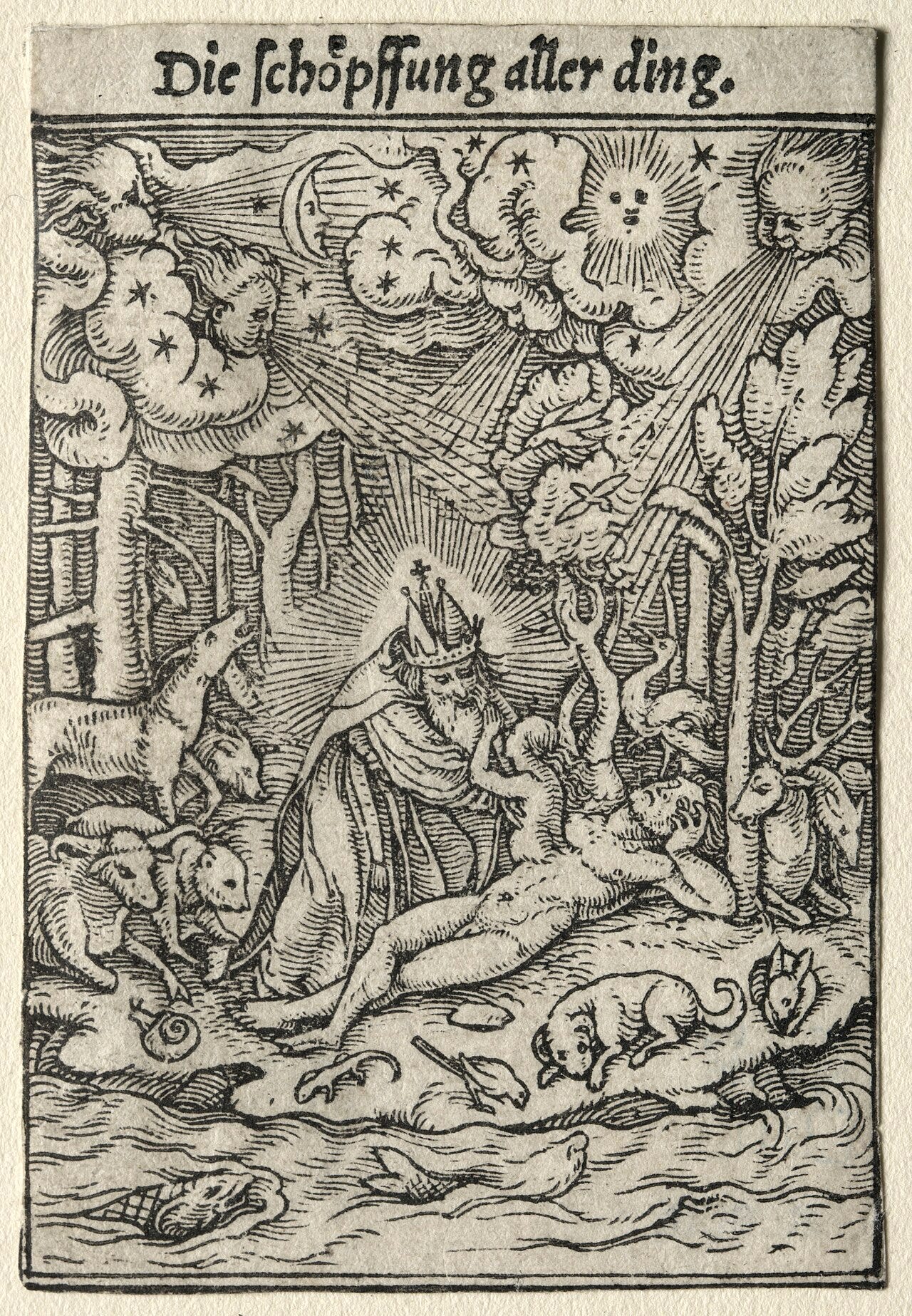
Hans Holbein designed 41 tiny woodcuts around 1526, each showing death interrupting one person mid life: the merchant at his goods, the ploughman at his field, the child pulled from its mother.
Printed in Lyon in 1538, it became the most influential version ever made. The medium mattered: what is a woodcut. Holbein The full account is in Hans Holbein.
He drew the blocks by 1525 and Hans Lutzelburger cut them, dying in 1526 before the set was issued. It was finally published at Lyon in 1538 with Latin captions, and ran to eleven editions in twenty four years.
Bruegel removes the dance and leaves the army
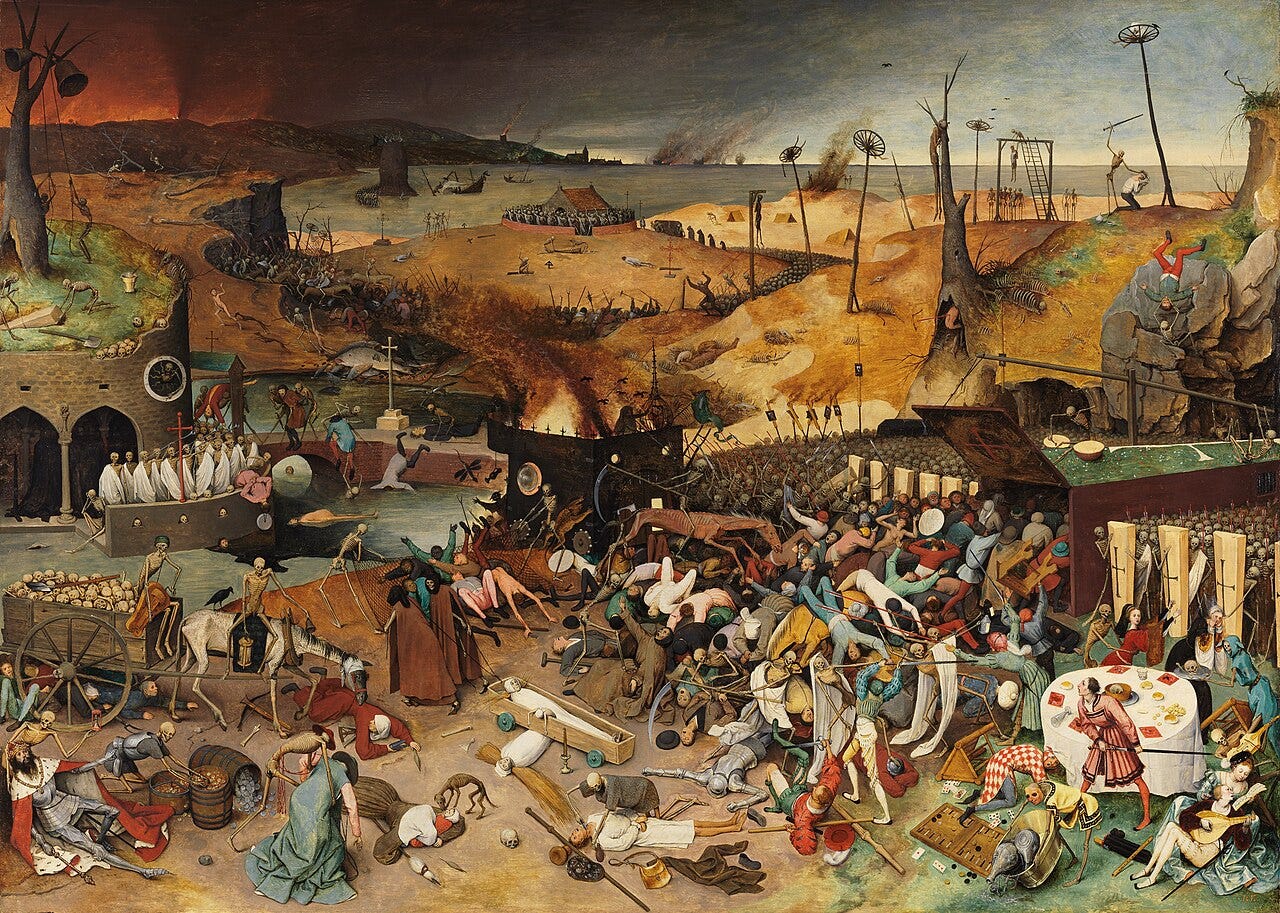
In The Triumph of Death, painted around 1562, the skeletons are no longer polite partners. They herd the living into a giant trap, drive a cart of skulls and cut throats in the corner.
Bruegel had lived through plague and religious war in the Low Countries. The Prado restored it in 2018. I go into his whole story in Pieter Bruegel the Elder.
The Triumph of Death was painted around 1562 and hangs in the Prado. There is no dance and no pairing off: an army of skeletons herds the living into a trap, which is a change of argument, not just of style.
The skull that hides in plain sight
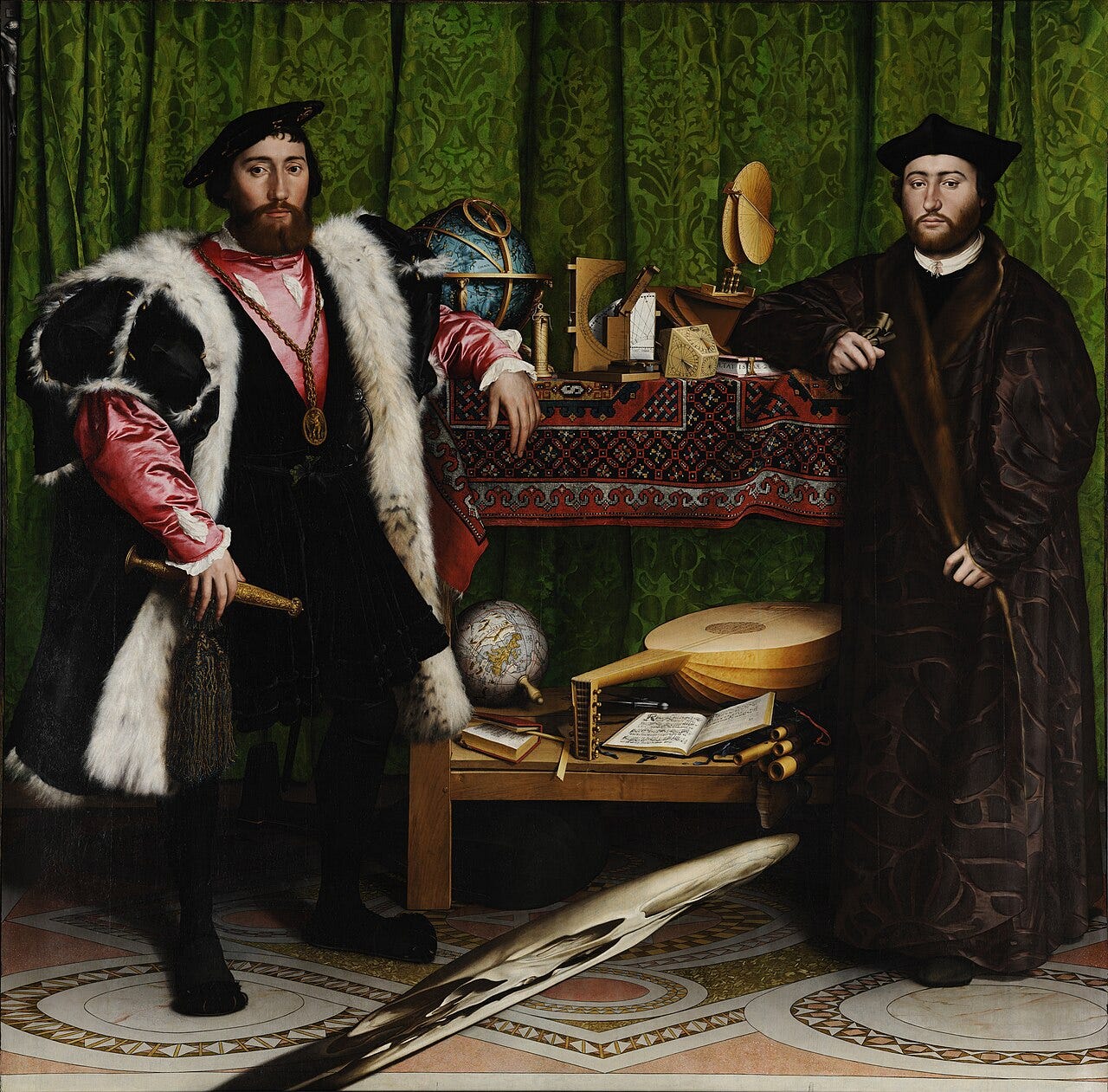
Holbein again, in 1533: in The Ambassadors, a stretched grey shape lies across the floor. Stand at the right angle and it resolves into a skull.
The technique is anamorphosis, and the message is the same as the dance: all this wealth, and still. I go through the whole painting in The Ambassadors.
Anamorphosis was a party trick before it was a memento mori. Holbein put the stretched skull across the floor of The Ambassadors in 1533, and it only resolves if you stand close to the right hand edge and look back along the picture.
The Dutch move it onto a table
Seventeenth century painters replaced the walking skeleton with a still skull beside a watch, a candle and a wilting flower. Same sermon, domestic scale.
That genre has its own grammar, and I go through it in what is vanitas and memento mori.
The Leiden painters turned the reminder into a table top: a skull, a snuffed candle, a watch and a tipped glass. Vanitas as a named genre dates from the 1620s and lasts about sixty years.
Mexico rewrites the whole thing
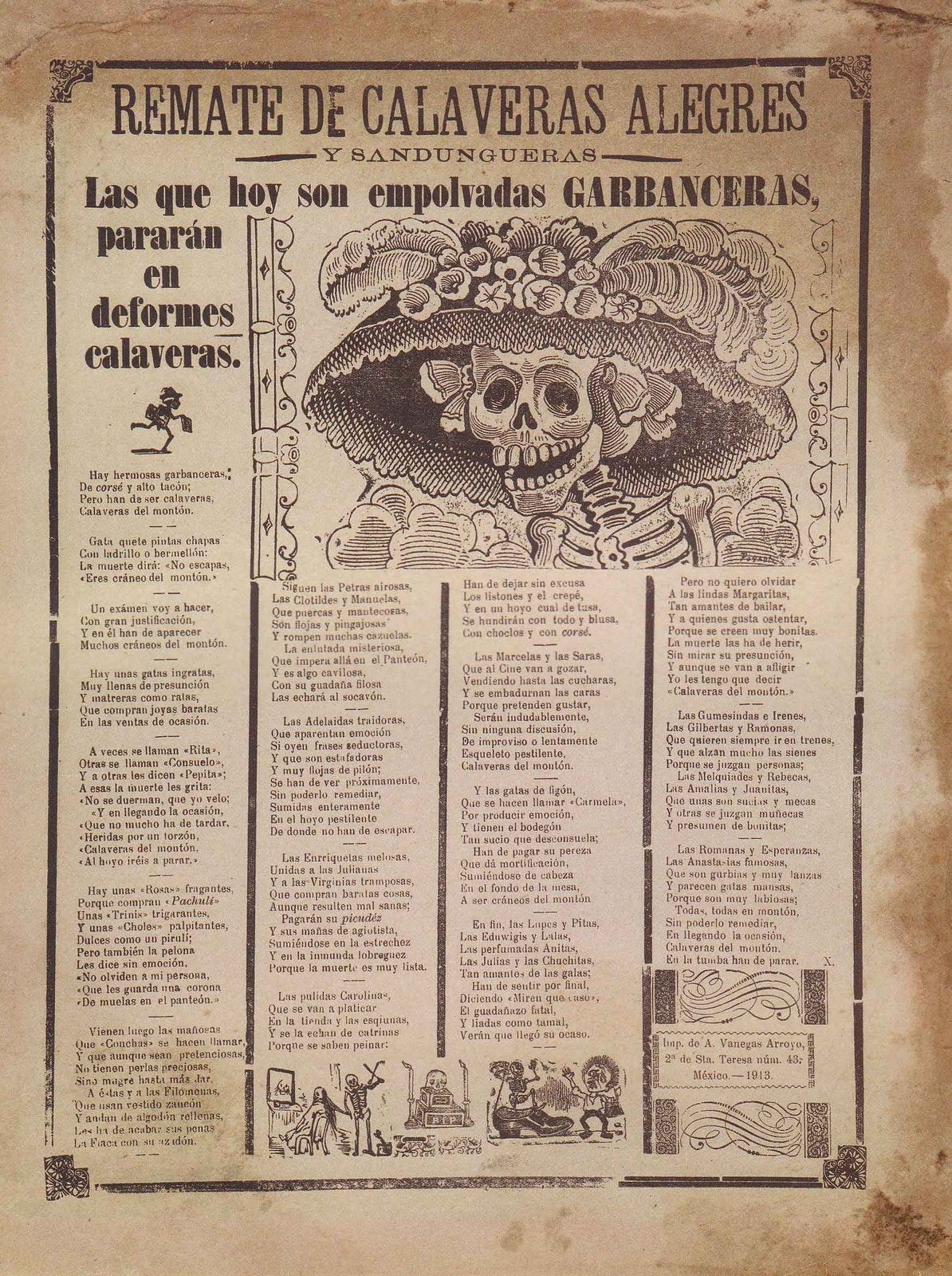
Jose Guadalupe Posada engraved skeletons dressed as everyone: dandies, revolutionaries, drunks, and above all La Catrina, a skeleton in a giant feathered hat mocking Mexicans who denied their indigenous roots.
Diego Rivera later put her at the centre of a mural and gave her a full body. The medieval dance became a national icon.
Posada engraved the calavera around 1910 as a political cartoon, not folk art, mocking Mexicans who denied their indigenous roots. Diego Rivera put her in a mural in 1947 and gave her the name Catrina.
The 19th century makes death a friend
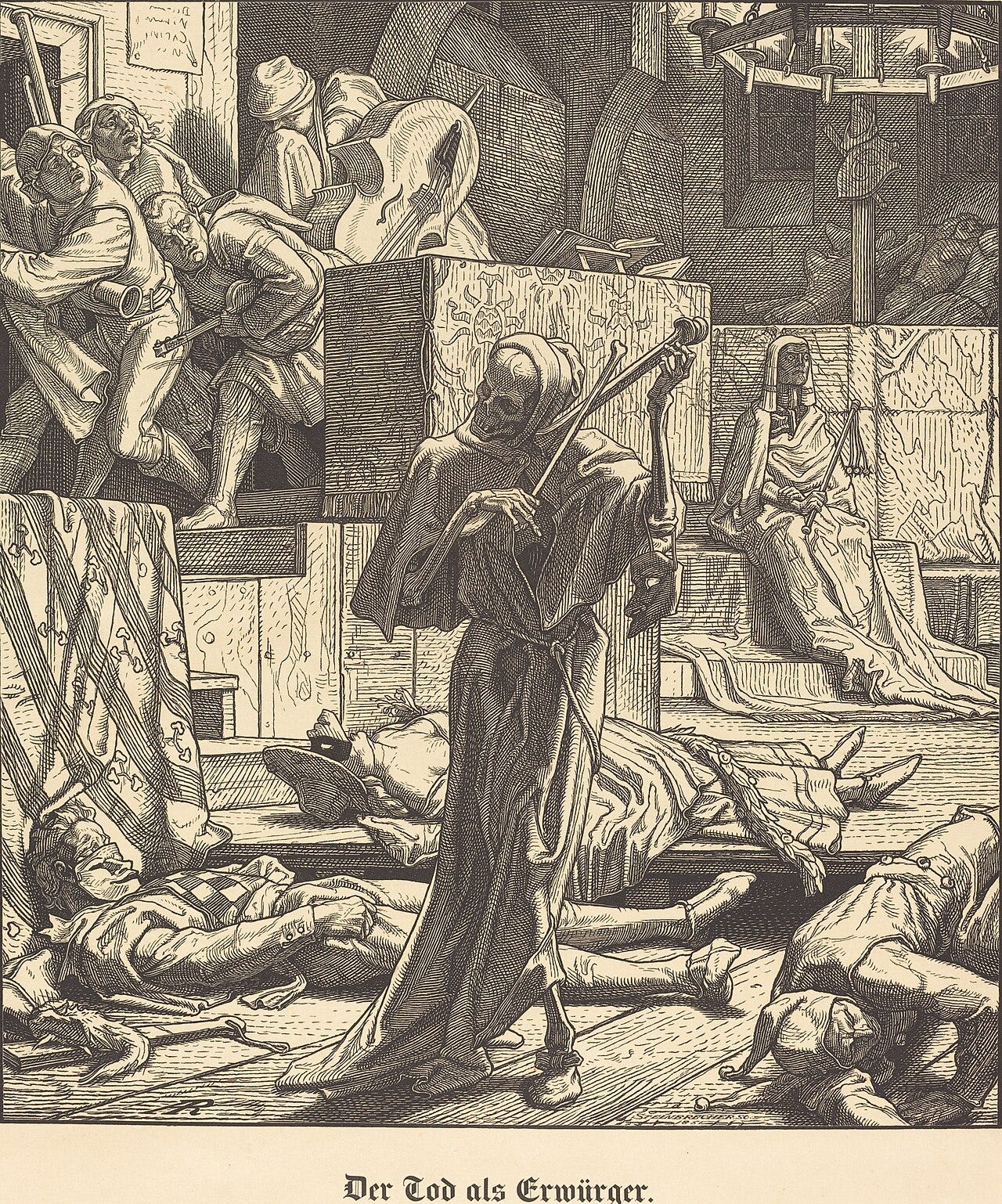
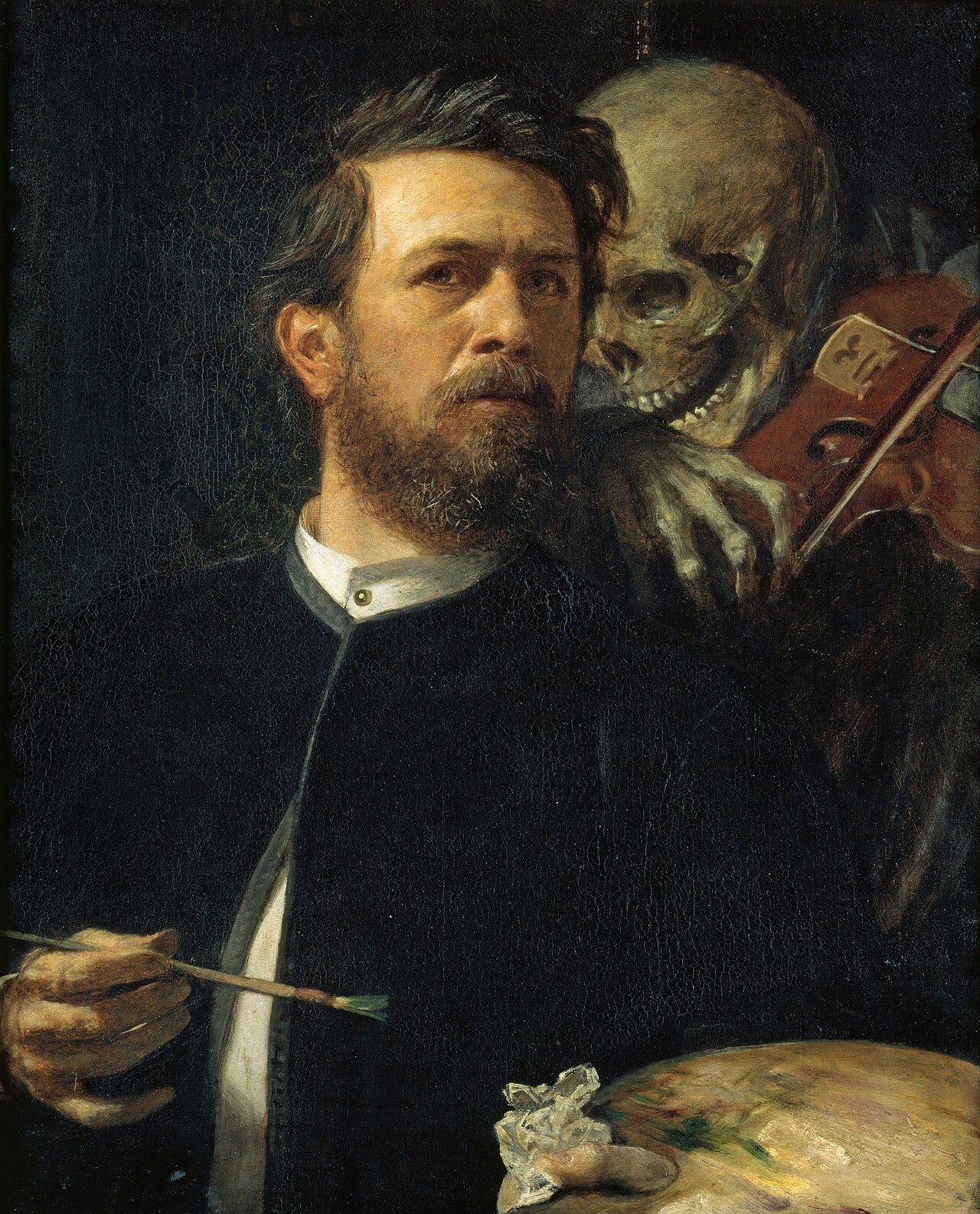
Alfred Rethel drew Death arriving at a Paris masked ball during the cholera outbreak of 1831, playing two bones like a fiddle, and Arnold Bocklin painted himself with a skeleton fiddling over his shoulder.
Bocklin's self portrait is the moment the skeleton stops being a warning and becomes a colleague. More on him in Arnold Bocklin.
Rethel published Death as a Friend in 1851 as one half of a pair, the other being Death as a strangler at a Paris ball. The gentle version sold far better, which tells you what the market wanted.
What the dance still raises, six centuries on
What is the danse macabre? A medieval subject showing skeletons leading people of every rank to the grave, first recorded on a Paris cemetery wall in 1424.
Why did it appear then? The Black Death had killed roughly a third of Europe. The dance argued that plague ignored rank, which it visibly did.
Who made the most famous version? Hans Holbein, whose 41 woodcuts printed in 1538 spread the subject across Europe.
What is La Catrina? A Mexican skeleton figure engraved by Posada around 1910, satirising social climbing, later adopted as an emblem of the Day of the Dead.
Where would I go to see them? The Prado for Bruegel, the Rijksmuseum for The Ambassadors, and the Met for Holbein's prints.
A footnote that changes the picture: the Holy Innocents cemetery was finally emptied in 1786 and its bones were carried across Paris by night into the quarries that became the Catacombs. The wall that started the danse macabre is gone, but its occupants are still down there, stacked in patterns by later workers who clearly understood the assignment.
The plague that started this dance gets its own gallery in Plague in Art, and the tabletop version of the same warning continues in Famous Vanitas Paintings. All three belong to this guide to art history's macabre side.
The procession is not the only way painters staged this warning. Death given a face and wings carries the same idea in a single figure, and the skull on its own, stripped of the procession tells it through one object alone.