Sofonisba Anguissola: The Complete Story
Sofonisba Anguissola proved, in the 1550s, that a woman could be a famous painter, and Europe took notes. Born in Cremona around 1532, praised by Michelangelo, court painter to the king of Spain, she lived to 93 and advised a young Van Dyck on her deathbed years.
Every barrier had a workaround, and she found them all. Here is the longest, luckiest, most consequential career of the Renaissance's women painters.
Sofonisba Anguissola at a glance:
1532 or so: born in Cremona to a minor nobleman who decides to educate all six daughters as an experiment.
1554: in Rome, the young Michelangelo tests her with a drawing challenge and passes her sketches around.
1559: summoned to Madrid as lady-in-waiting and drawing teacher to Queen Isabel, painting the court all the while.
1580: widowed, she remarries by choice a Genoese sea captain met on the voyage home.
1625: at over 90, receives the young Van Dyck in Palermo and gives him painting advice he writes down.
Six sisters, one experiment
Her father, a minor Cremonese nobleman, did something unheard of: he sent his daughters to train as painters, Sofonisba first, to the local master Bernardino Campi around 1546.
Barred, as a woman, from studying anatomy or the male nude, she made her subject what she could study endlessly: herself and her family. Her self portraits became her ambassadors across Italy.
Michelangelo's test
Around 1554 her father sent drawings to Michelangelo, who set her a challenge: draw a crying boy, harder than a laughing one.
She answered with Boy Bitten by a Crayfish, her little brother howling over a pinched finger, and the old master praised it.
The drawing circulated for decades; Caravaggio, scholars note, seems to have remembered it in his own Boy Bitten by a Lizard.
More incredible painter stories
If Sofonisba Anguissola pulled you in, you will love these too:
Lady in waiting with a brush
In 1559 Philip II summoned her to Madrid as lady in waiting and drawing teacher to the young queen, Elisabeth of Valois.
For a decade she painted the Spanish court, though etiquette meant many works went unsigned or were absorbed into court painters' names; her portrait of Philip II in the Prado wore another attribution for centuries.
The king later dowered her marriage, a pension attached: the first woman painter with a state career.
The myth: a charming amateur
Because she painted no altarpieces or nudes, the histories long filed her as a gifted noblewoman rather than a professional.
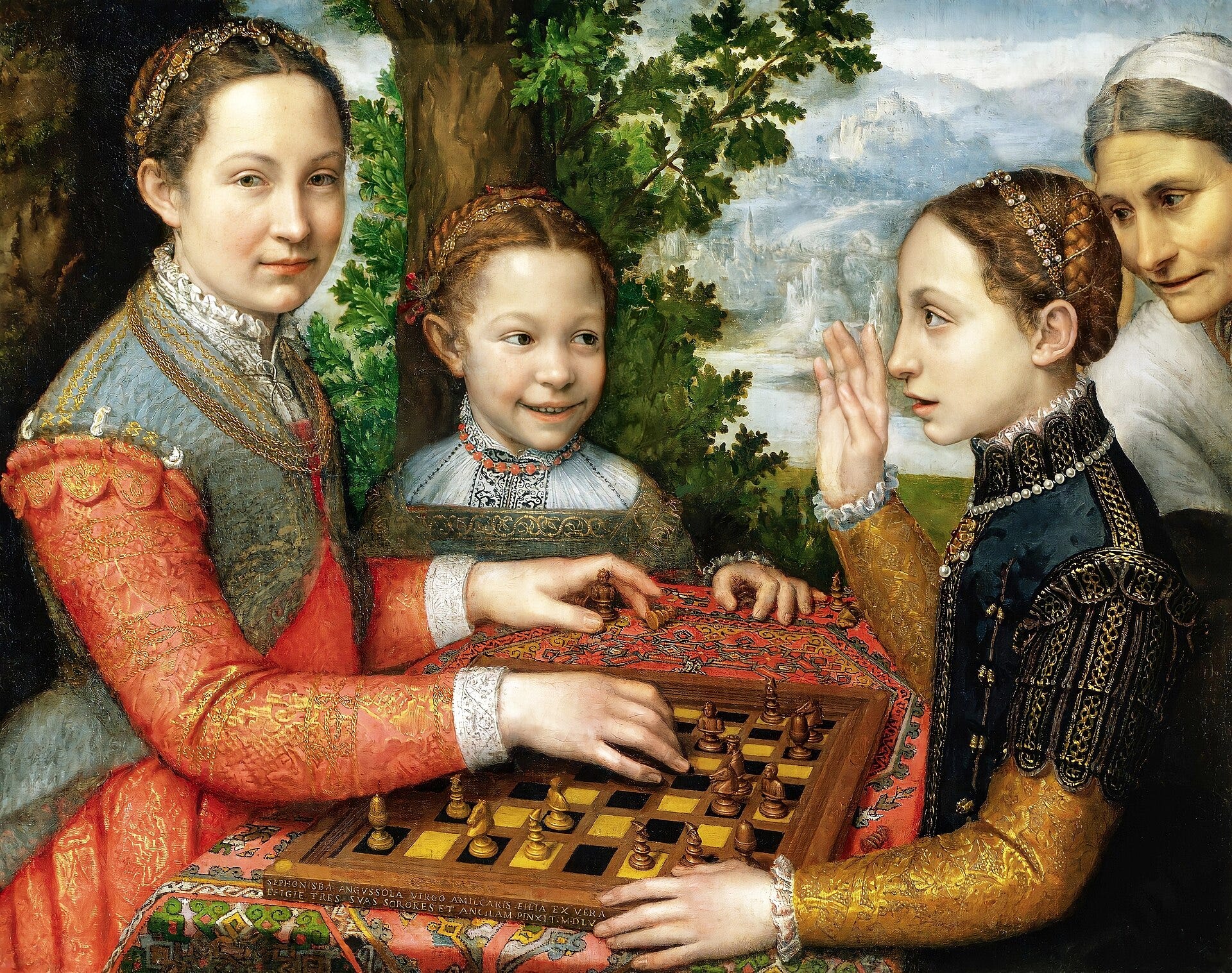
The record disagrees: Vasari visited and praised her, Philip paid her, and her intimate group portraits, above all The Chess Game of 1555, three sisters mid match, invented a warmth Italian portraiture did not have.
The limits were imposed; what she built inside them changed the genre.
The long last act
Widowed once, she chose her second husband herself, a Genoese sea captain, and lived on in Genoa and then Palermo, painting and advising.
In 1624 the young Anthony van Dyck visited her at about 92, sketched her in his notebook, and wrote down her advice on lighting elderly faces: set the light high, she told him, so the wrinkles soften.
She died in 1625; her husband's epitaph called her among the illustrious women of the world.
Where to see Sofonisba
The Chess Game hangs in Poznan, Poland; the Prado keeps the Spanish court portraits under her name at last; Boston's MFA, the Uffizi and Cremona's museum hold the self portraits that made her name travel.
The self-portrait business
Between Dürer and Rembrandt, nobody painted their own face as often as Sofonisba. It was strategy: a noblewoman could not sell paintings, but she could send them.
The self-portraits went out as diplomatic gifts: at the spinet, with a book, holding a medallion of the family name.
Each one makes the same double claim, virtuous and very good, and the courts of Europe got the message.
The sea captain
Widowed around 47, she remarried within a year or two, below her rank and entirely by choice: Orazio Lomellino, a Genoese ship captain she met on the voyage back to Italy.
The marriage lasted four decades. His shipping money and her Spanish pension made her houses in Genoa and Palermo required stops for young painters.
He outlived her and had carved on her tomb that she belonged among the illustrious women of the world. A husband's epitaph, and fair art history.
The paintings that lost her name
For three centuries her pictures survived under other names, men's names. Her Philip II in the Prado wore Sánchez Coello's label; the Lady in Ermine passed as an El Greco.
Court portraits went unsigned, which made the erasure easy, almost clerical.
Reattribution has run for a century and is not finished. Several museum labels bearing her name are younger than their visitors' grandparents.
The Sofonisba Anguissola questions that keep coming up
What is she known for? Self portraits and family scenes, and serving Philip II's court as the first woman painter with a royal career.
Did Michelangelo really praise her? Yes: he set her the crying boy challenge around 1554 and admired the result.
What is The Chess Game? Her 1555 portrait of three sisters mid game, warmth new to Italian portraiture.
When did she die? In Palermo in 1625, at about 93.
Did she paint men? Constantly at the Spanish court: Philip II, Don Carlos, the Duke of Alba. Unsigned, which is exactly how several spent centuries credited to men.
How many works survive? Around fifty broadly accepted, with attributions still moving. The Chess Game in Poznań and the Cremona family portraits anchor the list.
More secrets to unlock
The last lesson, taken down by Van Dyck
Van Dyck's 1624 notebook page survives, sketch and notes together: the most sought after portraitist of the next age recording painting advice from a woman born before Michelangelo finished the Last Judgment. She outlived every rule written to contain her, and got the last lesson in.