
Sonia Delaunay (1885 to 1979) was a Ukrainian born painter who settled in Paris, where she and her husband Robert Delaunay built Orphism, an early abstract art made of color contrasts. She is remembered for refusing to keep that color on the canvas: she stitched it into a baby's blanket, wore it to a dance hall, printed it in a book two meters long and put it on a car.
Museums hang her circles and arcs of color. She considered her first abstract work to be a blanket.
Cool Stories About Art is a newsletter to learn art the fun way.
Join 200,000+ readers and get:
10 new art stories / month
The entire archive of content (1,000+ articles)
Comment, ask questions, and chat with other readers
In 1911 her son Charles was born, and she made him a blanket from bits of fabric, sewn together in patches of color. The arrangement, she wrote in 1956, recalled the houses of Russian peasants and "seemed to me to evoke cubist conceptions." She and Robert then applied the same method to other objects and to paintings.
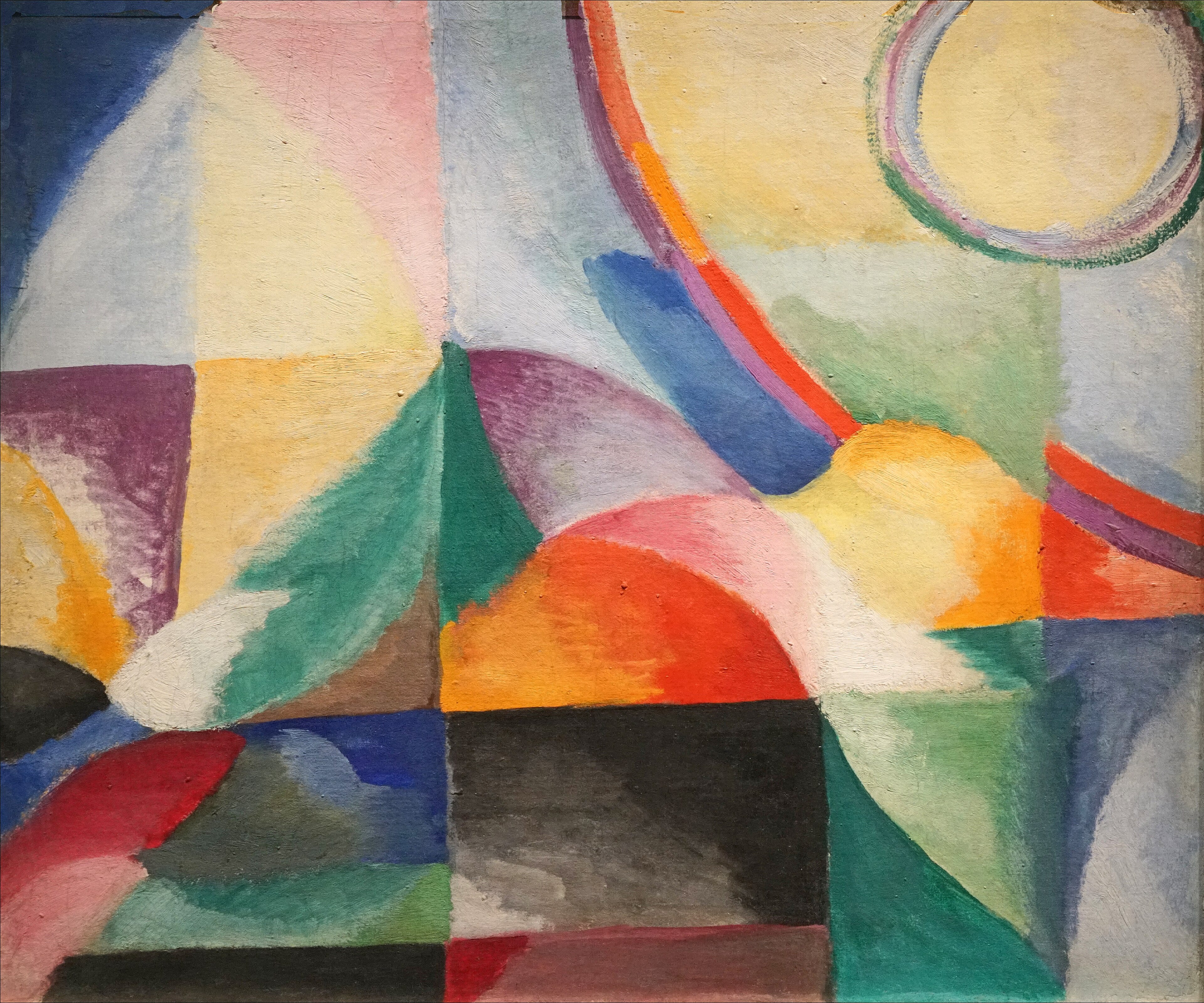
The Thyssen museum in Madrid, which owns the painting above, adds that she stopped painting for more than two years after Charles was born, and that her designs for quilts, cushions and tablecloths, which had no fixed top or bottom, may have shaped the canvases she made next.
That may explain an oddity of the painting itself. The signature on Simultaneous Contrasts sits as if the picture stood upright, yet the museum concludes from similar paintings that it should hang horizontally.
Her career has a second tidy story, told about the end of her life. In 1964, most short biographies say, she became the first living woman to have a retrospective at the Louvre, and the Centre Pompidou repeats it. Yet the Pompidou also lists the catalogue of that Louvre exhibition, and its title is Donation Delaunay. That title turns out to matter.
What You'll Discover
Why she married a gallery owner first.
What she made from a baby's blanket.
What she wore to the dance hall.
What she and Cendrars made together.
What she did to a Citroën.
That Louvre claim, checked.