To paint a sunset, you just have to be outside at the right time. To paint a sunrise, you have to get up in the dark.

That difference shaped everything on this list. The painters here set alarms, climbed hills before dawn, or watched the light arrive through a window they could not leave. What they caught is the strangest few minutes of the day, when the world exists but has not committed to anything yet.
Quick answer: Famous sunrise paintings include Claude Lorrain's A Seaport at Sunrise (1674), Hokusai's Red Fuji (about 1830 to 1832), Turner's Sunrise with Sea Monsters (about 1845), Van Gogh's Enclosed Wheat Field with Rising Sun (1889), and Georgia O'Keeffe's Light Coming on the Plains (1917).
Here are eleven of them, in the order they were made.
1. Claude Lorrain, A Seaport at Sunrise (1674), Alte Pinakothek, Munich
Claude Gellee, called Le Lorrain, did something that sounds obvious now and was not then. He put the sun itself in the picture, low over the water, and made the viewer stare straight into it.
He painted this version at around seventy years old, near the end of a long career built almost entirely on light over harbors. He returned to the seaport at sunrise idea several times in his late years, each version slightly different.
For more than a century afterward, painting a harbor against the rising sun meant competing with Claude. Turner, who appears later on this list, asked to be buried next to him in spirit by having his own paintings hung beside Claude's at the National Gallery in London.
2. Francois Boucher, The Rising of the Sun (1752 to 1753), Wallace Collection, London
This is sunrise as mythology. Apollo rises from the sea to start the day, surrounded by nymphs and tritons, in the most luxurious dawn ever commissioned.
Madame de Pompadour, mistress of Louis XV, ordered it from Boucher as a full scale model for the Gobelins tapestry manufactory, paired with a companion piece, The Setting of the Sun. The tapestries took over three years to weave and cost 8,160 livres, which made them the most expensive works Gobelins had ever produced.
The finished tapestries hung in the king's bedroom at the Chateau de Bellevue. The paintings were sold with Pompadour's collection in 1766, passed through several hands, and were bought in 1855 by the 4th Marquess of Hertford, which is why both now hang in the Wallace Collection.
3. Philipp Otto Runge, Morning (1808), Hamburger Kunsthalle, Hamburg
Runge planned a cycle of four paintings called the Times of Day, and he imagined them displayed together in a purpose built room, experienced with music and poetry. He completed only Morning.
At the center, Aurora, goddess of dawn, floats above a wide landscape while a newborn child lies in the grass below. For Runge, morning meant birth, the beginning of a soul as much as the beginning of a day.
He died in 1810, at thirty three, with the rest of the cycle unrealized. A second, larger version of Morning survives only in fragments.
4. Caspar David Friedrich, Morning on the Riesengebirge (1810 to 1811), Nationalgalerie, Berlin
Friedrich hiked the Riesengebirge mountains in 1810 and sketched their rock formations before composing this dawn scene in the studio. Ridges recede into morning haze, and on the highest rock stands a summit cross.
Look closely and there is a small drama on the peak. A woman in white helps a man climb the final rocks toward the cross, a quiet allegory of faith placed inside a real mountain sunrise.
The painting was a success in Friedrich's lifetime and was acquired by the Prussian king, Friedrich Wilhelm III. Friedrich painted other dawns and moons that we cover elsewhere on this site.
5. Katsushika Hokusai, Fine Wind, Clear Morning, also called Red Fuji (about 1830 to 1832), multiple collections
The most famous sunrise in Japanese art shows no sun at all. What it shows is the effect: Mount Fuji turned deep red by early morning light, an event that actually happens on clear mornings in late summer and early autumn.
Hokusai made it as part of his series Thirty Six Views of Mount Fuji, begun when he was around seventy years old. The series used Prussian blue, a pigment newly imported into Japan, which is why that sky still looks so intense.
Because it is a woodblock print, Red Fuji exists in many impressions with real differences in color between them. You can find impressions at the Museum of Fine Arts Boston, the Philadelphia Museum of Art, and the Metropolitan Museum of Art, among others.
6. J.M.W. Turner, Sunrise with Sea Monsters (about 1845), Tate Britain, London
Near the end of his life, working in the coastal town of Margate, Turner painted sunrises that had almost stopped being pictures of anything. This unfinished canvas is mostly a wall of yellow and pink light over water.
The title came later, and it may oversell the drama. Tate suggests the murky pink shapes at the bottom are probably fish, and you can make out a red and white float and part of a net nearby.
Turner never exhibited it. It was found in his studio and entered the national collection with the rest of the Turner Bequest, which is how a private experiment became one of his most reproduced late works.
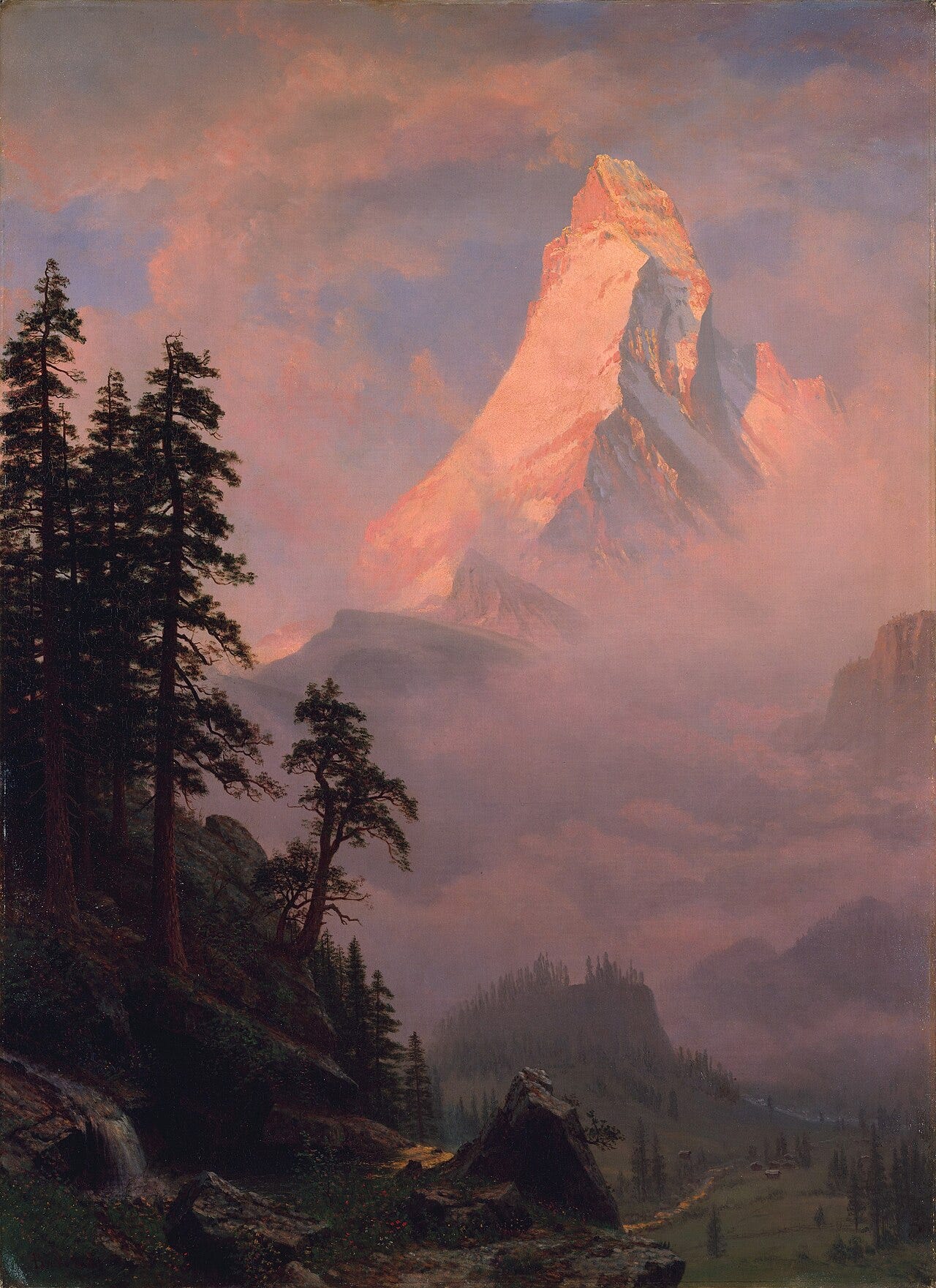
7. Albert Bierstadt, Sunrise on the Matterhorn (after 1875), Metropolitan Museum of Art, New York
Bierstadt built his fame on enormous American mountain scenes, but here he turned the same machinery on the most notorious peak in Europe. The Matterhorn catches the first light while the valley below stays in shadow.
The mountain came with a story every viewer knew. It had only been climbed for the first time in 1865, by Edward Whymper's party, and four of the seven climbers died on the descent.
So a sunrise on the Matterhorn was never a neutral subject. Bierstadt was painting first light on a mountain that had just killed people, and the picture trades on that tension.
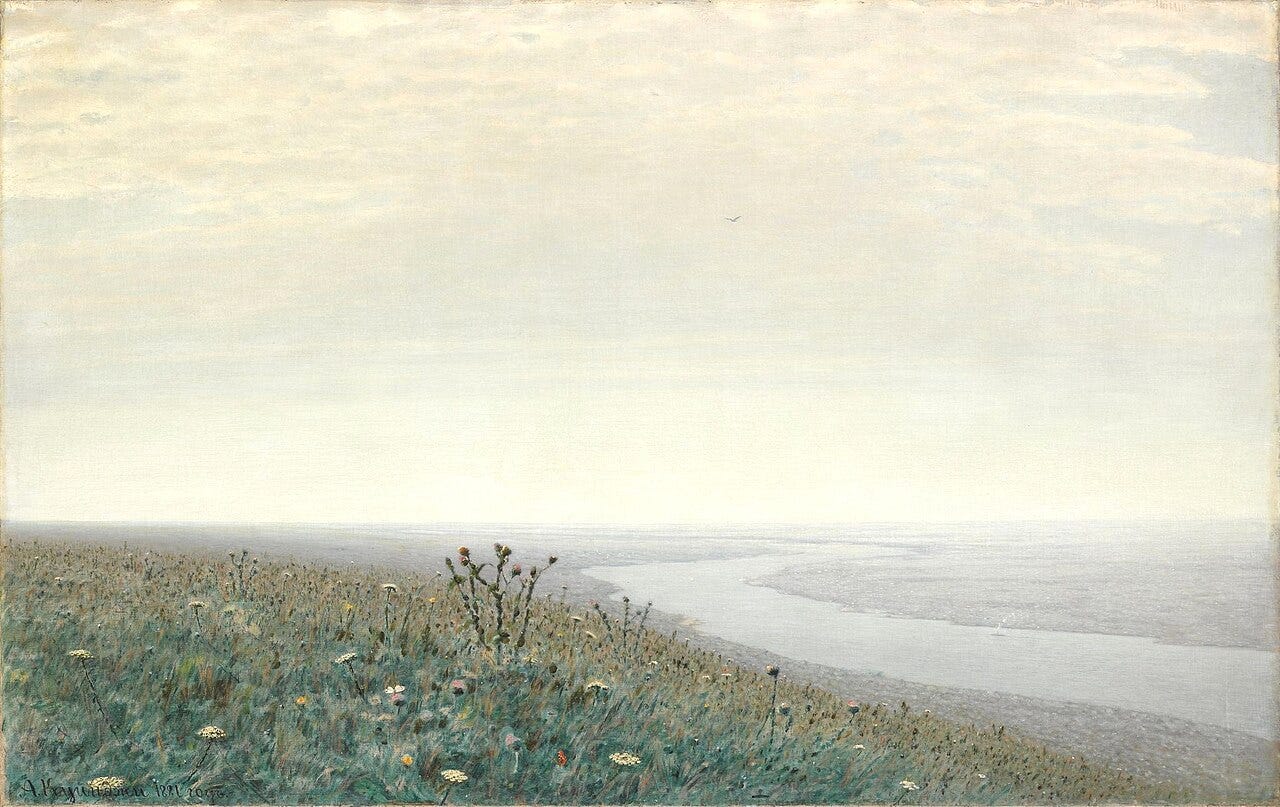
8. Arkhip Kuindzhi, The Dnieper in the Morning (1881), Tretyakov Gallery, Moscow
Kuindzhi was the great light trickster of Russian painting. In 1880 he had exhibited a single painting, Moonlit Night on the Dnieper, alone in a darkened room, one of the first single work exhibitions in Russia, and crowds lined up to see it.
The Dnieper in the Morning came the year after, and it pulls the opposite trick. There is no visible sun anywhere in the picture, only river mist thick enough to feel damp, and yet the whole canvas reads as glowing dawn.
Shortly after this period, at the height of his fame, Kuindzhi essentially stopped exhibiting for the rest of his life.
9. George Inness, Sunrise (1887), Metropolitan Museum of Art, New York
Inness in his last decade painted landscapes that seem to be dissolving, and this sunrise is one of them, a soft blaze of orange behind loosely brushed trees. He was deeply influenced by the mystic Emanuel Swedenborg and treated landscape as a spiritual subject.
Here is the odd detail. The Met itself notes that the painting's provenance and exhibition history are obscure, because Inness produced other paintings with the same subject, title, size, and date.
In other words, even the museum that owns it cannot fully untangle which early records refer to this exact sunrise.
10. Vincent van Gogh, Enclosed Wheat Field with Rising Sun (1889), Kroller Muller Museum, Otterlo
Van Gogh painted this sunrise from inside the asylum of Saint Paul de Mausole in Saint Remy, where he had committed himself in May 1889. The walled wheat field was the view from his window.
He described it to his brother Theo: through the barred window he could see a square field of wheat in an enclosure, above which he saw the morning sun rising in all its glory. He painted that view over and over for a year, in every season and weather.
One thing never made it into the paintings. The iron bars he mentioned in the letter do not appear on the canvas, which shows the field as if seen from open air.
11. Georgia O'Keeffe, Light Coming on the Plains No. II (1917), Amon Carter Museum of American Art, Fort Worth
In 1917 O'Keeffe was a twenty nine year old teacher at West Texas State Normal College in Canyon, Texas, and the Texas plains gave her a horizon with nothing on it. She painted the sunrise there as a sequence of three small watercolors on cheap paper.
Each one is almost nothing: concentric arcs of blue wash opening around a pale center, the light itself with the landscape removed. Decades before her famous skulls and flowers, these are some of the earliest fully abstract sunrises in American art.
All three are now at the Amon Carter Museum of American Art in Fort Worth.
Before painting, there was dawn
Sunrise was a subject long before easel painting existed. In ancient Egypt, the morning sun had its own god, Khepri, shown as a scarab beetle rolling the sun disc over the horizon the way a real scarab rolls a ball of dung.
Under the pharaoh Akhenaten in the 14th century BC, reliefs showed the sun disc Aten with rays ending in small hands, reaching down to the royal family. Painters of the last four centuries were late arrivals to a very old subject.
Where to see them
New York, Metropolitan Museum of Art: Bierstadt's Sunrise on the Matterhorn, Inness's Sunrise, and impressions of Hokusai's Red Fuji.
London: Turner's Sunrise with Sea Monsters at Tate Britain, Boucher's The Rising of the Sun at the Wallace Collection.
Germany: Claude Lorrain's A Seaport at Sunrise at the Alte Pinakothek in Munich, Runge's Morning at the Hamburger Kunsthalle, Friedrich's Morning on the Riesengebirge in Berlin.
Elsewhere: Van Gogh's wheat field at the Kroller Muller Museum in Otterlo, Kuindzhi's Dnieper at the Tretyakov Gallery in Moscow, O'Keeffe's watercolors at the Amon Carter Museum in Fort Worth, and further Red Fuji impressions at the Museum of Fine Arts Boston and the Philadelphia Museum of Art.
Sunrise, sunset, and the rest of the sky
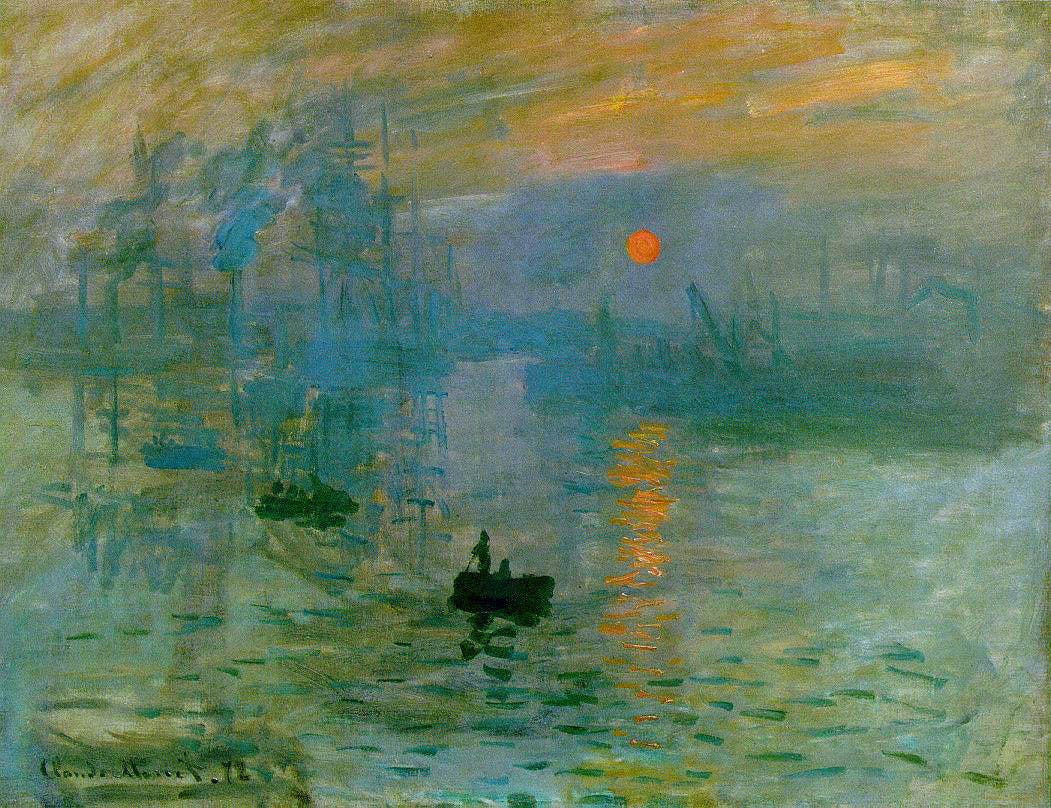
If this page put you in the mood for the other end of the day, we cover it in Sunset Paintings, including Monet's Impression, Sunrise, which despite its name lives comfortably among the dusks, and Aivazovsky's dawn shipwreck The Ninth Wave, which also appears on our storm page.
Painters have treated the two ends of the day differently for centuries. Dusk is drama and endings, available to anyone standing outside at the right hour, while dawn tends to attract painters interested in beginnings, hope, or simply the discipline of being awake before everyone else.
For the sun itself as a painted object across the whole day, see The Sun in Art.
For the full family of sky pages, start with The Sky in Art.
Sunrise painting FAQ
How can you tell a painting shows a sunrise and not a sunset? Often you cannot from the image alone. Titles, letters, and documentation usually settle it, as with Van Gogh's letter about his morning sun. Heavy mist and cool shadows suggest dawn, but they are clues, never proof.
Why are there fewer sunrise paintings than sunset paintings? Practicality is a big part of it. Dawn light changes fast, the working conditions before it are cold and dark, and for centuries painters had to observe at sunrise and then reconstruct the scene in the studio.
What is Red Fuji? It is both a print and a real event. On clear mornings in late summer and early autumn, dawn light can turn Mount Fuji's slopes red, and Hokusai's Fine Wind, Clear Morning fixed that moment into one of the most reproduced images in art.
Did any painter on this list actually watch the sunrise he painted? Van Gogh did, repeatedly, from his asylum window in Saint Remy, and described it in letters to Theo. O'Keeffe worked from the dawns she saw on the Texas plains in 1917.
Which sunrise paintings can I see in one city? New York does best. The Metropolitan Museum of Art holds the Bierstadt, the Inness, and impressions of Hokusai's Red Fuji under one roof.
What is the oldest sunrise image in art? Far older than painting as we know it. Egyptian artists were carving the morning sun as the scarab god Khepri thousands of years before Claude Lorrain put a rising sun over a harbor in 1674.
The Kroller Muller Museum, where Van Gogh's Enclosed Wheat Field with Rising Sun hangs, holds almost 90 of his paintings, the second largest Van Gogh collection in the world.