Sunset Paintings: 12 Famous Skies That Set Art on Fire
The most famous sunset paintings turn a burning sky into the real subject, from Turner's blazing slave ship and Monet's misty sunrise to the blood red heavens of Munch's Scream. One of them even handed a whole movement its name.
A sunset lasts a few minutes and never holds still, which is exactly why painters keep chasing it. I have picked twelve skies across four hundred years, and one small canvas of a dawn changed the course of art, as you can read in what Impressionism is.
Why painters chase the dying light:
The color. A sky that turns gold, pink and violet in minutes, gone before you can mix the paint.
The mood. Endings, calm, dread and glory, all read straight from a low sun.
The challenge. Light so bright and quick it forces a painter to work fast and loose.
The drama. Fire in the sky behind a ship, a mountain or a lone figure.
What I would read after this
The ones I would send you to next:
Was Monet really the first Impressionist, the painting that may have got there first
Inside Monet house at Giverny, room by room, including his own bedroom
Vermeer, Woman Holding a Balance, what is actually on those scales
1. Claude Monet, Impression, Sunrise (1872)
A hazy orange sun hangs low over a misty harbor, its light broken into a few loose dabs on cold blue water. Monet painted this view of Le Havre at dawn in 1872, working so fast and rough that a critic sneered it was a mere impression.
The insult stuck and turned into a banner. From the title of this one small canvas came the word Impressionism, and I trace who really lit that fuse in who painted the first Impressionist.
2. J M W Turner, The Slave Ship (1840)
Behind the beauty of this blazing sunset lies a real crime. Turner showed The Slave Ship in 1840, taking as his subject a massacre in which a slave ship threw sick captives overboard to claim the insurance, then set the whole scene under a sky of orange, red and gold.
The sun drops into a wild sea while shackled bodies sink in the foreground, a sunset turned into an accusation. The picture was given to the critic John Ruskin by his father, and though Ruskin called it the noblest sea Turner ever painted, he later admitted he could no longer bear to live with what it showed.
3. Claude Lorrain, Seaport at Sunset (1639)
For two centuries, painters who wanted to paint a sunset studied Claude Lorrain first. Around 1639 he was arranging harbors like this one, ships lying still in golden light while the sun sinks between grand buildings and lays a path across calm water.
He ordered nature into perfect calm, framing the light with columns and masts so the eye slides straight to the sun. Turner loved these pictures so completely that he demanded two of his own hang beside two Claudes in London forever, a young rebel bowing to the old master of the setting sun.
4. Caspar David Friedrich, Woman before the Rising Sun (about 1818)
A woman stands with her back to us, arms slightly open, facing a low sun that floods a quiet valley with pale gold. Caspar David Friedrich painted her around 1818, small and alone before the vast light.
Because we cannot see her face, we take her place and feel the dawn as she does, a private moment of awe. For Friedrich the rising sun was never only weather, but a sign of hope, faith and the soul reaching for something beyond the hills.
5. J M W Turner, Norham Castle, Sunrise (about 1845)
A castle melts into a wash of blue and gold as the sun rises through river mist, the solid stone almost dissolved by light. Turner painted Norham Castle around 1845, near the end of his life, and left it looking barely finished.
There is almost no drawing left, just glowing color and a blur where the sun burns through. Critics of his day thought he had lost his skill, while later painters saw a man who had raced a hundred years ahead toward pure light.
6. Ivan Aivazovsky, The Ninth Wave (1850)
Ivan Aivazovsky painted the sea perhaps six thousand times, and almost never in front of it. The Ninth Wave, from 1850, is the most loved of them all: survivors cling to a broken mast as a giant wave rears over them, while the sky behind glows with a warm sunrise.
He carried the light of the water in his head and worked at astonishing speed, conjuring terror and hope in a single frame. Russians have treasured this dawn over the waves ever since, half shipwreck and half prayer.
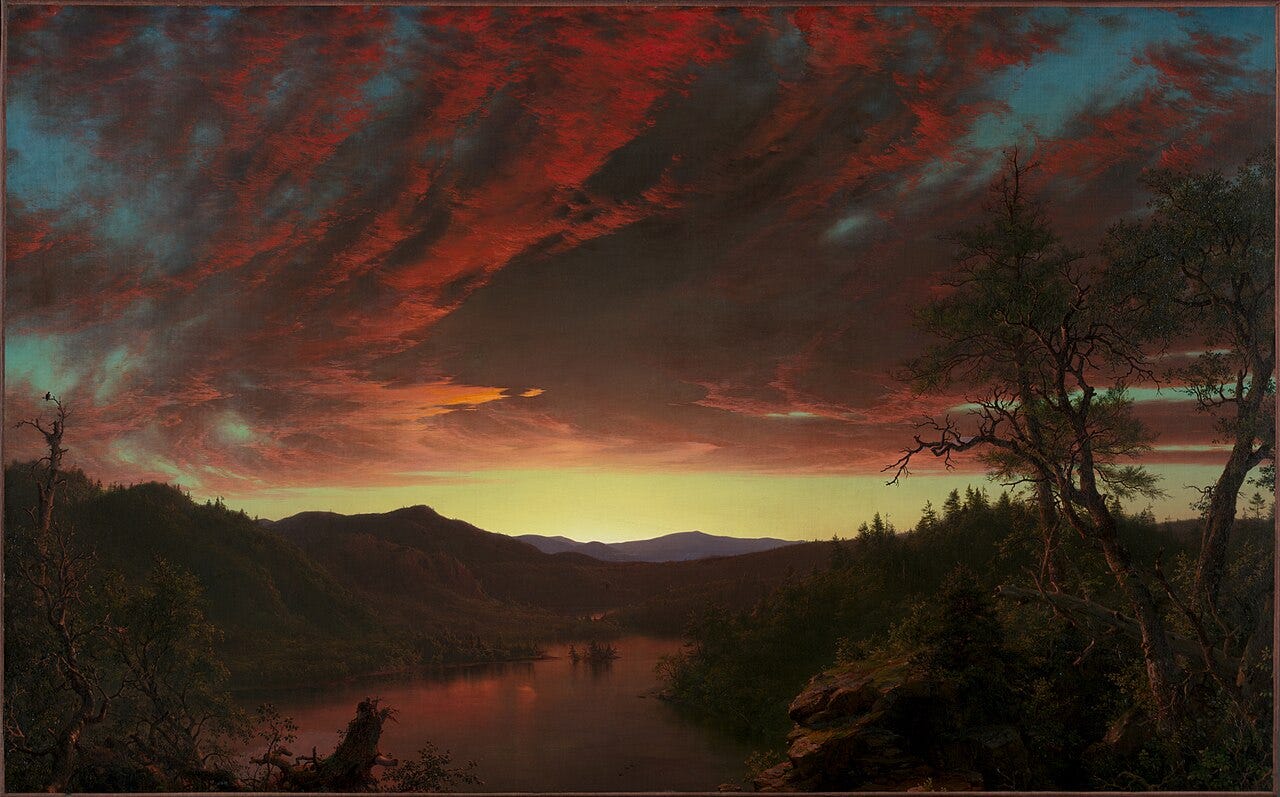
7. Frederic Edwin Church, Twilight in the Wilderness (1860)
A sky of scarlet and orange clouds burns above an empty American forest, not a single human figure in sight. Frederic Edwin Church painted Twilight in the Wilderness in 1860, on the eve of the Civil War.
Many have read that flaming sky as a quiet warning, a country about to tear itself apart, shown as a sunset over an untouched land. Church built the color from close study of real skies, then pushed it until the whole heaven seems on fire.
8. Albert Bierstadt, Sunset in the Yosemite Valley (1868)
Crowds once paid at the door to stand before a painted sunset like this one, lit in a dark room so it seemed to burn from within.
Albert Bierstadt made Sunset in the Yosemite Valley in 1868, pouring molten gold down the cliffs and across a still river.
He tuned the light far past what any eye would meet on the spot, turning a real canyon into a vision of paradise, and selling the American West to eastern crowds as a promised land.
9. Vincent van Gogh, Sower with Setting Sun (1888)
A farmer flings seed across a field while a huge yellow sun sinks right behind his head, glowing like a halo. Van Gogh painted the Sower in 1888 in the south of France, in homage to his hero Millet.
He made the sun enormous and almost sacred on purpose, lifting a simple peasant into something close to a holy figure. Van Gogh chased the setting sun over and over that year, writing to his brother that yellow was the color of God and of love.
10. Edvard Munch, The Scream (1893)
A figure claps its hands to its face and howls on a bridge under a sky of screaming orange and red. Edvard Munch painted The Scream in 1893, and most people miss that the famous sky is a sunset, a story I follow in Edvard Munch, the complete story.
The blood red clouds were real. Munch wrote of walking at sunset when the sky suddenly turned to blood, and some scientists think he was seeing skies stained by the distant eruption of Krakatoa in 1883.
The scream is not his own. Munch said it was nature that screamed and passed through him, so the sunset is not a backdrop but the very source of the terror.
11. Claude Monet, Houses of Parliament, Sunset (1903)
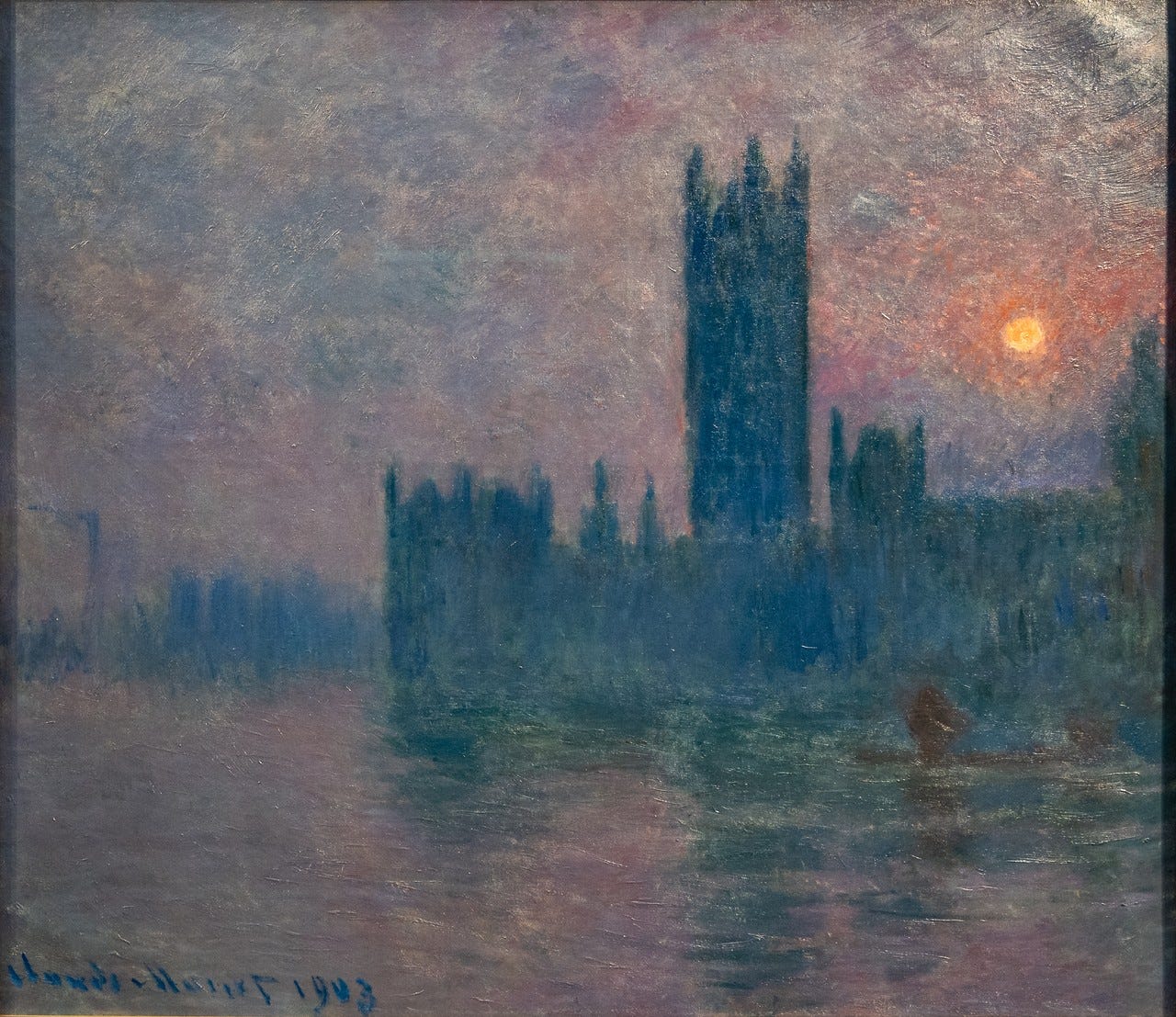
Monet crossed the Channel to paint fog. Between 1900 and 1904 he set up on a terrace at St Thomas' Hospital across the Thames and painted the Houses of Parliament again and again, their towers looming as blue silhouettes while the sun burned violet and orange through the haze.
He kept many canvases going at once, switching them as the light shifted minute by minute, hunting the exact color of fog and sun. You can follow how he chased light in the open air across his whole life in his complete story.
12. Maxfield Parrish, Daybreak (1922)
At its peak this picture was said to hang in one American home in four. Maxfield Parrish painted Daybreak in 1922, two figures resting by a pool beneath tall columns as a soft blue and gold dawn glows over distant mountains.
It became one of the most reproduced pictures of the whole twentieth century, its dreamy twilight so popular that the deep glowing blue is still called Parrish blue.
A picture made to sell as a cheap print outsold nearly every serious painting of its day, proof that a good sky sells itself.
Where to catch the light
Monet, Impression, Sunrise: the Marmottan Monet, Paris.
Turner, The Slave Ship: the Museum of Fine Arts, Boston.
Turner, Norham Castle, Sunrise: the Tate, London.
Aivazovsky, The Ninth Wave: the Russian Museum, Saint Petersburg.
Church, Twilight in the Wilderness: the Cleveland Museum of Art.
Munch, The Scream: the National Museum, Oslo.
If the burning sky pulled you in, keep going:
The secret behind Monet Magpie, one bird in the snow, and why it matters
The Ambassadors, detail by detail, the object at the bottom that only works from one side
Luncheon of the Boating Party, detail by detail, who everybody at that table actually was
Sunsets in paint, a few quick questions
What is the most famous sunset painting? Monet's Impression, Sunrise from 1872, which gave Impressionism its name, along with Turner's fiery seascapes.
Which painting is named after a sunrise? Monet's Impression, Sunrise. A critic mocked its title in 1874, and the word Impressionism stuck.
Is the sky in The Scream a sunset? Yes. Munch described a blood red evening sky, possibly colored by the eruption of Krakatoa in 1883.
Who painted the most sunsets? Ivan Aivazovsky, who made around six thousand seascapes, most of them lit by sunrise or sunset.
Why are sunsets hard to paint? The color changes within minutes and the light is very bright, so painters often work fast and from memory.
The sky gets the last word
Set them in a row and the sun does all the talking. Claude arranges it into calm, Turner sets it on fire over a crime, Friedrich turns it into prayer, and Munch lets it scream.
A single misty sunrise Monet dashed off in Le Havre in 1872 handed a whole movement its name, mocked into history by one annoyed critic.
And a Maxfield Parrish dawn, painted to be sold as a cheap print, ended up glowing on the walls of what was said to be one American home in four.