
Swans in art are almost never peaceful. Zeus arrives as one to assault a queen, a Dutch swan attacks the viewer as political propaganda, and Tchaikovsky’s ballet turned the bird into a woman under a curse. Here is what painters actually did with the most elegant animal in Europe.
I have put these in the order I would show them to someone, starting with the one that made a swan a national symbol.
Learn art the fun way
The swan that defended a republic
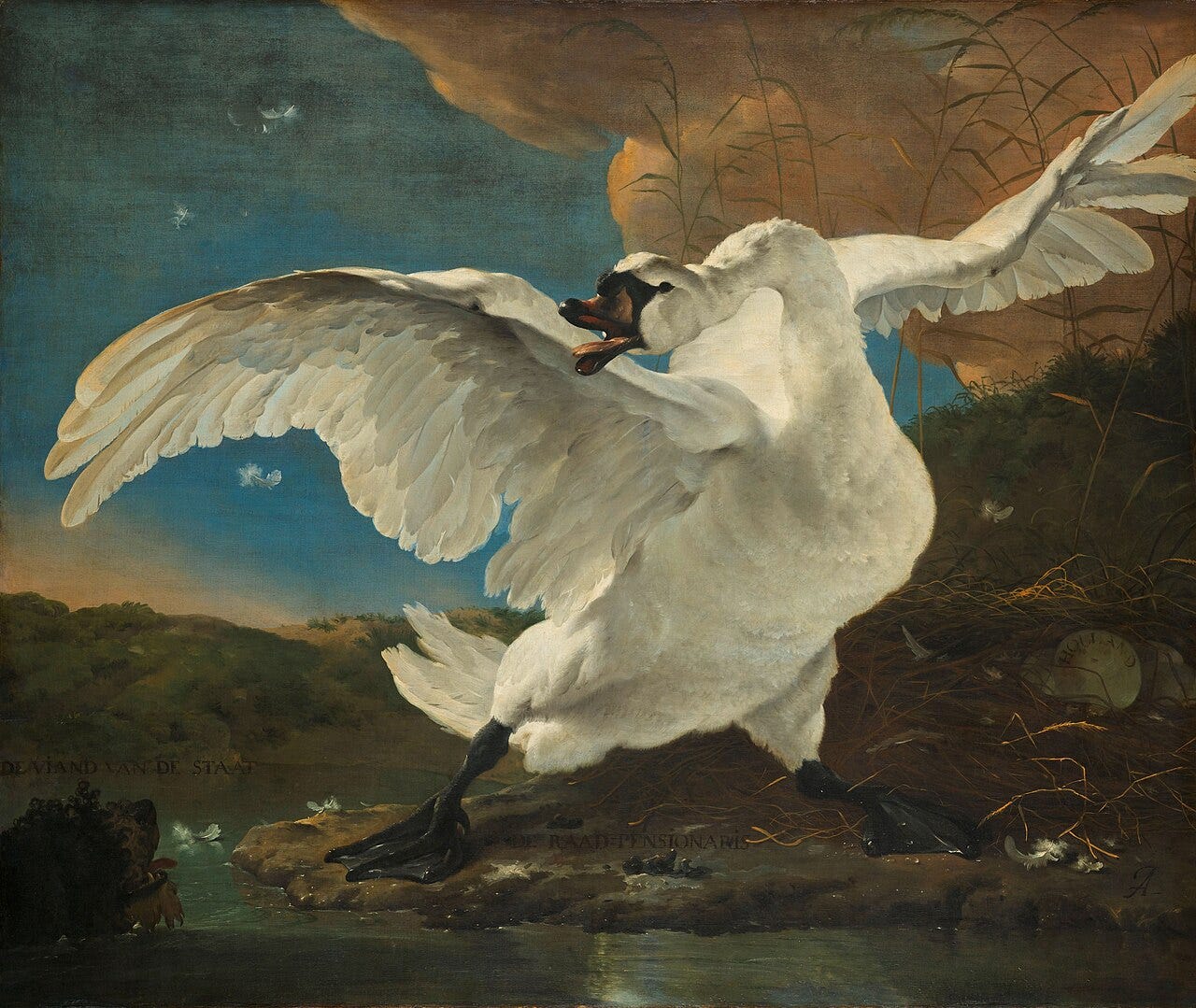
Jan Asselijn painted The Threatened Swan around 1650: a white bird rearing over its nest with wings spread and beak open, hissing straight at us.
Later owners added inscriptions turning the swan into the Dutch statesman Johan de Witt defending the republic against its enemies. The bird was recruited into politics after the fact, and the Rijksmuseum still shows those added words.
A swan can break a man’s grip and has a wingspan close to two and a half metres, so the aggression in these pictures is not invented. In England every unmarked mute swan on open water still belongs to the Crown, a right that dates from the twelfth century.
The myth painters could not stop repeating
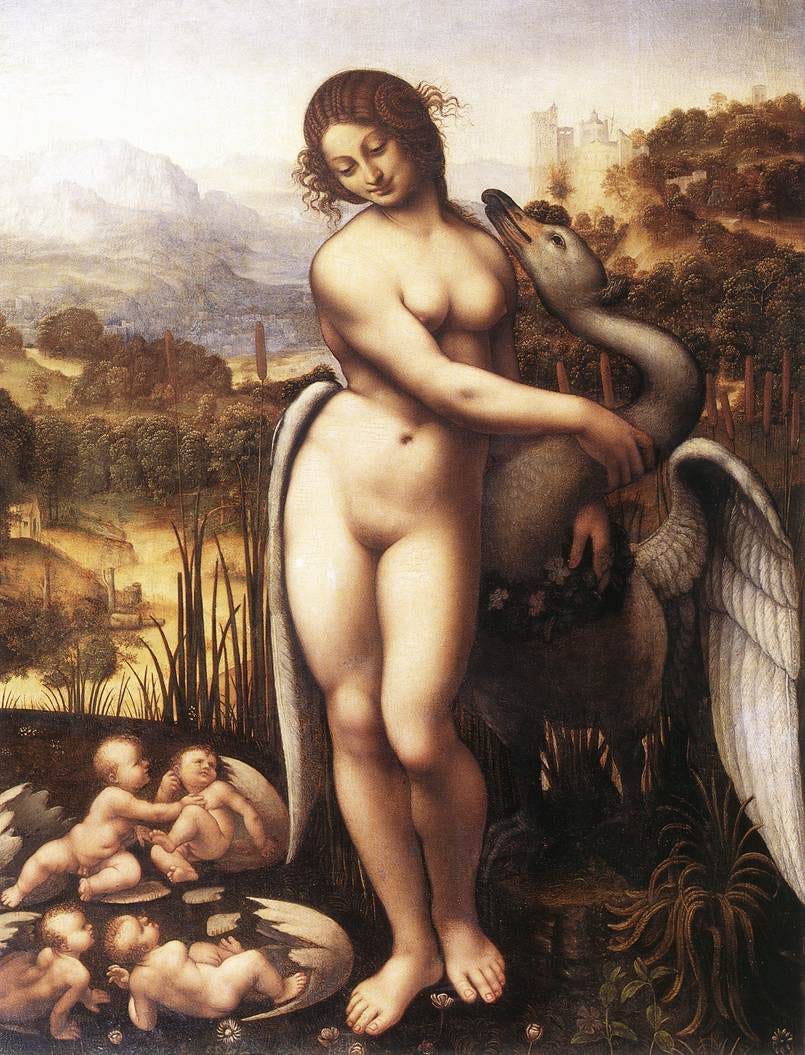
Leda and the Swan gave the Renaissance an excuse to paint an assault as a love scene. Leonardo painted a standing Leda, Michelangelo painted a reclining one, and both originals are lost.
Leonardo’s survived at Fontainebleau into the 1600s before vanishing, possibly destroyed for indecency. Copies by pupils are all that remain. The whole loss is part of my guide to Leonardo da Vinci.
Ovid tells it in the Metamorphoses, and painters used the myth as licence: a naked woman with a bird was mythology, the same woman alone was indecent. That loophole is why the subject survives from Leonardo to Boucher.
Michelangelo painted a Leda around 1530 for the Duke of Ferrara and then refused to hand it over after an insult from the duke’s agent. The original is lost, destroyed in France in the seventeenth century on grounds of decency, and survives only in copies.
Correggio and the sky full of disguises
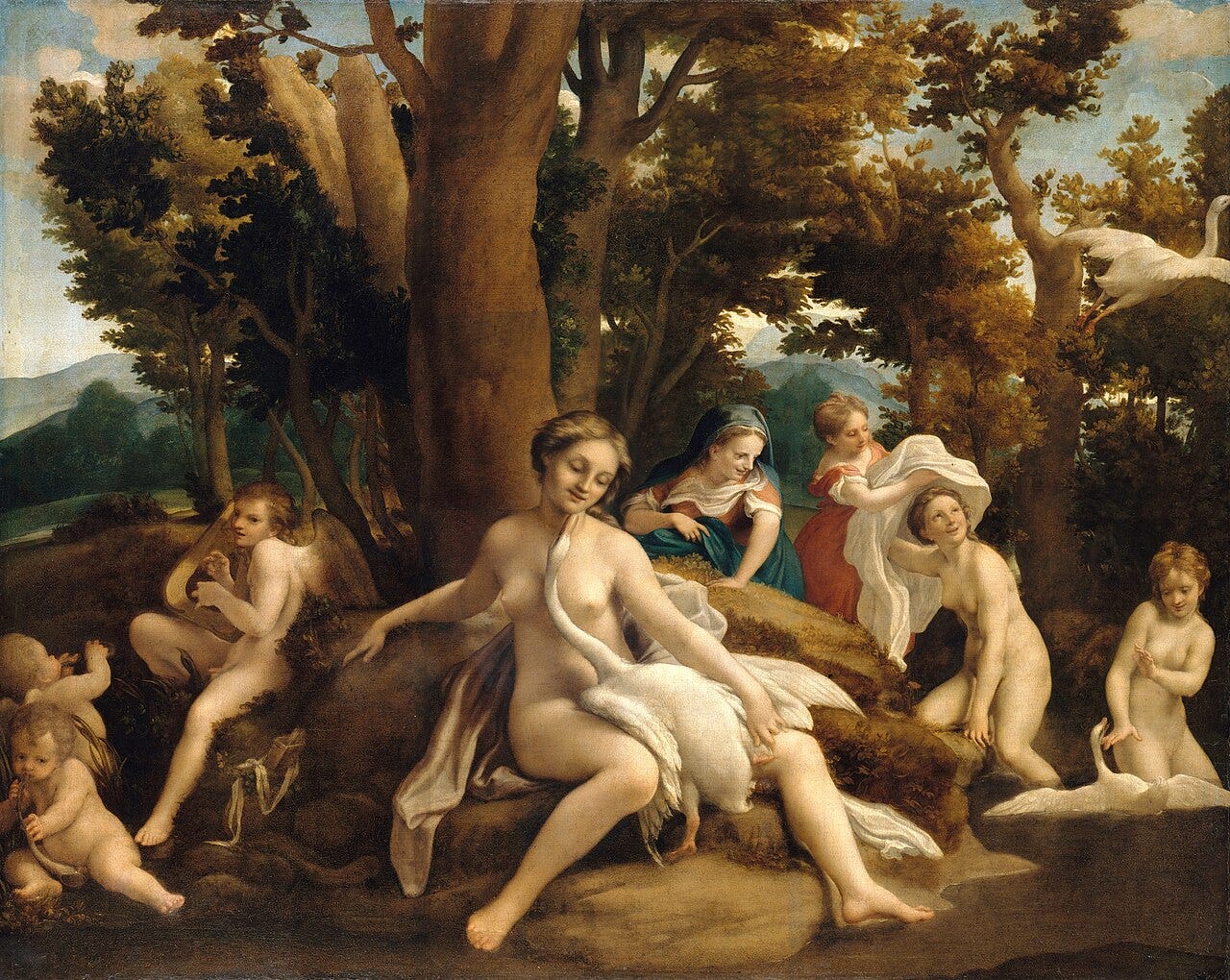
For the Duke of Mantua, Correggio painted a series of Jupiter’s seductions in animal and elemental form, Leda among them.
The Leda was later cut apart by a devout owner who could not bear the head, then reassembled and repainted. I tell his whole strange career The full account is in Correggio.
The Loves of Jupiter series was painted around 1531 for Federico Gonzaga, who gave it to the emperor Charles V. One canvas, the Leda, was later cut up by a devout French owner and clumsily reassembled, which is why her head is a repainting.
Swan Lake and the bird as a woman
After 1877, the swan stopped being a myth and became a ballerina. Painters and poster artists across Europe redrew the bird as a white tutu, a bent neck, an arm.
That transfer from animal to dancer is why most people today picture a swan as tragic rather than aggressive. Dance in painting is its own subject: famous dance paintings.
Tchaikovsky’s ballet premiered in Moscow in 1877 and failed. The version everyone knows is the 1895 Petipa and Ivanov revival in Saint Petersburg, and the white and black swan pairing comes from that staging, not the original.
What people actually ask about swans
What tops the list? The Threatened Swan by Jan Asselijn, the first painting acquired by the Rijksmuseum.
Why did so many painters do Leda and the Swan? It let them paint a nude and a myth at once. The subject was scandalous enough that several versions were destroyed.
Are the Leonardo and Michelangelo Ledas lost? Yes, both. They survive only through copies made by students and followers.
Are swans really aggressive? Nesting swans are genuinely dangerous, which is exactly what Asselijn painted before anyone made it political.
The swan in Japanese and northern prints
Away from Greek myth, swans and geese fill Japanese prints as seasonal markers: birds crossing a moon, a flock over reeds, snow on water.
Hokusai and Hiroshige used them as calendar signals rather than symbols. The Met’s print collection holds a large group of these.
Japanese printmakers treated water birds as seasonal markers within the bird and flower genre, kacho ga. The swan carries no myth there, only the time of year, which is a completely different job for the same animal.
Northern European printmakers had a different problem: the swan is white, and so is the paper. Etchers solved it by drawing only the water and the shadow, leaving the bird as an absence, which is the opposite of how oil painters work.
The dying swan and the vanitas tradition
Dutch still life painters hung dead swans in kitchen pictures beside game birds and fruit, wings open, neck falling off the table edge.
The beautiful bird became a display of wealth and a reminder of death in the same canvas. That grammar of objects is in what is vanitas.
The belief that a swan sings once, at the point of death, comes from Aesop and Plato and is entirely false. Painters used it anyway, because a beautiful thing that dies is exactly what a vanitas needs.
Pavlova danced The Dying Swan around four thousand times between 1905 and her death in 1931, and asked for her swan costume to be brought to her at the end. The image outlived the myth by a very long way.
Where I would go to see them
Amsterdam first, for the Asselijn. Then the Prado, which holds several of the Jupiter seductions, and the National Gallery in London for the Renaissance copies.
One last fact worth carrying: The Threatened Swan was the very first painting acquired for the Dutch national collection in 1800. A country chose an angry bird as its founding picture.