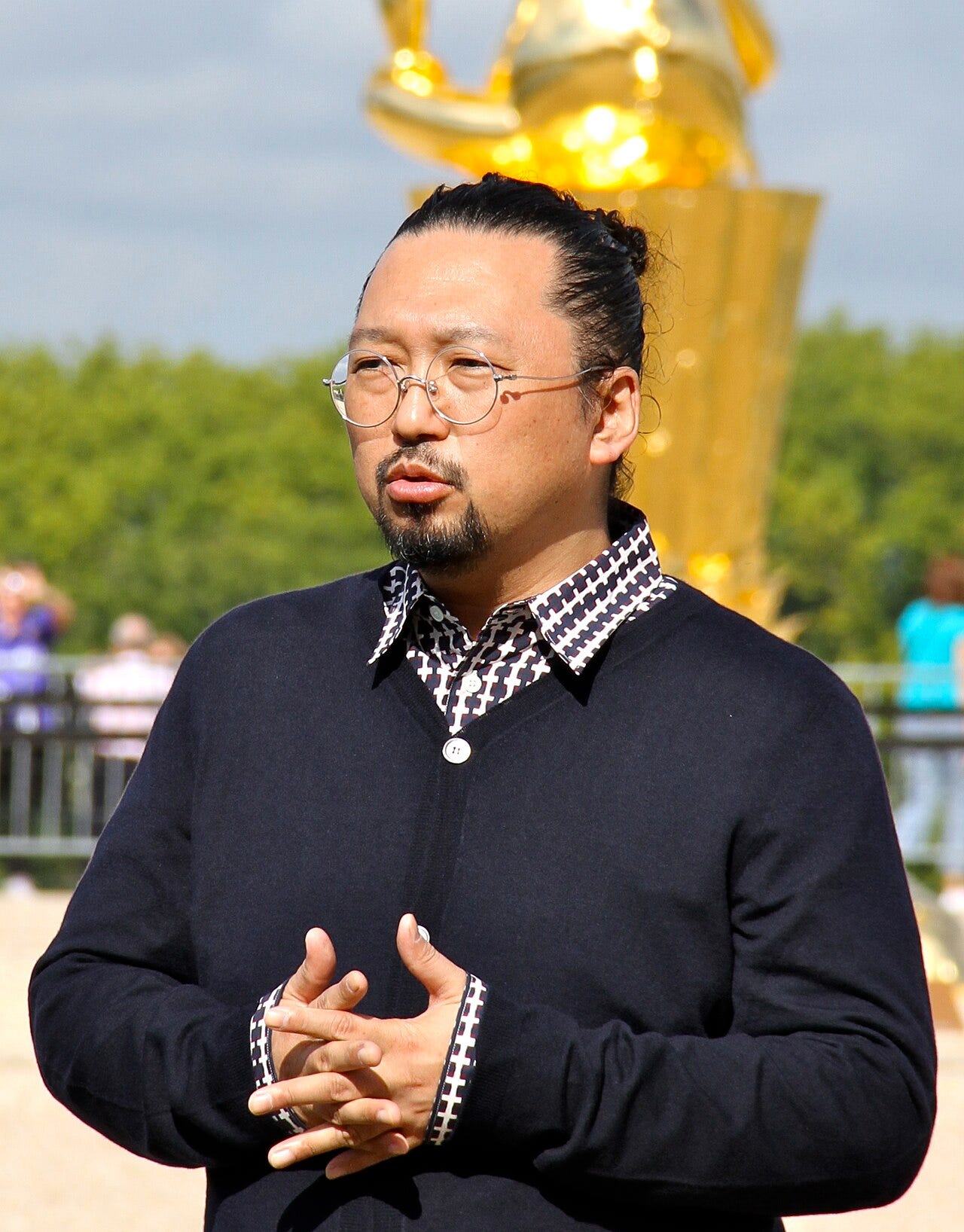
Takashi Murakami: The Complete Story

A flower grins at you in dazzling colour, petals like a child drawing, a face all sunshine. It looks like the happiest image in the world.

Murakami Doctor History Museum

Then you learn that Takashi Murakami links those smiling flowers to the trauma of a country rebuilt under the shadow of the atomic bomb, and the grin changes.

Murakami fused Japanese pop culture with the fine art world and made a fortune doing it, becoming one of the most recognisable living artists on earth while smuggling real anxiety inside the candy colours.


The ideas behind modern art, free in your inbox.


Where I would go next

Three worth opening next:


The theory called Superflat

Murakami built a theory he named Superflat. It points to the flat, depthless look shared by old Japanese woodblock prints and modern anime, and argues that in Japan there is no real line between high art and low pop culture.

He traces that flatness back through masters like Hokusai, blending the spirit of japonisme with the energy of pop art.

The smile with a shadow

Torii gate of Benten iwa Murakami shi Niigata ken Japan 2024
Torii gate of Benten iwa Murakami shi Niigata ken Japan 20240614 YAS1816
Torii gate of Benten iwa Murakami shi Niigata ken Japan 2024
Torii gate of Benten iwa Murakami shi Niigata ken Japan 20240614 YAS1816

His most famous motif is a flower with a beaming cartoon face, repeated in glowing colour, pure joy by design. But Murakami ties his cute, exploding style to postwar Japan, a culture saturated with consumer fantasy and haunted by catastrophe.

The sweetness is armour over real unease, which is why the grinning flowers never feel quite as simple as they look.

Mr DOB and the otaku world

Long before the flowers he invented Mr DOB, a round character with big ears and a mouth full of sharp teeth, somewhere between Mickey Mouse and a monster, a kind of self portrait of his style.

It came straight from his love of otaku culture, the world of obsessive anime and manga fans, which he treats as a serious modern tradition worth taking into the gallery.

Art, brands and the factory

Murakami runs his work like a business. His company Kaikai Kiki employs a large team to produce paintings, sculptures, films and merchandise, a modern version of the old master workshop.

He blurred art and commerce on purpose, designing handbags for Louis Vuitton, album covers for Kanye West, and toys sold beside gallery pieces. To critics it was selling out; to him it was the whole point.

Takashi Murakami, common questions

What is he known for?

Superflat, his smiling flowers, and merging anime style pop culture with fine art.

What is Superflat?

His theory that Japanese art and pop culture share a flat look and no high low divide.

Did he work with fashion brands?

Yes, most famously a long collaboration with Louis Vuitton.

Is he still working?

Yes, he remains one of the most active living artists.

Why the flowers keep blooming

Murakami turned a cartoon flower into a global brand and a serious argument at once. Love him or not, he proved an artist could sit in the gallery and the gift shop simultaneously, and that the line between them was always thinner than the art world liked to admit.


110,000 people read Cool Stories About Art every week. Join free.


His company name, Kaikai Kiki, comes from an old phrase once used to praise the wild, strange brilliance of a classical Japanese painter.

The most modern artist in Japan named his studio after a sixteenth century compliment. His giant inflatable and steel sculptures now tour the world, and a cartoon flower he dreamed up has become one of the most recognisable images of our branded, anxious age, sold in the gift shop and the saleroom at once.

The grin, and the shadow behind it, are both entirely his.


Get the secrets behind the paintings. Free, every week.