Tamara de Lempicka: The Complete Story
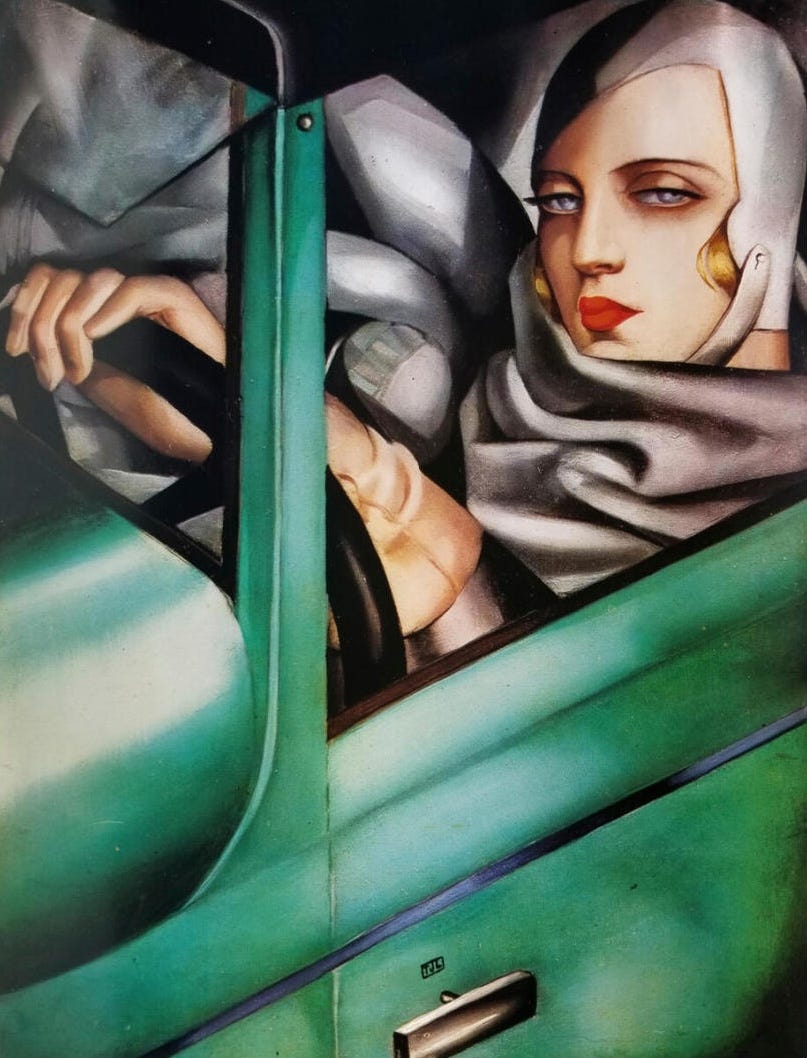
Tamara de Lempicka talked her husband out of a Bolshevik prison, reinvented herself in Paris as a baroness with a paintbrush, and painted the Jazz Age in chrome. The green Bugatti in her most famous self-portrait never existed. She drove a small yellow Renault.
Art Deco has one face, and she painted it, mostly of herself. The story underneath the lacquer is stranger than the glamour.
De Lempicka at a glance:
Born Maria Gorska in Warsaw in 1898; the title of baroness came later, by marriage.
Talked her husband out of a Cheka prison during the Revolution.
Painted the Green Bugatti self-portrait in 1929; she actually drove a small yellow Renault.
Fled to America in 1939, weeks before the war.
Portrait de Marjorie Ferry brought 21.2 million dollars in 2020.
Warsaw, Petrograd, escape
Maria Gorska was born in Warsaw on May 16, 1898, into a prosperous family, and married the lawyer Tadeusz Lempicki in St Petersburg in 1916.
When the Cheka arrested him during the 1917 revolution, she worked consulates and favors until he was released, and the couple fled to Paris with little more than her jewelry.
He never fully recovered; she enrolled in art classes and decided glamour would be the family business.
Soft cubism, hard shine
She trained with Maurice Denis and, decisively, with Andre Lhote, whose tamed geometry she turned into a style: Ingres redrawn with fenders and lipstick.
Through the 1920s she painted duchesses, industrialists, and lovers of both sexes, charged top prices, and won a medal at the 1927 Exposition in Bordeaux.
Her nude Beautiful Rafaela of 1927 remains the painting critics reach for when arguing she was more than chrome.
More incredible painter stories
If Tamara de Lempicka pulled you in, you will love these too:
The Bugatti that never was
In 1929 the German fashion magazine Die Dame commissioned a cover self-portrait, and she delivered Tamara in the Green Bugatti: helmeted, gloved, unreachable at the wheel.
She owned no Bugatti; her car was a small yellow Renault, stolen one night while she danced. The image became the emblem of Art Deco and of a certain idea of the modern woman, which was precisely the product she was selling.
The myth of the born aristocrat
The title in her name arrived in 1934, when she married her longtime patron Baron Raoul Kuffner, years after the persona did.
De Lempicka built the baroness from scratch: adjusted birthdates, a polished accent, staged photographs, d'Annunzio courting her at his villa while she kept the upper hand and the commission.
Calling her a shallow decorator misses that the self-invention was the artwork, decades before anyone said personal brand.
Decline, Mexico, and the strangest revival
She reached America in 1939, just ahead of the war, and Hollywood loved her briefly. Postwar taste buried Art Deco, her abstract turn was dismissed, and she stopped exhibiting in 1962.
She died in Cuernavaca, Mexico, on March 18, 1980, and her daughter Kizette scattered her ashes from a helicopter over the Popocatepetl volcano. 2 million dollars.
The Lhote system under the lacquer
Her teacher Andre Lhote preached a softened cubism: keep the geometry, restore the finish. She industrialized the lesson.
Every portrait is built from cylinders and steel folds, lit like cinema, polished until the brushwork disappears. Ingres with a chrome bumper, as critics said.
The persona as a daily performance
She adjusted her birth year, staged photographs at the easel in couture, and timed her arrivals at parties for maximum report.
The self-invention was not vanity overspill; it was distribution. Magazine covers of the painter sold the paintings, decades before anyone said personal brand.
The revival that came from collectors
Museums ignored her for decades; the rescue came from buyers. Madonna, Jack Nicholson, and Barbra Streisand collected her, and the videos and loans that followed rebuilt the audience.
By the time Portrait de Marjorie Ferry made 21.2 million in 2020, the woman written off as decor had the strongest market of any Art Deco painter.
The Tamara de Lempicka questions that keep coming up
Who was Tamara de Lempicka? A Warsaw-born painter who fled the Russian Revolution to Paris and became the defining portraitist of Art Deco in the 1920s and 30s.
Did she really drive a green Bugatti? No. The 1929 self-portrait was invented for a magazine cover; she drove a small yellow Renault. The myth was the commission.
How much does a Lempicka cost? Portrait de Marjorie Ferry brought 21.2 million dollars in 2020, and her market has climbed with each celebrity collector revealed.
Where can I see her work? Much of it is in private hands, but the Centre Pompidou holds her, and major retrospectives now circulate between Europe and the United States.
Why did she paint herself in a Bugatti she did not own? The German magazine Die Dame commissioned a modern-woman cover in 1929. The car was invented for the image, which was exactly her method.
Where are her ashes? Her daughter Kizette scattered them from a helicopter into the crater of Popocatepetl in 1980, at her request.
More secrets to unlock
One last fact
The woman who painted herself untouchable at the wheel ended scattered over a volcano: Kizette dropped her mother's ashes into the crater of Popocatepetl, the last grand gesture of a life composed entirely of them.